MercoPress. South Atlantic News Agency



HMS Gloucester helps catch £ 4 million of cocaine in mid Atlantic
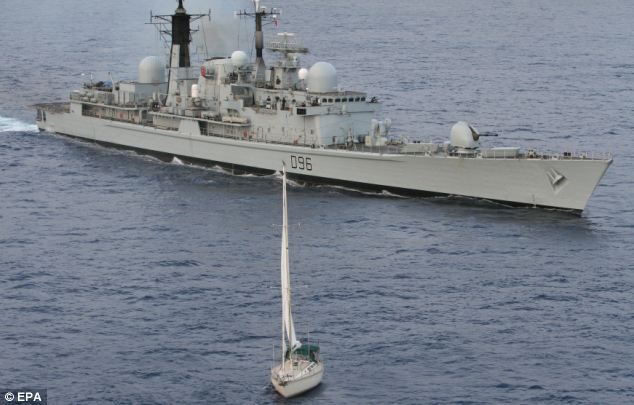 HMS Gloucester looms over the yacht Tortuga whilst a Cape Verde law enforcement team searches for narcotics on board
Portsmouth-based HMS Gloucester en route to the Falkland Islands has helped capture £4 million worth of cocaine – hidden in a yacht's rudder. The Royal Navy ship intercepted the suspect yacht Tortuga in the mid-Atlantic.
The vessel – registered in Florida – was then taken to Cape Verde, off the western coast of Africa, where cocaine with a street value of £4 million was found hidden within the rudder.
The Royal Navy was asked for help from Cape Verde authorities in tracking down the yacht. HMS Gloucester – en route to the Falklands where she will spend the next seven months – was then diverted to intercept.
HMS Gloucester's Commanding Officer, Commander David George, said the yacht had nowhere to run: “the last thing a drug smuggler wants to be seeing as the sun comes up is a Royal Navy warship bearing down on him. He can't run and he can't fight”.
“HMS Gloucester provided the ideal launching pad for the Cape Verde law enforcement team to intercept these drugs. She is fast, has long-range detection radar, and one of the fastest helicopters in the world, the Lynx Mk 8. There was no argument”.
“Thanks to close co-operation between the Cape Verde authorities, international counter-narcotics agencies and the Royal Navy, millions of pounds' worth of cocaine has been stopped from reaching our streets”, said Commander David George.
The operation, which took place in the early hours of Friday last week, is the first one of its kind between the UK and Cape Verde authorities.
But it comes after efforts by the Royal Navy and Serious Organised Crime Agency to increase counter narcotics missions in the area.
Defence Secretary Dr Liam Fox said: “This is another example of the great work the men and women of the Royal Navy carry out around the world which helps protect us at home”.
He added that the Royal Navy plays a crucial role in intercepting drugs that could be destined for Britain's streets: “I am very proud of their efforts. It was an eventful start to Gloucester's latest deployment”.
The Type 42 destroyer and her company of 280 men and women left Portsmouth on August 20 and will spend the next seven months protecting British interests around the Falkland Islands and South Georgia in the South Atlantic.
It will also be making official visits to South American countries such as Brazil and Chile.
HMS Gloucester will be taking over patrol duties of the south Atlantic area from Devonport-based HMS Portland.


Top Comments
Disclaimer & comment rules-

-

-

Read all commentsNext “Snow” party at the HMS Gloucester..... (HMS:High Majesty Ship :-)
Aug 31st, 2010 - 04:28 am 0They just “Hit the Jackpot”...
“... protecting British interests ...” “ making official visits ....... Brazil and Chile ...”
Aug 31st, 2010 - 04:52 am 0Says it all :-)
If they follow the example of the HMS Manchester crew......... they will be extremly popular with the “girls”, “pimps” and “pushers” on any port :-)
Aug 31st, 2010 - 06:19 am 0http://www.thesun.co.uk/sol/homepage/news/2594003/Wren-in-1m-drug-smuggle-rap.html
http://www.thesun.co.uk/sol/homepage/news/2594003/Wren-in-1m-drug-smuggle-rap.html
Commenting for this story is now closed.
If you have a Facebook account, become a fan and comment on our Facebook Page!