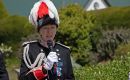
Meryl (Lady Thatcher) unveils “The Iron Lady” poster before Parliament
US actress Meryl Streep gave a sneak peek Monday at what she will look like as.” The award-winning star unveiled the official poster for the upcoming film in London before Parliament House.
Just from the promo shot, Streep bears a strong resemblance to Britain's first female Prime Minister Margaret Thatcher who is credited with turning around the UK economy and major international feats such as the Falklands conflict and the fall of the Iron Wall.
The two time Oscar winning Streep visited Parliament to research the role of Thatcher, who governed Britain from 1979 to 1990.
The 62-year-old actress told the Daily Mail It took a lot out of me, but it was a privilege to play her, it really was.
I still don't agree with a lot of her policies, added Streep. But I feel she believed in them and that they came from an honest conviction, and that she wasn't a cosmetic politician just changing make-up to suit the times. She stuck to what she believed in, and that's a hard thing to do.
“It was one of those rare films, where I was grateful to be an actor and grateful for the privilege of being able to look at a life deeply with empathy”.
Thatcher's family has expressed fears the film will be critical, but director ‘Mamma Mia!’ Phyllida Lloyd says it is not ideological.
Lloyd said that when they see Meryl's performance they will understand how much care and attention to Lady Thatcher's dignity she's given it.
However the film has already divided audiences over whether an American actress should portray such an iconic British figure.
The Iron Lady, which hits British cinemas on Jan. 6, depicts an ageing Thatcher looking back on the highs and lows of her career and the personal price she paid for power.
The film is likely to be a major media talking point over the coming weeks in Britain, where former conservative leader Thatcher is still a divisive figure both revered and reviled by the public.


28 comments Feed
Note: Comments do not reflect MercoPress’ opinions. They are the personal view of our users. We wish to keep this as open and unregulated as possible. However, rude or foul language, discriminative comments (based on ethnicity, religion, gender, nationality, sexual orientation or the sort), spamming or any other offensive or inappropriate behaviour will not be tolerated. Please report any inadequate posts to the editor. Comments must be in English. Thank you.
What a Turnip!
She took on and beat the socialists that wanted to hold everyone back who had ambition. How dare I make individual choices about my own life!
A great visionary.
WTF, Maggie was a superb PM.
Pity the vegetables stabbed her in the back.
Greatest British leader since Boudicca.
Stone glass houses
Brazil was the first country to deliver diplomatic recognition to the Pinochet-led junta -- the United States had agreed with Pinochet that, for practical purposes, it should not be the first to do so, though it welcomed the military regime.
A few days later, Brazil gave Pinochet an emergency $100 million loan. The Nixon administration's ``invisible blockade'' against Allende also ended, and American economic and military aid, under preferential terms, began to flow generously to the Pinochet regime.
I guess we should have had no contact with the world at all, Right?
By Jeremy Smith, Reuters, 14 May 2000
RIO DE JANEIRO, May 14 (Reuters)—Brazil's former military rulers taught interrogation and torture techniques to Chile's feared secret police after a bloody 1973 coup that brought Gen. Augusto Pinochet to power, a Brazilian newspaper said on Sunday.
The O Globo daily—one of Brazil's leading newspapers—said it had obtained U.S. Central Intelligence Agency documents showing Pinochet modelled his DINA secret police on Brazil's then equivalent, the National Information Service (SNI).
From December 1973, Globo said, Brazilian officers held classes for their
brag about how harsh we can be to dictators who are our enemies.
Or provide training
Chilean counterparts in interrogation, communications interception and torture techniques, in three specialised camps in Sao Paulo, Rio de Janeiro and Manaus.
www.hartford-hwp.com/archives/42/159.html
Just getting a measure of the range of comment.
Beef @ #4 has the conventional wisdom, but fails to temper it with the social hurt that came with it. I tend to agree with him - as you would expect.
I hope the film tries to be 'British' and not Hollywood; it would be a great disservice to both if it Americanised British history - as so often happens in Hollywood WWII movies, where historical facts are overturned to make things palatable to the US box-office.
Just watched the DVD of the US mini-series Angels in America, where Al Pacino wiped the floor with Streep - and Emma Thompson.
Streep, on a good day - and most days are good for this great, great actress - can bring passion to a part; on a bad day she 'under-acts'.
Thatcher-by-Streep could go either way.
Where do you see defensiveness, woman? My counter-argument is still there: a dictatorship has no reasons to ostracize another on the basis of the latter's authoritarianism. As such it makes all the sense that Brazil, specially during the military regime, would maintain and cultivate relations with neighboring military dictatorships. For the UK, the situation is different as Thatcher wasn't a dictator. She wasn't, though she was a friend of Pinochet, and stood up for him even after the emergence of credible reports of political torture and murder under his rule (she was more outspoken than any former member of South America's military regimes). The same applies to you, @sticky. Your little links don't refute anything, though, as expected, you're too dumb to see that. Brazil has no reason to be ashamed of its contacts either before, during or after the military regime, as we've always come clean as to our interests; we've always sought to have relations with whomever is of interest: dictatorships, democracies, 1st, 2nd or 3rd World. The UK, by contrast, is a wannabe promoter of human rights; as such it has much more explaining to do when it supports the likes of Pinochet or invades and kills Iraqis under false excuses.
lf it makes you feel better.
Anyway, we are supposed to be ignoring each other.!♥
Yet you'd critizise us for doing the same?
normally I'm not that much of a jerk towards women. But why should I let you monopolize the condescendence department? You're right about we being better off by ignoring each other, though.
@zethe
It's like those US ultra-nationalists who brag about their country being the leader of the free world, or the major patron of democracy abroad, at the same time they ignore coups d'état sponsored or tacitly approved by the US, or yet its close alliances with ultra-authoritariam regimes (Saudi Arabia, for instance). If they want to conduct close relations with the countries they see fit, including those under authoritarian regimes - so be it. But if that is the case, they should cease bragging about hating dictatorships or being the leaders of the free world. The same goes to every other country. You cannot be self-interested, you can't pursue what is best for YOUR country, and brag about how moral you are at the same time. This is hypocritical. If Thatcher thought her friendship with Pinochet advanced Britain's interests - and it doesm seem relations paid off - then there's nothing very wrong, or at least very unusual, about their closeness. But her admirers shouldn't brag about her being tough towards dictators, because that she was not.
Oh yes she was.
Her chief enemy was not Galtieri (that was a side-show), it was 'the enemy within'; the ultra-left, revolutionary leaders/manipulators of the 'workers' who manipulated democracy when in power, and undermined democracy when not.
More conservative than the Conservatives when it came to modifying their demands in the face of a country unable to win sufficient income to meet their ever-increasing demands, the Government had to eventually fight the dictatorship of the union bosses.
Prime Minister Thatcher did not fight to reach a compromise,
she used the power of the state to fight to destroy.
This is the way 'the British' do things if backed into a corner;
a fundimental problem needs fundimental treatment,
and leaders like Thatcher and Churchill never flinched from fighting to destroy to the point of surrender by the enemy.
. . . We shall go on to the end,
we shall fight in France,
we shall fight on the seas and oceans,
we shall fight with growing confidence and growing strength in the air,
we shall defend our Island, whatever the cost may be,
we shall fight on the beaches,
we shall fight on the landing grounds,
we shall fight in the fields and in the streets,
we shall fight in the hills;
we shall never surrender . . .
but as we saw from his memoirs and his tomes on world history, he didn't exactly enjoy the prospect or the actuality, hence Yalta.
Your partners in the ebb and flow of world affairs are often not a matter of choice but of circumstance.
Thatcher's Yalta-legacy meant that her contemporary USSR cold-war enemy operated like a dictatorship, and yet she never shrank from her Allied duties to face-up to this vast hegemonic dictatorship, at the same time as addressing the enemy within.
All in all, it's a messy world where the condition of 'my enemy's enemy is my friend' is a naively simplistic explanation of the expediencies of allegencies.
Commenting for this story is now closed.
If you have a Facebook account, become a fan and comment on our Facebook Page!