MercoPress. South Atlantic News Agency


Argentine high court ruling delays mining in glacier and peri-glacier areas
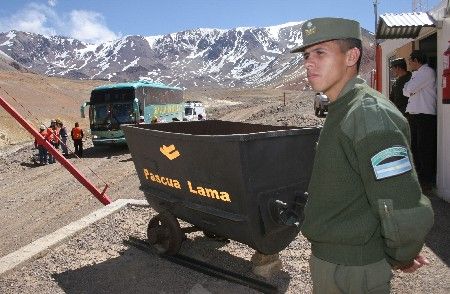 Barrick Gold Corp is involved in Pascua Lama, the world's highest-altitude gold mine
 Canadian mining giant Barrick Gold Corp. suffered a legal setback on Tuesday as Argentina's Supreme Court reversed preliminary injunctions that have blocked key parts of a glacier protection law.
The law requires a thorough inventory of Argentina's glaciers as well as “peri-glacial” areas where the ice has recently retreated but water remains below the surface. Together, the areas provide much of the country's fresh water.
The law also gives the national government a powerful tool to regulate the mining industry, which until now has been handled by provincial governments whose priorities sometimes clash with people living downstream from the mines.
Barrick maintains that it does not mine on glaciers and that it has already persuaded the provinces it will contain any environmental damage from gold mining, which requires lots of fresh water and a mix of toxic chemicals.
But until now, Barrick's lawsuits have pre-emptively blocked requirements to provide environmental impact statements to the national government.
Tuesday's ruling could have a major impact on Pascua Lama, the world's highest-altitude gold mine being developed on both sides of the Chile-Argentine border. Barrick said the 5 billion dollars project already has found nearly 18 million ounces of proven gold reserves, more than the company's Veladero mine, another open-pit mine nearby that is already in production.
Groups including Greenpeace Argentina and the Foundation for Environmental and Natural Resources cheered the ruling as a key step. The high court has yet to decide the constitutionality of the overall law, or rule on the environmentalists' requests for an immediate halt to Barrick's high-altitude mining.
Barrick did not immediately comment the decision, but in asking for an injunction against several aspects of the law it said enforcing the measures would unfairly “create a state of uneasiness and uncertainty” surrounding its operations.
The parts of the law Barrick objected to require the national government to define what a glacier is, inventory the remaining glacial and peri-glacial areas in Argentina, prohibit any activities that destroy glaciers, ban mining in glacial and peri-glacial areas, and require companies to provide environmental impact statements at the national level.
Rulings by lower courts that blocked those measures were fundamentally flawed, because the requirements provide for the very certainty that Barrick Gold claims it wants, the Supreme Court justices said. The glacier inventory “will make known exactly which areas are protected by law,” they wrote.
Barrick and other mining companies as well as the Argentine mountainous provinces that directly benefit from their control of the industry have challenged the law on constitutional grounds, saying the national government should have no role in regulating mining. But the justices said that ”the law must be applied its constitutional validity is resolved”.


Top Comments
Disclaimer & comment rules-

-

-

Read all commentsA mine to far, perhaps .
Jul 04th, 2012 - 06:45 pm 0Think is happy........................
Jul 04th, 2012 - 07:11 pm 0.............Condorito is not.
Jul 04th, 2012 - 07:26 pm 0Think, next time you are out riding, ask your horse if he is happy with his horse shoes. If you don't like mining you shouldn't use metal.
Barrick mined a similar, high altitude gold mine just south of Pasca Drama (above the Elqui Valley) for 30 years. They were extremely responsible. The Rio Elqui is still pristine, the sky above is still as clear as you could wish. The goats cheese and river shrimp are still heavenly.
Commenting for this story is now closed.
If you have a Facebook account, become a fan and comment on our Facebook Page!