Paraguayan industry lobby says forget Mercosur, calls for talks with Pacific Alliance
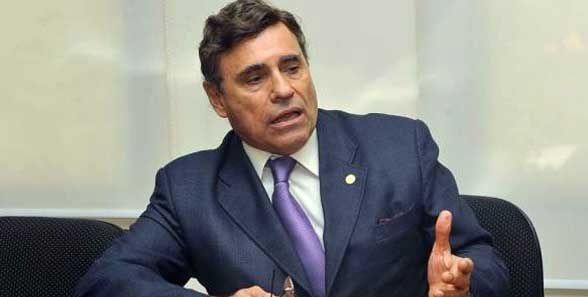
The president of the Paraguayan Industrial Union Eduardo Filippo said it was essential for the country to establish negotiations outside Mercosur, following the suspension from the group by the remaining three members allegedly because of the rupture of the democratic order.
Filippo said that Argentina, Brazil and Uruguay are not the only options for Paraguay and underlined the prospects of the new regional block, Pacific Alliance made up of Colombia, Chile, Peru and Mexico, “countries with which we can establish trade negotiations”.
“Currently Paraguay is among the world’s leading producers of soy and beef, actually we are among the top ten, and the whole world needs these commodities” said Filippo following a meeting with President Federico Franco in Government House.
“The ideological decision that is prevalent in Mercosur impedes manufacturing in Paraguay from working in peace and harmony”.
However Filippo admitted that so far sanctions applied on Paraguay during the recent Mercosur summit in Mendoza have not meant ‘economic losses’.
But he warned that the outdated Socialism some parties are interested in introducing in Paraguay, come from sectors close to the removed President (Fernando Lugo) and his administration.
“I’ve never seen a president from a liberal ideology trying to convince other countries or haranguing the Armed Forces so that they change sides”, underlined Filippo.
The Paraguayan Foreign ministry released a communiqué in which it argues that the decision adopted by Mercosur suspending the country and incorporating Venezuela as full member lacks all formal and material validity and will thus promote “the actions needed to leave them exposed as such”.
The Paraguayan government argues that suspending Paraguay from all activities in Mercosur “despite invoking the Ushuaia Protocol on Democratic Commitment, was adopted without having taking into account what is determined in Article 4 of the Protocol which demands ‘mandatory consultations with the state involved’”.
Since there was no consultation process with the Paraguayan Republic “the decision is not only illegal but illegitimate and violates the principle of due process”, says the foreign ministry release.
Therefore the Mercosur adopted decision has no formal or material validity and the government of Paraguay “will promote the necessary actions to leave it without effect”.
Furthermore in Paraguay there has been no rupture of the democratic order, on the contrary “democratic institutions are in full exercise and so are fundamental rights and freedoms guaranteed as foreseen in Articles 1 and 2 of the Ushuaia Protocol”.



21 comments Feed
Note: Comments do not reflect MercoPress’ opinions. They are the personal view of our users. We wish to keep this as open and unregulated as possible. However, rude or foul language, discriminative comments (based on ethnicity, religion, gender, nationality, sexual orientation or the sort), spamming or any other offensive or inappropriate behaviour will not be tolerated. Please report any inadequate posts to the editor. Comments must be in English. Thank you.
Being landlocked by other countries can be as much of a problem as it is a golden opportunity to concentrate on finished products and develop a manufacturing base. Instead of shipping tons of soybeans, they may invite food processing corporations to set up shop and produce high-quality processed food products that can be shipped by cargo airplanes. It is not an easy way, but it is a promising one.
”How is this going to work ? Paraguay is land locked surrounded by Brazil, Argentina and Bolivia (mercosur and ABLA countries) do they think that they can pull away from theses countries politically and economically then ship goods across them? Right now Paraguay has access to a river but the ports are controlled by Argentina, Brazil and Uruguay”
It should work the same way as it works for Switzerland but Switzerland's neighbours aren't run by thugs............
Interesting comment, and I agree the idea of a blockade is repugnant.
Let me know your thoughts on the blockade on Cuba... :)
I think the blockade of Cuba is repugnant. It had its purpose but should have been lifted at the end of the cold war. The US does itself no favours continuing the blockade. Most of the US’s allies do not approve of it. The extent to which the US pursues it is astonishing.
Here in Chile, Walmart bought over Lider (a supermarket chain) a couple of years back. All Cuban Rum was swiftly removed from the shelves.
Obviously Walmart doesn’t have any philosophical objection to Cuban rum, but the orders come from above.
This contrasts greatly with the argie blockade where the Falkland Islands owes argieland exactly NOTHING. Moreover, the argie blockade would appear to be in support of a denial of democracy and human rights. And it seems to want to bar Falklands trade with any other country.
So the U.S. embargo seems to me to be an action between the U.S. and Cuba with no other country affected. Whilst argieland's blockade of the Falkland Islands affects every possible trading partner and seeks to strangle the Falklands economy. Do you understand the difference?
I doubt you will agree as you are an indisputable arge as*-licker. Doubtless by this time your entire face is brown.
@11 Do you think it would help if Cuba pays the $6 billion it owes. This is the trouble with tinpot countries. They like to run up debts, but don't like paying them back. Ooops, does that apply to argieland? Supported by the urgies!
Falkland Islands know what it is like to have the neighbours from hell.
I confess to being ignorant about the Cuba embargo. I had no idea there was an outstanding debt. Even if this is the case, it is an undignified act, the world’s largest country continuing its prosecution against a tiny, impoverished country. I am by no means a fan of Castro’s Cuba, but the cold war is long over and the US should find the magnanimity to drop its persecution and be the “bigger” country.
After all the UK wrote off 100s of million pounds of 3rd world debt in 2000. The US could do the same. It is not about the money.
It is not strictly true to say the embargo is an action between the US and Cuba. The fear of US legal prosecution goes way down the chain in to subsidiaries of US companies (like the example I gave above) operating in foreign countries.
For the record I strongly disagree with any Argie blockage against the FI.
US citizens and companies owned land and assets in the island which were nationalized but never paid back. If a Chilean company doing business in Bolivia had her assets nationalized without restoring them financially for their losses, certainly Chile would be taking diplomatic and commercial reprisals to that country.
But Cuba was never completely isolated from US, they continued importing many things from american companies, including food and medicines, which are not part of the embargo, to this day the US continues to export huge amounts of food to the island.
Of course the correct thing for a government to do is pay the market value of a company that it nationalises.
In the early 70s the Chilean govt nationalised US (and to a lesser extent British) mining interests in Chile. These included Chuquicamata, the largest copper mine in the world at the time, along with several other large mines. If you worked out their market value it would be an order of magnitude higher than the $6billion mentioned in reference to Cuba.
The US protested and isolated Chile, but has never been compensated. Why is Chile not subject to a vindictive embargo today?
I would hazard that it is not about the money. The US wants to punish Cuba even today.
Incidentally, those who would like to blame the dark days of dictatorship on the US rather than on ourselves should note that once in power Pinochet did not restore the mines to their owners or compensate the US – odd behaviour for a “US puppet”.
Or it was just impossible to do, as it would be practically imposssible to return the exiles in Miami to their exact pre-1959 properties even if capitalism was restored in Cuba. Its quite well documented now that Nixon and Kissinger created the conditions that led to the other 9/11 of 1973. But hats of to you for calling the dictatorship dark days and opposing the blockade of Cuba.
On the article itself, Paraguay is about as close to the Pacific as Afghanistan or libya is to the North Atlantic. Like NATO, the Pacific Alliance is clearly an unpleasnat ideological bloc
Definitely Cuba´s embargo had a more political and strategic motivation, since it was closer to the US.
I wasn´t aware of the nationalizations in Chile. Thanks for the info. I never took Pinochet for a US Puppet, history is far more complex than that.
You’re welcome.
BK,
You are mixing up Chileans with Cubans. But to answer your question, yes, it would have been possible to return the mines (although very unpopular). If you can kill your opposition and rivals, returning a mine to its owner is not such a big deal. It wasn’t done, because it wasn’t in Chile’s interest. Contrary to what you probably believe, Pinochet was his own man.
It is not well documented that Nixon created the conditions for the coup. It is documented that he wanted to depose Allende. The CIA backed attempted coup was a complete farce and backfired badly. Pinochet seized the opportunity to the dismay of the CIA. The CIA did not want him. He out manoeuvred their man and was uncooperative with the Americans on many issues. He even assassinated one of his rivals with a car bomb one block from the Whitehouse – if that isn’t a provocation I don’t know what is.
Of course I refer to the “dark days”, nobody wants a dictatorship. Incidentally, the dark days also refer to the events that came before the coup.
Commenting for this story is now closed.
If you have a Facebook account, become a fan and comment on our Facebook Page!