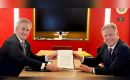
Rousseff pledges to prop the economy but with no EU-style austerity measures
Brazil will not adopt EU-style austerity measures to tackle its economic crisis and will instead cut taxes and maintain social programs, President Dilma Rousseff said on Friday.
Inaugurating an oil platform in the north-eastern state of Bahia, the Brazilian president launched fresh criticism of the belt-tightening measures adopted by debt-ridden European countries, including salary cuts and higher taxes.
Brazil is following a different path. This is not our way. Our way is to maintain our investments, seek each time to ensure that the subsidies, the advantages and the successes of this development are distributed, she noted.
She made clear that resource-rich Brazil, the world's sixth largest economy, will not restrict any labour rights, will boost stimulus measures and will act to prevent the national currency, the Real, from appreciating against the dollar as this would harm the already fragile industrial sector.
Rousseff pointed to the central bank's decision to cut its base rate from 12.5% last August to a historic low of 8% this week. Bank authorities hope their gradual rate cuts will reduce the cost of credit for consumers.
We will stick to this target: tax cuts. Gradually we will turn the crisis into an opportunity, Rousseff said.
She added that her government wanted to reduce production costs in a systematic way, through tax cuts and not as is being done there (in Europe) by cutting salaries and social gains.”
Brazil is currently experiencing anaemic growth which authorities blame on the impact of the Euro zone debt crisis, the economic slowdown in China and the poor performance of US economy.
Last year, Latin America’s largest economy grew a tepid 2.7% last year, down from a sizzling 7.5% in 2010. And the central bank has slashed its official GDP forecast for this year to 2.5% from 3.5%, while market analysts are projecting growth of 2%.



13 comments Feed
Note: Comments do not reflect MercoPress’ opinions. They are the personal view of our users. We wish to keep this as open and unregulated as possible. However, rude or foul language, discriminative comments (based on ethnicity, religion, gender, nationality, sexual orientation or the sort), spamming or any other offensive or inappropriate behaviour will not be tolerated. Please report any inadequate posts to the editor. Comments must be in English. Thank you.
She will promote her welfare programmes but will neglect medical and eudcation programmes.
She says that she will not cut Govt. expenses, how?
Maybe the same way that she ,and her Govt., is treating the Federal University Professors.
She, and her Govt., refuse to go into Negotiation with the University Professors about Career Pathway Rationalization and a modest pay increase.
The professors have been on strike since May and still the Govt. refuses to go into any form of discussion with them.
I'm not very knowledgeable of CFK's policies, but I do think she and Dilma are different. Dilma feels the need to appease to the orthodox establishment -- it's part of the 'pragmatic', rational leftist image that the administration has cultivated since the Lula years. The increase in the basic interest rate and the huge budget cuts of last year, which ultimately soured the economy, were no doubt a response to the financial markets' concerns, expressed in shill tone on specialized publications, that Brazil was overheating and in risk of losing control over inflation. CFK isn't nearly as worried about the interests of financial capital, as proven by the traditionally high-handed that she deals with the currency market and her refusal to sacrifice growth for the sake of low inflation.
Thats why I love her! She's high handed with the bankers and generous with the poor
#6 I think Michelle may be more like Cristina next time round, now that Chilean society has been opened up by the 2011 protests
You should be stay out of ordinary/hearsay comments ......
**
Brazil money market interest rates made balance curve last year
started Jan by 10.83 % ...in July saw 12.38 % and after lowering to 10.84 in December gradually...now at the same level.
Long term interest rates never changed stayed at 6 % level.
**
This doesn't explain why the Economy has been slowing down !
Bachelet is just a center-left politician. If she was in the same situation as Dilma, she'd probably would resort to the same, market-based policies that Dilma is employing and that, IMO, won't work. As the market itself is unstable and unwilling to take up risks, solutions to effects of the world crisis will require a break with the centrist consensus, and the market-based ideology it presupposes.
Max = geo?
It doesn't actually matter that interest rates are lower now. Business owners' animal spirits has been already affected. The government embraced the overheating hysteria of the markets. And -- this at a time that the Euro crisis was deepening and the US was undergoing serious talks about sovereign debt -- cut public investment and increased interest rates, in response. Government actions gave support to a pessimistic narrative about the national economy in a moment that the world scenario was already gloomy -- thus, denting investor feeling. Just cutting back interest rates won't do.
You remember i had declared few times at many Brazil related articles
since last years.
.. The Brazil Economy can never grow at high level speeds...
.. The interest rates lowering will be vainly and won't do ..
.. The Brazil Economy is not as same as Argentina Econ has high growth rates.
.. The Global Trade restrictions have lagged effects on Countries' Econ growth rates..can not be direct main reason.Brazil export 13 % GDP.
For example : recent China growth slowing not caused from foreign trade ex-post effects.
This is silly and you have never provided any reasons for that. Brazil's growth problems are tied to its dependency on hot cash to spur investment. During the 2007-2010 period, however, the country grew well, and partly because it had to some extent broken with that dependency by giving a more prominent role for public funds and SOEs to invest more. During that period, fixed goods investment baceme a major growth engine, mostly because of state micro-reforms to spur investment. (All good periods for the Brazilian economy have coincided with state activism.) Much of the recent slowdown is due, not to any impossibility for long-term growth for Brazil, but to current policies that have left investment to the market only, departing from the previous years.
- The interest rates lowering will be vainly and won't do
I had already said this.
- The Global Trade restrictions have lagged effects on Countries' Econ growth rates
But Brazil has forms of foreign dependency other than exports. Many sects of the economy are hooked on hot money and short-term loans from abroad. And with the crisis, the inflow of such cash isn't the same as before. In other words, the economy is deprived now from both public and speculative money.
but
FOREIGN TRADE(export/import) lowered between from mid 2007 until the end of 2009.
**
foreign direct investment (FDI)
FDI lowered from the start of 2008 until the end of 2009.
FDI soared from 2009 until the mid 2010 but no positive effects on the growth.
**
BANK LENDING to both household/firms soared even after year 2010 but no growth up.
**
GROWTH RATE lowered entered to negative between 2008-2010
jumped to high rate start of 2010 but lowered sharply until the end of 2011 and today...
**
HOT MONEY especially focused in short term equities not direct loaning of the firms.
Commenting for this story is now closed.
If you have a Facebook account, become a fan and comment on our Facebook Page!