MercoPress. South Atlantic News Agency

Except for Uruguay, Mercosur ranks poorly in the World Press Freedom Index
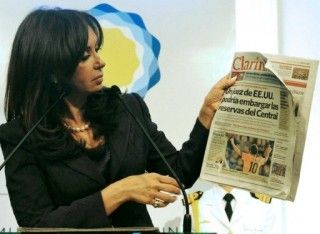 Argentina dropped to position 54 because of the ongoing conflict between the government of President Cristina Fernandez and the Clarin Group
 Argentina dropped seven positions and now ranks 54 in the 2013 World Press Freedom Index of 179 countries elaborated by Reporters Without Frontiers. Uruguay is the best ranked in South America, position 27, while other Mercosur full members standing are not very encouraging: Paraguay, 91; Brazil, 108 and Venezuela, 117.
In the case of Argentina (54) the RSF reports points out that it fell several positions “amid growing tension between the government and certain privately-owned media about a new law regulating the broadcast media”.
Regarding Brazil (108), down nine points, “the country continued last year’s fall because five journalists were killed in 2012 and because of persistent problems affecting media pluralism”.
The 2013 World Press Freedom Index has Finland for the third year running as the country that most respects media freedom. It is followed by the Netherlands and Norway. Although many criteria are considered, ranging from legislation to violence against journalists, democratic countries occupy the top of the index while dictatorial countries occupy the last three positions, points out RSF. Again it is the same three as last year: Turkmenistan, North Korea and Eritrea.
The Latinamerican ranking has Costa Rica as the best positioned, 18, followed by Uruguay, 27; El Salvador, 38; Haiti, 36; Argentina, 54; Chile, 60; Guyana, 69; Paraguay, 91; Peru, 105; Brazil, 108; Venezuela, 117; Ecuador, 119; Colombia, 129; Mexico, 143 and Cuba, 171.
Other countries such as the U.S. climbed fifteen positions and now rank 32, while the UK is 29, Australia, 26 and Spain, 36.
“The Press Freedom Index published by Reporters Without Borders does not take direct account of the kind of political system but it is clear that democracies provide better protection for the freedom to produce and circulate accurate news and information than countries where human rights are flouted,” Reporters Without Borders secretary-general Christophe Deloire said.
“In dictatorships, news providers and their families are exposed to ruthless reprisals, while in democracies news providers have to cope with the media’s economic crises and conflicts of interest. While their situation is not always comparable, we should pay tribute to all those who resist pressure whether it is aggressively focused or diffuse” he added.


Top Comments
Disclaimer & comment rules-

-

-

Read all comments“No, no it's all lies. Any statistics or ratings not made by the Argie government themselves are all untrustworthy because the world is against us and only CFK can save us”.
Jan 31st, 2013 - 07:23 am 0@1 Boovis
Jan 31st, 2013 - 09:30 am 0Be careful you're channeling Nostril. It could be bad for your sanity! LOL
But you've hit the nail on the head, that is exactly what the Malvinistas will post, or they will say, we such and such is worse than us, and provide a link to a document where they've only read the headline, and completely misunderstood it, because the document is actually not supporting their position.
La Campora's standards are dropping. But I suppose you only get what you pay for, and I understand that the price of bread and sausages has skyrocketed, so they are probably only feeding their trolls every other day.
Stand by for a counter attack on the UK press, my guess is they will miss-represent the reasons for the Levelson Enquiry! Oh and the evil Murdoch empire.
Jan 31st, 2013 - 10:35 am 0Commenting for this story is now closed.
If you have a Facebook account, become a fan and comment on our Facebook Page!