MercoPress. South Atlantic News Agency
Politics
-
Friday, August 28th 2026 - 18:56 UTC
The Pope says states struggle to control the concentration of artificial intelligence
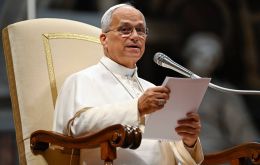
Pope Leo XIV warned on Friday of the difficulty states face in overseeing artificial intelligence, which in his view is concentrated in the hands of a small number of major economic and technological players, and called for the use of such tools to be governed by ethical criteria.
-
Friday, August 28th 2026 - 14:15 UTC
Washington negotiates stakes in Venezuelan oil fields with leases of up to a century

The United States government is negotiating with Venezuela's interim administration to acquire stakes in a group of the South American country's oil fields, under arrangements that would include leases of up to a hundred years, the outlets Axios and Bloomberg reported on Thursday citing unnamed senior US officials.
-
Friday, August 28th 2026 - 12:48 UTC
Falklands: Chilean shipping line drives new link and promotes Expo with Islands and Punta Arenas products

The formalization of a regular commercial maritime link between the Falklands and Chile, together with the promotion of an Expo of Islands and Chilean products in Punta Arenas, are being pushed with considerable enthusiasm by the Chilean shipping company Easter Island Naviera (EIN), which connects Easter Island with mainland Chile.
-
Thursday, August 27th 2026 - 23:55 UTC
The Falklands close the second Loligo squid season three days after reopening it

The Falkland Islands Fisheries Department announced on Thursday the closure of the second Loligo squid season due to low biomass levels, just three days after fishing had resumed following a two-week pause.
-
Thursday, August 27th 2026 - 21:43 UTC
Drums in his neighbourhood and a wake in parliament: Uruguay bids farewell to Ruben Rada

Uruguay bade farewell on Thursday to musician Ruben Rada with a wake open to the public at the Legislative Palace, the seat of parliament, after hundreds of people had gathered the previous night with drums in the neighbourhood where he grew up, with no official summons involved.
-
Thursday, August 27th 2026 - 08:20 UTC
Beijing asks Washington to “overcome obstacles” before Xi's White House visit
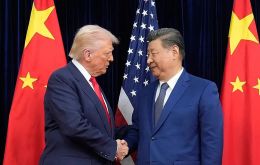
Chinese Foreign Minister Wang Yi has urged the United States to “remove interference” and “overcome obstacles” in high-level exchanges between the two countries, during a meeting in Beijing on Wednesday with US Ambassador David Perdue, as part of preparations for President Xi Jinping's state visit to Washington.
-
Thursday, August 27th 2026 - 08:09 UTC
Argentine lawmakers travel to Brasília to repair relations with Brazil
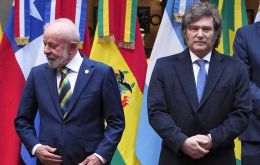
A delegation of Argentine deputies and senators from opposition parties will travel to Brasília next Wednesday with the aim of repairing bilateral relations, strained since President Javier Milei referred to his Brazilian counterpart, Luiz Inácio Lula da Silva, in offensive terms. The group is due to meet the Brazilian Senate's foreign relations committee, the foreign ministry and representatives of the presidency.
-
Wednesday, August 26th 2026 - 16:41 UTC
The US postpones residence visa interviews at all its consulates

The United States State Department has instructed its embassies and consulates worldwide to reschedule immigrant visa interviews, the category covering applicants for permanent residence from abroad, while consular officers complete a training programme on admissibility criteria.
-
Wednesday, August 26th 2026 - 08:42 UTC
Chile debates a state of emergency of up to eight months without congressional approval
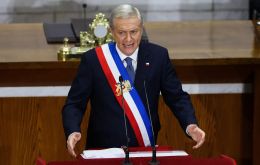
José Antonio Kast's government indicated on Tuesday it was willing to amend the constitutional security reform bill it submitted to the Senate on August 17, after the proposal drew objections both from the opposition and from parties within its own coalition.
-
Wednesday, August 26th 2026 - 08:35 UTC
Chevening Scholarship Falkland Islands; Deadline: 06-Oct-2026

The Chevening Scholarship Falkland Islands offers exceptional future leaders from the Falkland Islands the opportunity to pursue a fully funded one-year master's degree at a UK university. The program supports individuals with leadership potential who want to develop their professional expertise and return home to contribute to positive social, economic, environmental, or community development.