MercoPress. South Atlantic News Agency


With no accord on US debt limit, Moody’s could downgrade US ratings
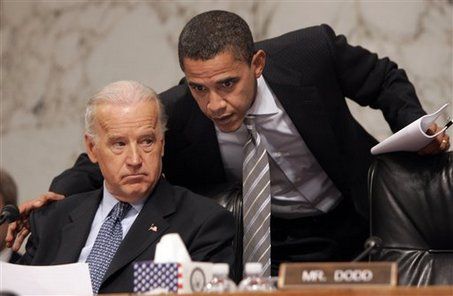 Obama and Biden involved in a furry of negotiations
 Moody's has warned it may downgrade the US debt rating if Congress fails to increase the US debt limit in the coming weeks and risks default. The agency warned of political “entrenchment” preventing an increase.
Republicans on Wednesday blocked a bill to raise the debt limit, demanding Democrats first agree to spending cuts.
The US risks default if Congress does not authorise more borrowing by August. A downgrade would increase borrowing costs, slowing the economic recovery. The US runs a 1.5 trillion US dollars deficit and is already about 14.3tr in debt.
The country reached its debt ceiling last month, but the US treasury department has begun taking extraordinary measures to avoid breaching the limit.
Leaders of both parties agree to the need to trim the budget in the face of massive budget overruns, but Republicans have refused to allow tax increases, while Democrats have vowed to protect costly social programs.
The White House argues the United States would face “catastrophic” consequences if Congress does not raise the cap on total US government borrowing by 2 August.
Republicans and Democrats have engaged in a flurry of negotiations led by Vice-President Joseph Biden and President Barack Obama, who has called for Congress to raise the debt limit without conditions, has held meetings with congressional leaders of both parties.
On Thursday US Treasury Secretary Timothy Geithner held a meeting at the US Capitol with Republicans, including many newly elected congressmen who have indicated they see little risk to a showdown.
In a statement this week, Moody's warned that if Congress does not act to increase borrowing authority in the coming weeks, it could downgrade the AAA rating on US government debt “due to the very small but rising risk of a short-lived default”.
Such a move would increase borrowing costs, hindering the already struggling economic recovery.
“The rating outlook will depend on the outcome of negotiations on deficit reduction,” the agency said, in what analysts interpreted as a criticism of both parties.
“A credible agreement on substantial deficit reduction would support a continued stable outlook; lack of such an agreement could prompt Moody's to change its outlook to negative on the AAA rating.”
The agency said it had anticipated “political wrangling” on the debt increase but noted “the heightened polarization over the debt limit has increased the odds of a short-lived default”.
Moody's move took Washington by surprise, even though in April, ratings agency Standard & Poor’s warned it could cut its credit rating on US government debt over concern Democrats and Republicans would not be able to agree a plan to reduce the growing deficit.


Top Comments
Disclaimer & comment rules-

-

-

Read all commentsUff! Another competing for the Big Defaulter Country in the world award.
Jun 04th, 2011 - 01:27 am 0This is not fair. At least can we hold the title until the end of 2011?
Moody and S&P won't downgrade US (bogus) tripple A, though the rest of the growing economies already did (not in public). The government will raise the debt ceiling, meaning keep kicking the can down the road until the road ends dead. QE3 is comming. Again, Quantitave easing is print more digital numbers what the paper is not worth at all and keep buying junk that nobody else wants. Or see it like this, the Fed is a dog, it “creates” crap and eats its own crap.
Jun 04th, 2011 - 01:48 am 0http://youtu.be/PTUY16CkS-k
@ Fido Dido
Jun 04th, 2011 - 03:17 am 0Ha Ha Ha
Amazing this video!
: )
Commenting for this story is now closed.
If you have a Facebook account, become a fan and comment on our Facebook Page!