Bolivia gets involved in Chile/Peru ongoing maritime dispute
International relations between Chile and Bolivia are tense and could worsen, considering the impact of a Monday press release from Bolivia’s Ministry of Foreign Relations.
The ministry announced that it had submitted a formal diplomatic note to the International Court of Justice (ICJ) at The Hague asking to be involved in the ongoing maritime dispute between Chile and Peru.
“Bolivia’s main goal regarding the maritime dispute is to inform the ICJ regarding its views on a subject of vital interest for the Bolivian person which is its right to sovereign access to the Pacific Ocean,” the press release stated.
Bolivia has been landlocked since 1884, following its defeat by Chile in the War of the Pacific (1879-1883). Previously, Bolivia’s borders extended to the ocean through what is now northern Chile.
The press release takes on added importance because Bolivian President Evo Morales announced in March (the anniversary of Bolivia’s loss in the War of the Pacific) that he intends to sue Chile at the ICJ for sovereign sea access. Morales has already created a maritime claim organization to prepare legal actions for a Bolivia v. Chile case.
Morales claimed he opted for an international resolution “because developments were so slow” in bilateral discussions between Chile and Bolivia. Bolivia’s Senator Bernard Gutiérrez, head of the government’s opposition, said Morales was “using the proposal in an irresponsible way to distract attention from structural issues” in Bolivia.
Although sea access has been an unresolved diplomatic dispute between Chile and Bolivia since the 19th century, major new developments occurred in the past year.
Late last year Peru gave Bolivia a 99-year lease on a small stretch of coastline in southern Peru, the first time since the War of the Pacific that Bolivia has held sovereignty over coastal territory.
Still, Bolivia would like to see a sovereign strip of land bridging the distance between the rest of Bolivia and the ocean.
Just last month, Bolivia threatened to bring the matter up for a vote at an Organization of American States (OAS) meeting, but ultimately withdrew the issue.
This newest development signals that Bolivia is continuing to pursue international recognition of its claim.
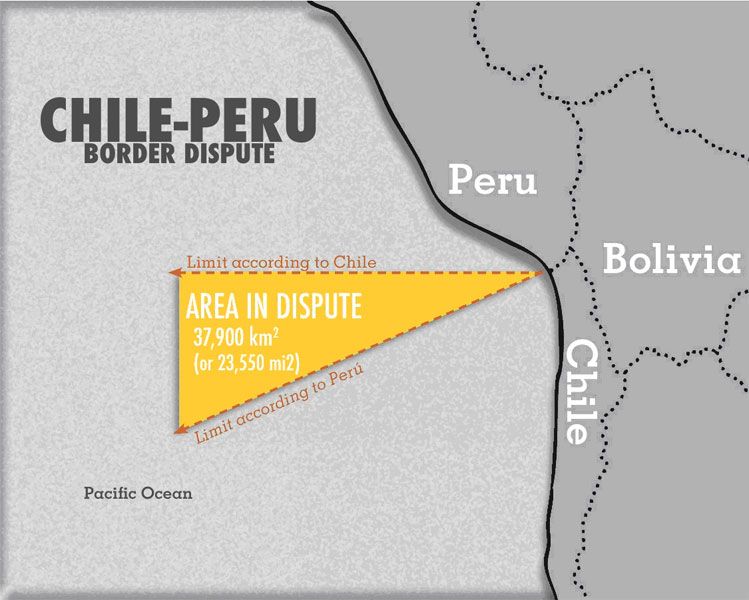
The disputed ocean territory extends outward from the border between Chile and Peru. However, that location is also the most likely area for Bolivian sea access.
One sea access solution, proposed in 2009 by three Chilean architects, was a 93-mile long underground tunnel running along the Chile-Peru border out to the coast. The tunnel would end within the disputed ocean territory. The proposal suggested that the territory be declared international waters.
By Benjamin Schneider - The Santiago Times



59 comments Feed
Note: Comments do not reflect MercoPress’ opinions. They are the personal view of our users. We wish to keep this as open and unregulated as possible. However, rude or foul language, discriminative comments (based on ethnicity, religion, gender, nationality, sexual orientation or the sort), spamming or any other offensive or inappropriate behaviour will not be tolerated. Please report any inadequate posts to the editor. Comments must be in English. Thank you.
Are all South American states stuck in a 19th century diplomacy mindset?
A raised road would be a cheaper option.
Are all South American states stuck in a 19th century diplomacy mindset?
All boundaries in northern Chile have been settled, Bolivia has no right to claim anything after the peace and friendship treaty with Chile, signed 1904, already long 25 years after the war had ceased already. Peru's borders are also delimited, 1929 on soil, and 1952/54 by treaty and 1968/69 by final cartography agreed by both countries.
All these claims made by Bolivia and Peru have been started, due to very low image of their respective leaders at the moment of initial campaign. Peru demanded Chile in 2006, when Alan Garcia (their president) had an aprobation of 8% (!!!). Shortly after the campaign started, his popularity recovered...
Same thing to Evo Morales of Bolivia. He had excellent relations with Chile until early 2011 (we all remember his visit in 2010 with Piñera to the trapped miners), then... start of 2011, Morales suffered a huge breakdown with the Gasolinazo, in where he wanted to eliminate subsidy to fuel, resulting in 80% increase of prices. This awakened big resistance in Bolivia, and his aprobation fell from 60% to 30%. Even after he had taken back the law, people would not forgive him, so few days later he started with the hostile speach against Chile.
In Peru and Bolivia, antichilean sentiment is VERY strong, and in politics it pays out for sure. This is no secret.
Is it because they know they would have no viable legal case to present?
Countries, which have NO chance to win someting they do not own themselves, GO to the ICJ, because they have nothing to lose. According to the attitude: I do not own it, but maybe there is a chance of 0,0001% i could win, so lets try!
Countries, which have or at least, think they have a kind of right, would not dare to go to the ICJ, because they fear to lose supposed rights, if the result is adverse to their needs.
just give up 5 lousy miles between them and let bolivia have the middle bit,
problem solved,, or is this just to simple,
The real issue of course, is that some south cone countries do not believe that Treaties last for ever!!
just give up 5 lousy miles between them and let bolivia have the middle bit,
problem solved,, or is this just to simple
1st, because we have already tried this solution in 1975, but Peru opposed to this idea. Chile back than had a deal with Bolivia, to give them a strip at the border with Peru up to the sea, in compensation to some Bolivian territory more south. Peru opposed to this, mentioning the border treaty of 1929, in which there is a clause, that neither Chile, nor Peru are entitled to traspass border territory to a third party, without the go of the other signatory.
Peru was not willing to let Chile traspass territory to Bolivia, which was once Peruvian. Peruvians blame Bolivians to provoke the war with Chile, abusing the secret alliance pact and to drag them into the war of the pacific and retiring in early stage, leaving the scenario of a merely Peruvian-Chilean war. Partly, I understand that...on the other side, Peruvian were very eager to enter the war back then, to supposedly get it's part of the chilean bounty (they thought it would be an easy win).
2ndly: Why should we? Are we mother Teresa to solve all the internal issues of other countries, sacrificing ourself in an altruistic mission? Knowing mentality of our neighbours, if we would grant them a 5 mile strip to the sea, in the next step they would ask for a 10, mile strip and so on. There intention is not really to get access to the sea, because Chile does grant them free pass to the sea (without any tolls!).
The sea access is not the problem, its just a distraction from severe political and social issues, and they search an external punching back to feel better.
If SoAm countries are really going to be the strong trading partnership they would have the world believe, they should be able to negotiate transport across the land without any need to transfer ownership of land.
From the Chilean point of view, I would not want to do anything to increase the border with Bolivia. Northern Chile is the main route of drugs from Bolivia and it is almost impossible to police as it is. Besides, won't it just give the Bolivians even more access to stealing cars?
Just like the Falkland Island Claim. Pan y circo...
Interesting,
But the wrong people answered the questions, so it backfired a bit,
9 Redhoyt (#)
Why should they? We won't give up 5 miles of the Falkland Islands
[to quick]
I was hoping that that more [other] bloggers would have given the same reply.
i.e, if they would not, then why should the Falkland’s,
But sorry my fault
I take the blame to clever by half , mmmmm
That's the day that I will wear my uniform again and gladly die for my country !!!!
Hence why Pinochet telphoned Mrs Thatcher early April 1082 offerring to put his forces through in 3-5 days onto the Atlantic coast and cut off most of the Arg southern airbases and get back the Patagonia they lost in the 1880,s - luckily for all, Mrs T, did not want to get into World War 3 so she declined the offer!
But there does seem to be a typical S American mentality at work - pick a fight - loose it - then moan afterwords that it was unfair!
ow, I just can agree totally with you.....Chile has fought and lost a lot of Chilean lives for that territory, so no one have the right to give it to any other......like the Brithis did for Falklands Islands.
The Bolivia's president Evito has a nut lost in his mind, it seems like the only neurona that he can has had was burnt out....difficulty he can walk and chewing gum at the same time....In his crazy mind he has thought that he can win some if they go to the ICJ (as well as the Peruvian president thought the same), at least more popularity...!!!
It starts with the colonial division made by the spainards in the Leyes the India (laws of the indian), the royal administration laws for all spanish colonies on american soil, before our independency took place.
In those Leyes de India, the spanish settled the frontiers for the real Audiencia de Charcas, the region known today as Bolivia. The spanish definition for this dependency from the viceroyalty of Peru, did not have direct access to the sea, according to the will of the spanish king. You can read in the Leyes de India, that even before independency the Audiencia de Charcas was officially assigned the peruvian port of Arica for their seatrade, with NO traspass of authority.
In 1776, the dependancy of Charcas was traspassed by the spanish king to the newly created Viceroyalty of the Rio de la Plata, what we know today as Argentina. The Leyes the India did not forsee any border modification for Charcas though, which meant, they somehow lost privileges for peruvian port of Arica, and became landlocked.
Beginning of the 19th century, our southamerican colonies started to gain independency according to the rule of utis possidetis, which means... they inherited the territories with borders defined by the colonial administration. First was Argentina in 1810 (though not their whole territory), then Chile in 1817, Peru in 1820 and finally Bolivia in 1825. That's when the trouble starts, because once Bolivia was freed, their leader Sucre claimed Bolivia with access to the sea, something which was not compatible with the utis possidetis.
Chile also had claimed this territory (despoblado de atacama hasta la frontera con Peru acorde las leyes de india unhabited dessert of atacama up to the peruvian border according the leyes de india). TO BE CONTINUED... I have no space anymore to write. Please write something so I regain some right to continue :D
I do know something about Uti Possidetis Juris. For example, I know the concept did not exist prior to 1810, and was not proclaimed until the Conference of Lima in 1848. I also know that it doesn't seem to work!
I'm looking forward to the rest. I had thought the matter resolved by a Treaty, but then treaties do appear to be of limited value in the south cone.
The plan backfired as the Paraguayans won the war.
Sergio, ManRod, is this correct?
Now, Chile was not free of errors neither. Chile did not protest against Sucre's definition of Bolivia in 1825, which overlapped previously defined Chilean borders in 1817. The Chilean government ignored this, probably due to other more important issues in the newly founded republic, or because they thought Bolivia would not take effective possesion of this region. We must consider that we are talking about the region of the Atacama, a very arid and sparely inhabited desert place, which was barely tapped yet. Only few small villages at the coast with Chileans existed then.
For a long period, this region was of no interest for Chile neither Bolivia. Bolivia remained using the Peruvian port of Arica for their exports, while the Atacama remained unattractive for both countries.
This changed in the 1860 ies, when chilean and british mining companies discovered rich deposits of nitre, they started to extract. Chilean an Bolivian frontiers were still not defined correctly, but Chile had done more to settle it's people in the region. Example: Antofagasta, a city founded and mostly inhabitted by Chileans.
Nevertheless, in 1866 and 1874 Chile and Bolivia agreed a border treaty, in which Chile did resign to the territories north of the 24 parallel and later 23 parallel, with the condition that Chilean companies in the now bolivian territory would not have to pay taxes for the next 25 years. Though Bolivia inbetween in 1873, had signed a secret military pact with Peru against Chile, so afterwards it's obvious they had other intentions. And they came true: Bolivia breached the treaty in 1878, when they ignored the tax clause, and they claimed taxes of the Chilean companies in Antofagasta. Chile protested against this same year, but Bolivia did not step back from this. in 1879 Bolivia confiscated the companies (who denied taxes due to the treaty) and Chile saw this as the annulation of the limit treaties with Bolivia. War broke out...
Keep going :-)
Hi Red,
on what exactly do you base this? Uti Possidetis is an old roman law, it was also accepted by Britain regarding the spanish colonies way back before 1810, in the 16th century for the spanish colonies.
Regarding the convention of Lima in 1848, I think you slightly misunderstood: It is indeed correct, that it was the first time SA countries agreed on it all together, but in 1848 they accepted it retrospectively, that this rule HAD been applied since 1810.
Small detail, but big effect :)
It's true, that it didn't really work 100%, but it is accepted as the legal rule for the claims of our newly born nations. Of course there were later wars and segregation, which results did overthrow the uti possidetis status quo from 1810, but that's a plausible consequence, and does not contradict to the uti possidetis of 1810. We should not forget, that the romans initially used it also to justify territorial conquests after wars, and only later it's meaning shifted to a border keeping meaning.
Isolde... yes you are right. Bolivia started a war a gainst Paraguay, mainly due to suspected Oil deposits in the Chaco (I admit that I am not aware, if the Parana access might have been a secondary aim). Bolivia was military superior to Paraguay, but they lost the war anyway. Paraguay seems to be a very fierce little nation, how else would they have faced Brasil, Argentina, Uruguay in the war of the triple alianza.
Uti Possidetis Juris is less well established, and far more controversial. For openers try en.wikipedia.org/wiki/Uti_possidetis
Whether it is 'retrospective' and whether it can bind other States (particularly outside SA) is less than clear. Britain does not accept it as a principle defining Argentina's right to the Falkland Islands for example ...
I'm being nagged, as I'm late going out .... I'll try and come back to this !
to my understanding, Argentina cannot base on Uti Possidetis for the Islands, because in 1810 it's posession was not clear. It was not possible or clear to apply uti possidetis, ita possideatis, due to the dispute between Spain and Britain about ownership of the Islands, and if the Islands were included or not in the nootka convention. But I do not want to dig to deep here, as I am not an expert in Falkland/Malvinas matters.
I only know, that the constitution of Argentina (1853) did not include the Islands, as it neither included Patagonia, because last one was still terra nullis then. (check article 46 of the constitution).
As far as I understand it, Argentina is still claiming that her boundary in 1810 was defined by Uti Possidetis Juris and therefore that included the Falkland Islands which the British had left in 1774. The British position is that removing the garrison is not the same as a renunciation of sovereignty. The issue is certainly a live one in this particular dispute, and on these pages!
Nootka is a different problem, although once again it comes down to interpretation. Personally I do not think that the Falkland Islands were 'adjacent' for the purposes of the Nootka agreement. They only look 'adjacent' if you have satelite imagery but as this was not available in 1790 I suspect that the term 'adjacent' would not include anything more than a day's sailing away. That would certainly put the Falklands outside of Nootka. It is in any event academic, as the secret clause in the Nootka agreement would have authorsied the British action in 1833!
Thanks for the tip regarding the 1853 Argentine Constitution, I'll take a look.
:-)
no oil, no dispute
But do you think this can be taken for granted from your contact?
By the way, just detected a mistake in my previous text. The Argentine constitution does mention the Malvinas, though in article 46 they do not define a representative for the constitution (as for all resting provinces).
I guess, Argentina always knew on the long term, that Chile was a bigger headache than a limited war against UK on islands in the Alantic.
Argentina knew exactly well, in what constellation it had put herself with Chile after threatening with invasion since end of the seventies, against what many people nowerdays claim over there.
Related io the Bolivia - Paraguay conflict on these days I have no idea what the aim was, but tought it must be because the needs for seatrade way more than oil deposits. Bolivia has claimed from ever that their poverty comes from the fact they are a landlocked country (Didn´t they know how the poverty is on Switzerland, an ever landlocked country? or Austria?) but the true is that they have those poverty levels because their own idiosyncrasy.....
Islander1, In the event that it could be true whta tou have been told, we had the right to act this way in compensation as Argentina acted when Chile was coming back from a war on 19th century, so no way for others countries could be involved in a bipartite conflict (as it was in the previous 1978 conflict wcich reachead at a almost war level due a not acceptation of the Brithish HM the Queen pronunciation under currently valid borders controversy solutions treaty signed by both, Argentina and Chile).
”200 Think Jul 23rd, 2010
……a little personal anecdote about why I don’t believe all this “military” bullsh** about Chileans and Argentineans being mortal enemies:
“El destino quizo que, en noviembre del 78, visitase a un gran amigo (Nicasio Urquizo, q.e.p.d.) administrador de la estancia “Remolino” sobre el canal de Beagle.
Allí fui testigo presencial de una reunion entre los almirantes Massera y Toribio Merino que, con un montón de Güisky encima, se cagaban de risa de nosotros, los civiles huevones que nos tragabamos la historia de la Guerra.
en.mercopress.com/2010/07/20/argentina-blockading-the-falklands-with-no-respect-for-islanders-human-rights
Nicasio Urquizo??? Massera and Merino drinking together @ an estancia?
nice fairy tale ! come on.... the link you have given just redirects me to another theme where you commented the same again. Nothing found in the internet. Hostility and invasion plans in 78 was a FACT, or are you gonna tell me, that Operacion Soberania has never been planned?
I really dislike the negation, because I believe that people who originally spread this (don't mean you, you probably had positive and friendly intentions, which are fine in nowerdays) , do this in the intention to minimize the guilt or responsability of the argentine Junta and shade another light in the Malvinas regional developpment.
I give you a much better and real link, check out this (just for history reasons)
en.wikipedia.org/wiki/Operation_Soberan%C3%ADa
41@ About Operación Soberanía, IT WAS A FACT that I suffered personally...The meeting beteen the Admirals never was, so the guilty of you Junta is valid until now....
;)
Manuel, regarding your comment 42... Are you so blinded by your preconceptions that you can’t read...???
I wrote:
”…a little personal anecdote about why…”
”……….....……..…personal……….....……...…”
Get it now?
Anyhow, Nicasio and his wife are dead now…..
So are those two admiral bastards….
Maybe, one day, some of the few others involved in this “odd rendez-vous” will document it…..
I just have my memories………..
The Chileans seem much more sociable and easier to talk to.
lt seems they don't trust the Argentine ambitions either.
As far as Chile trusting us , is very irrelevant and I don't really care ...... :-))
Peace?
You are not insulting like the other Argentines on here & l have never read that you want to throw us off our land either.
l hope you would know that myclaimsto Patagonia are just a reaction to Argentina's claims to the Falklands.
l do not want us to take over any part of Argentina despite what Forgetit says.
l would hope that you don't want to take over our lslands either?
Yes indeed, Peace
Isolde l have never read that you want to throw us off our land either
Come on Artillero, no te hagas el galan and tell her the truth :-))
MercoPress missed this one:
Chilean miners seek damages from government
articles.cnn.com/2011-07-16/world/chile.miners.suit_1_chilean-miners-san-jose-mine-president-sebastian-pinera?_s=PM:WORLD
What do you think Sergio or Manuel about this lawsuit?
Some people say they are Gentlemen(like you, Think)even when they are not.
Other people actually ARE Gentlemen.
The truth is not about the Islands nor the Islanders .....is about the presence of British forces so close to us. Am I right ?
Well there was only a detatchment of Royal Marines prior to your invasion of 1982,and The lad from Iceland reckon we were asking for it,by not having more
Malvinas is part of Argentina
,should Isla Martín García be part of Uruguay?
The enclave island is within the boundaries of Uruguayan waters
The British forces wouldn't be in the Falklands if Argentina wasn't a threat.
The British are not here to protect us from Chile or Brazil or Uruguay.
They are here to protect us from Argentina.
those countries don't have a claim on the Islands
And neither do you.
Commenting for this story is now closed.
If you have a Facebook account, become a fan and comment on our Facebook Page!