Uruguayan populist president Jose Mujica, as described by BBC
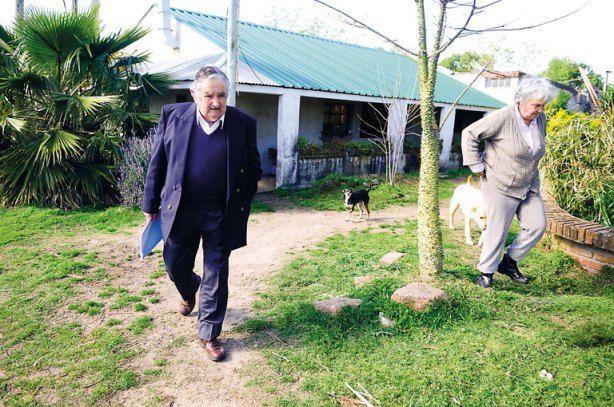
It's a common grumble that politicians' lifestyles are far removed from those of their electorate. Not so in Uruguay. Meet the president - who lives on a ramshackle farm and gives away most of his pay.
Laundry is strung outside the house. The water comes from a well in a yard, overgrown with weeds. Only two police officers and Manuela, a three-legged dog, keep watch outside.
This is the residence of the president of Uruguay, Jose Mujica, whose lifestyle clearly differs sharply from that of most other world leaders.
President Mujica has shunned the luxurious house that the Uruguayan state provides for its leaders and opted to stay at his wife's farmhouse, off a dirt road outside the capital, Montevideo.
The president and his wife work the land themselves, growing flowers.
This austere lifestyle - and the fact that Mujica donates about 90% of his monthly salary, equivalent to 12,000 dollars, to charity - has led him to be labelled the poorest president in the world.
I've lived like this most of my life, he says, sitting on an old chair in his garden, using a cushion favoured by Manuela the dog. I can live well with what I have.
His charitable donations - which benefit poor people and small entrepreneurs - mean his salary is roughly in line with the average Uruguayan income of 775 dollars a month.
In 2010, his annual personal wealth declaration - mandatory for officials in Uruguay - was 1.800 dollars, the value of his 1987 Volkswagen Beetle. This year, he added half of his wife's assets - land, tractors and a house - reaching 215.000 dollars.
That's still only about two-thirds of Vice-President Danilo Astori's declared wealth, and a third of the figure declared by Mujica's predecessor as president, Tabare Vasquez.
Elected in 2009, Mujica spent the 1960s and 1970s as part of the Uruguayan guerrilla Tupamaros, a leftist armed group inspired by the Cuban revolution. He was shot six times and spent 14 years in jail. Most of his detention was spent in harsh conditions and isolation, until he was freed in 1985 when Uruguay returned to democracy.
Those years in jail, Mujica says, helped shape his outlook on life.
I'm called 'the poorest president', but I don't feel poor. Poor people are those who only work to try to keep an expensive lifestyle, and always want more and more, he says.
This is a matter of freedom. If you don't have many possessions then you don't need to work all your life like a slave to sustain them, and therefore you have more time for yourself, he says. I may seem a mad and eccentric old man. But this is a free choice.
The Uruguayan leader made a similar point when he addressed the Rio+20 summit in June this year: We've been talking all afternoon about sustainable development: to get the masses out of poverty.
But what are we thinking? Do we want the model of development and consumption of the rich countries? I ask you now: what would happen to this planet if Indians would have the same proportion of cars per household than Germans? How much oxygen would we have left?
Does this planet have enough resources so seven or eight billion can have the same level of consumption and waste that today is seen in rich societies? It is this level of hyper-consumption that is harming our planet.
Mujica accuses most world leaders of having a blind obsession to achieve growth with consumption, as if the contrary would mean the end of the world.
But however large the gulf between the vegetarian Mujica and these other leaders, he is no more immune than they are to the ups and downs of political life.
Many sympathise with President Mujica because of how he lives. But this does not stop him for being criticised for how the government is doing, says Ignacio Zuasnabar, a Uruguayan pollster.
The Uruguayan opposition says the country's recent economic prosperity has not resulted in better public services in health and education, and for the first time since Mujica's election in 2009 his popularity has fallen below 50%.
This year he has also been under fire because of two controversial moves. Uruguay's Congress recently passed a bill which legalised abortions for pregnancies up to 12 weeks. Unlike his predecessor, Mujica did not veto it.
He is also supporting a debate on the legalisation of the consumption of cannabis, in a bill that would also give the state the monopoly over its trade.
Consumption of cannabis is not the most worrying thing, drug-dealing is the real problem, he says.
However, he doesn't have to worry too much about his popularity rating - Uruguayan law means he is not allowed to seek re-election in 2014. Also, at 77, he is likely to retire from politics altogether before long.



33 comments Feed
Note: Comments do not reflect MercoPress’ opinions. They are the personal view of our users. We wish to keep this as open and unregulated as possible. However, rude or foul language, discriminative comments (based on ethnicity, religion, gender, nationality, sexual orientation or the sort), spamming or any other offensive or inappropriate behaviour will not be tolerated. Please report any inadequate posts to the editor. Comments must be in English. Thank you.
If only other world leaders could do,act and think like he does.
How to compare the republican austerity and simplicity to obscenity, arrogance and insolence?
Argentina and Uruguay, the same origin, so physically close but so far
away ethically
Argentina, Argentina...What have they done to you?
Argentina What have they done to you?
#5 And yet Pepe and Cristinita are friends and comrades - go figure!
You say:
One of his pet projects, with which I agree, is to refurbish the frieght system by rail. One of the reasons for going to Spain was to negotiate a big deal with a Basque railway company to do just that but with his absence that one looks like a moribund duck on the point of death
I Say:
I suppose that, in your British Colonial Mindset, it is still necessary for an Uruguayan President to crawl all the way up to the Central Countries and humbly ask them to pleeeease invest some pennies in our Nations......
I Think:
That if there is any meat in that rail proyectyou mention, that Basque Company will be in Uruguay tomorrow, washing Pepe's feet, thrombosis included.....
As to Pepe and the railway he is doing his best and we have new Russian rails installed on the old track but still with a speed limit at best of 25kph
Yes the Brits ahnded over a functioning rail network to the ROU govt. All goverments whether Colorado, Blanco or Frente have allowed to the system to be starved of essential maintenance for sixty years by commission or omission and now we need a billion dollars to restore the system. The Union Ferroviaria blocks any innovation, all 1025 of them an average age 57 and still want to play trains with the rules of the 50s. Just three trains per day of forestry products would take 100 trucks off our overstretched road system. So less cost to our country in imported diesel fuel and a helluva sight better for the environment also, Good for Pepe if he can find a company to invest but they wont do it unless they get a return on the money they invest. And another PLUNA fiasco we can do without, so caution I THINK
Are you drunk or what?
Try to read my post again and tell me where you see any Anti-Uruguayan paragraph, sentence, line, word, letter, punctuation mark or whatever......
Besides... In Argentina, to call a Uruguayo: Yoruga is as derogatory and ofensive as to call a Francisco: Pancho
At least, after decades of being ignored by Europe and the US, Uruguay seems to be back on the map, with foreign entrepreneurs showing interest in large-scale mining ventures and in building railways and a deep-sea port on the Atlantic coast. I have doubts whether the former is the way to go - what do you think?
Like you I admire our president as a human being. But I also think that our President should have been in his office monitering the damage caused by the recent cyclone, rather than helping a neighbour hold down his shed's roofing in the wind. In general, his admistration skills are wanting and his subordinates seem to be ignoring him (e.g. limiting moneys spent on foreign travel).
Port An excellent idea but I wonder if the implications havebeen fully thought through. If this is to be a port a granelit wil of course take business not only fromBuenos Aires but also Montevideo. A transport eat west infrastructure would have to be built. And of course there are environmental considerations
As to the mega mine Urugay has little experience in this, the only precedent being the gold mine in Minas de Corrales operated by Orosur (OMI.L) and has been running for two decades. The environmental problems have been minimal and it has brought prosperity and a higher living standard to the area. Its also put the equivalent of 6,000 troy ounces of gold annually into the government coffers as well as paying taxes as any other company
The Aritiri iron mining project is on a much larger scale and I dont think has been properly thought through. Apart fromthe environmental considerations the mine is going to need an awwful lot of electricty to run which at present has to be imported or generated with imported oil. It would be nice if we could do a deal with Paraguay touse thier excess hydro power, but this has been bocked by Argentina asking a ridiculos price for use of thier transmission lines
Yes, I agree with you regarding the Aritiri project. As for new railways, I believe they will be necessary regardless of mega mining ventures, unfortunately starting from scratch. AFE is a joke, albeit an expensive one. As for the deep-waters port on the Rocha coast, perhaps you've omitted the main reason why it's becoming increasingly desirable - it's far from Argentina and their damaging foot-dragging over dredging for Montevideo and Uruguay River ports. The K-government has reminded us that we must rely on Argentina as little as possible.
I'm afraid I don't understand your reference to the poisoned chalice of the Union Restrictions. I wonder if you'd enlighten me, please?
In the 50 till the 70s we had a functioning rail system with many more trains than we have today on our network which is on its last legs. The workers of the Union Ferroviaria were relaitavly well paid on the basis of what remuneration was paid in UK to the railwaymen at that time. So now we have 1025 old buffers (excuse the pun) average age 57 who are holding our country to ransom so that they can continue to play trains with outdated working rules for thier own enjoyment at the vast expense to taxpayers such as you and I. Is this Fair? No it isnt
Thank you for that information, I had no idea that Unión Ferroviaria workers wages were based on those of UK railway workers. So presumably they still make above average salaries as compared to other empleados públicos? We were taught in liceo that the nationalisation of the railways was brilliant, but time shows otherwise. Well, in President Mujica's words (regarding other groups), We'll have peace when we all die off. What you tell me just reinforces my view that Uruguay will have to build a new railway from scratch, but not only for technical reasons.
Which route would you consider most important: La Paloma-Montevideo, La Paloma-Rivera or La Paloma-Fray Bentos?
And I demand sleeping and dining wagons........ as in the old times!
South America needs to look at the prime example ‘EUROPE’ but they are not going to you need brains for that and the masses do not have them they just have “wants”
Let me explain he is a dictator de facto trough the voice of the masses he in fact have a mandate he gives away welfare to the masses and they in turn give him dictatorial power. he punish with taxes the producers ,He laughs at the rule of law. Is not just in Uruguay all the Bolivarian countries are the same. The populous leaders play the class warfare.
They will give away all the wealth until the state collapses. Take a look at the Argentineans all started with Peron. Argentina could never be a serious country.
I disagree with you just as much as I disagree with the Mujica Administration.
Yes you have a democracy but is not functional the word democracy is not enough to solve problems and in this case will not work.
Take a look at Venezuela is a dictator they have the highest crime in the world double Mexico’s and in every Bolivarian country I see the crime soar, the uneducated masses supply part of their income with crime.
No source of work they do not create jobs but Venezuela can sustain the model a little longer because of oil.
Chile did the right think with Pinochet they got it right and they have the best economy in Latin America and is sustainable they will have a modern country and the first in Latin America that will be part of the first world by 2020 but noooo why copy what works let have a successful Bolivarian model yes is very smart!
DEMOCRACY=WELFARE
Commenting for this story is now closed.
If you have a Facebook account, become a fan and comment on our Facebook Page!