MercoPress. South Atlantic News Agency
Economy
-
Thursday, August 27th 2026 - 23:55 UTC
The Falklands close the second Loligo squid season three days after reopening it

The Falkland Islands Fisheries Department announced on Thursday the closure of the second Loligo squid season due to low biomass levels, just three days after fishing had resumed following a two-week pause.
-
Thursday, August 27th 2026 - 21:32 UTC
Specialist outlets estimate GTA VI absenteeism could cost the US a billion dollars

Video game and technology outlets estimate that the launch of Grand Theft Auto VI, scheduled for November 19, could cost the United States economy more than a billion dollars in lost productivity, due to the number of workers expected to skip work to play. The estimate has circulated within the sector's digital ecosystem since last year and does not come from a published study.
-
Wednesday, August 26th 2026 - 08:25 UTC
PM Burnham on taxes, “I won't be unrealistic, and people need to understand that”

Prime Minister Andy Burnham has suggested tax rises could be on the cards in the coming Autumn Budget, warning “I won’t be unrealistic” over the state of the public purse. The PM quickly pledged to give people “breathing space” and ease the cost of living after taking the keys to No.10 last month.
-
Monday, August 24th 2026 - 07:44 UTC
Unemployment displaces inflation as Argentines' main concern

Unemployment has become the leading problem Argentines want the government to solve, well ahead of inflation, according to the economic expectations report by the polling firm Opina Argentina released over the weekend. Thirty-six percent of respondents placed it first, followed by corruption on 32%, while inflation fell to 11% and insecurity to 9%.
-
Sunday, August 23rd 2026 - 22:41 UTC
Argentina votes this week on the reform barring the central bank from funding the Treasury

Argentina's Chamber of Deputies will on Wednesday debate the reform of the central bank's charter promoted by Javier Milei's government, which bars the monetary authority from financing the fiscal deficit through money creation and restores preservation of the value of the currency as its sole objective.
-
Sunday, August 23rd 2026 - 22:32 UTC
The Mercosur-Singapore trade agreement reaches Argentina's Congress
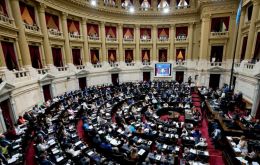
Argentina's Chamber of Deputies will on Wednesday take up ratification of the free trade agreement between Mercosur and Singapore, signed in December 2023 and still awaiting parliamentary approval. It is the first trade treaty the bloc has concluded with a Southeast Asian country.
-
Friday, August 21st 2026 - 10:47 UTC
ECLAC trims its 2026 forecast for Latin America and the Caribbean to 2.2%

The Economic Commission for Latin America and the Caribbean on Thursday lowered its regional growth projection for 2026 to 2.2%, one tenth below the estimate issued in December. The United Nations body expects a partial recovery to 2.5% in 2027 and warns that the current pace is insufficient to sustainably raise income per capita.
-
Friday, August 21st 2026 - 05:20 UTC
US gross national debt passes 40 trillion dollars for the first time
The gross public debt of the United States reached 40.047 trillion dollars on Tuesday, according to data released by the Treasury Department. It is the first time the figure has crossed that threshold, and it has arrived earlier than expected: the Congressional Budget Office had projected 39.4 trillion by the end of fiscal 2026 and placed the jump to 40 trillion in 2027.
-
Wednesday, August 19th 2026 - 21:50 UTC
A critical report says Argentina's investment regime concentrated capital in mining and oil

Argentina's Large Investment Incentive Regime (RIGI), created in 2024, “consolidated a strongly extractive profile and did not stimulate new sectors,” according to a report released on Wednesday by the RIGI Observatory, a coalition of civil society organisations and academic centres that examines the scheme from a critical standpoint.
-
Tuesday, August 18th 2026 - 06:52 UTC
Argentina's vice-president says she is “extremely worried” about those who cannot make ends meet

Argentina's vice-president, Victoria Villarruel, has again distanced herself from Javier Milei's government, voicing concern over unemployment and the financial difficulties facing households. “I am extremely worried about Argentines who today have no work or who cannot make ends meet,” she said at the opening of Expo Venado 2026, an agricultural fair in Venado Tuerto, Santa Fe province.

