MercoPress. South Atlantic News Agency
United States
-
Friday, September 25th 2026 - 10:41 UTC
“The UN has more reason to exist every day”, Uruguay's president said two days after Milei
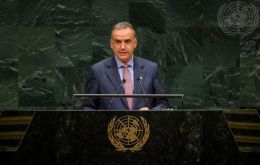
Uruguayan President Yamandú Orsi defended the United Nations' relevance and condemned the economic embargo on Cuba before the General Assembly on Thursday, in an address of just under twenty minutes that contrasted with that of his Argentine counterpart, Javier Milei, two days earlier from the same podium.
-
Friday, September 25th 2026 - 09:37 UTC
Trump and Xi end the state visit with the trade truce extended and no substantive deals
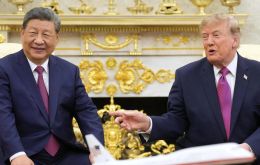
Chinese President Xi Jinping's state visit to Washington ended on Thursday with a two-month extension of the bilateral trade truce, agreed before the meeting itself, and no progress on the central issues dividing the two powers: tariffs, rare earths, agricultural purchases, Taiwan and export restrictions on advanced chips.
-
Thursday, September 24th 2026 - 10:47 UTC
Delcy Rodríguez tells the UN there will be elections in Venezuela, without setting a date
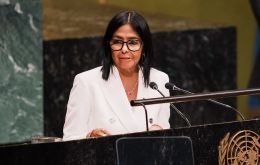
Venezuela's acting president, Delcy Rodríguez, announced on Wednesday before the United Nations General Assembly that her country will hold elections, without specifying when, and thanked US President Donald Trump for “his willingness to return to the path of diplomatic relations and cooperation”.
-
Thursday, September 24th 2026 - 00:11 UTC
Machado's team says three attempts to return to Venezuela failed in 24 hours
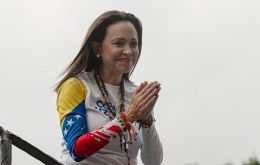
The circle around Venezuelan opposition leader María Corina Machado said this week that three attempts to return to Venezuela from Panama, by sea and by air, were thwarted within roughly 24 hours. One was recorded in a flight manifest placing her among the passengers of an aircraft that never took off; the document does not establish why.
-
Wednesday, September 23rd 2026 - 17:54 UTC
Milei at the UN: “The Malvinas are a national cause for us”
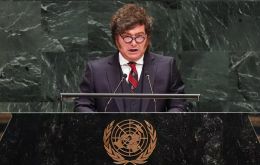
Argentine President Javier Milei called on the United Nations General Assembly on Wednesday to act over what he described as unilateral British actions in the Falklands, and accused the organisation of having “decided to look the other way” on the dispute. “The Malvinas are a national cause for us,” he said, repeating the phrase twice at the start of his address.
-
Wednesday, September 23rd 2026 - 09:49 UTC
Burnham at the UN: “the rights of British territories to remain British”
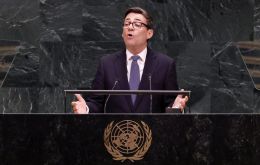
British Prime Minister Andy Burnham placed the Falklands among the challenges to the rule of law in his first address to the United Nations General Assembly, delivered on Tuesday evening in New York, setting them in the same sentence as Russia.
-
Wednesday, September 23rd 2026 - 08:55 UTC
Delcy Rodríguez calls her meeting with Trump “historic” and thanks him for his support
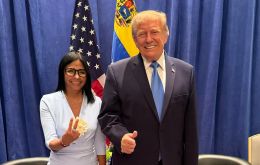
Venezuela's acting president, Delcy Rodríguez, described her first meeting with US President Donald Trump as “historic”. The encounter took place on Tuesday evening in New York behind closed doors and with no press access. Her post on the social network X is the only available account of what was discussed: the White House confirmed the meeting and those present but released no agenda or outcomes.
-
Tuesday, September 22nd 2026 - 19:45 UTC
Burnham says he raised the Falklands with Trump at their first meeting
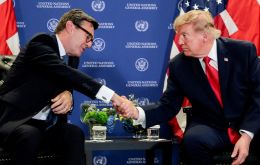
British Prime Minister Andy Burnham said on Tuesday that he raised the question of the Falklands with US President Donald Trump during their first meeting, held on the sidelines of the UN General Assembly in New York. “The Falklands we mentioned. And you were good enough to listen to us on those issues,” he told reporters. Trump made no public response on the archipelago.
-
Monday, September 21st 2026 - 10:15 UTC
Delcy Rodríguez arrives in New York for UN General Assembly, ahead of meeting with Trump
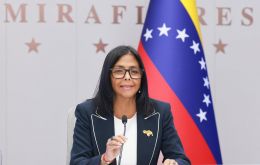
Venezuela's acting president, Delcy Rodríguez, arrived in New York in the early hours of Monday to take part in the 81st session of the UN General Assembly, days ahead of a planned meeting with US President Donald Trump on Tuesday.
-
Monday, September 21st 2026 - 09:44 UTC
US investigates ICE shooting of Venezuelan delivery driver in Austin

An Immigration and Customs Enforcement (ICE) agent shot and wounded a Venezuelan man on Sunday in Austin, Texas, while he was making a delivery for DoorDash, in an incident the Department of Homeland Security (DHS) confirmed it is investigating alongside the FBI and which prompted calls for an independent investigation from local officials.