MercoPress. South Atlantic News Agency
What are the conditions Maduro offered Trump? The keys behind US president’s ultimatum
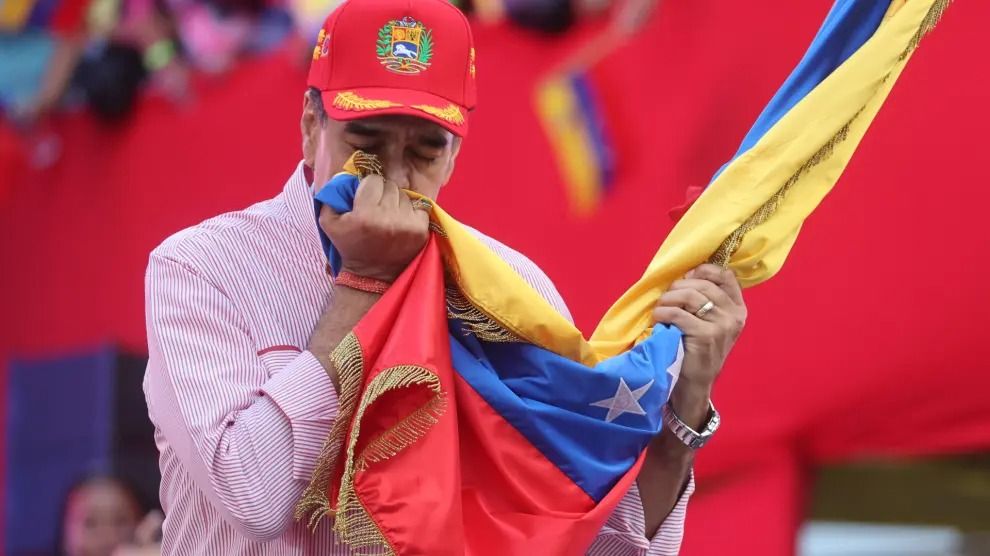 The Venezuelan president was reportedly willing to step down, but only under a set of political and judicial guarantees that Washington deemed unacceptable
 Amid an unprecedented military buildup and the formal designation of Venezuela’s so-called Cartel of the Suns as a terrorist organization, US President Donald Trump said on Wednesday that Nicolás Maduro “will do it,” when asked whether the Venezuelan leader had offered to step down. At the same press conference, Trump announced that US ground operations against “narcoterrorists” in Venezuela would begin “very soon,” adding: “We know where they live. We know where the bad guys live.” His comments come as more details emerge of a phone call in which, according to Reuters and France 24, Maduro reportedly laid out specific conditions for leaving office.
What Maduro reportedly put on the table
According to four sources familiar with the Nov. 21 call, cited by Reuters and echoed by other international outlets, Maduro signaled that he was prepared to relinquish power, but only in exchange for a package of political and legal guarantees that Washington ultimately rejected.
Those sources say Maduro made at least four key demands:
- Full legal amnesty for himself and his family, shielding them from prosecution.
- Closure of the International Criminal Court investigation into alleged crimes against humanity.
- Lifting of US sanctions on roughly 100 Venezuelan officials accused of human rights abuses, drug trafficking or corruption.
- An interim government led by Vice President Delcy Rodríguez before organizing new elections.
Three of the sources described the proposal as an attempt to secure layered protection for Maduro and his inner circle, both inside Venezuela and abroad.
Read also: Venezuela approves migrant repatriation flight from US despite Trump’s airspace closure claim
Trump’s response: rejection and a deadline
Most of those conditions were rejected by Trump during a roughly 15-minute conversation, according to Reuters and France 24. The US president instead offered Maduro safe passage out of Venezuela with his family, to Russia or another country of his choosing.
Republican Senator Markwayne Mullin, who sits on the Armed Services Committee, later told CNN that “we gave Maduro an opportunity to leave.” According to those accounts, Trump coupled the offer with a specific deadline: until Friday, Nov. 28, to step down.
Maduro did not accept. After the deadline expired, Trump publicly declared Venezuelan airspace “closed in its entirety” and maintained the largest US military deployment in the Caribbean in decades, a move Caracas denounced as a violation of its sovereignty and a prelude to possible intervention.
Terrorist designation and mounting military pressure
The exchange between the two leaders has unfolded alongside Washington’s political and military pressure campaign against the Venezuelan government. The United States has designated the Cartel of the Suns as a foreign terrorist organization and claims that Maduro and senior Venezuelan officers sit at the top of that network, which it accuses of moving drugs toward US territory.
Since early September, the US military has been striking small boats in the Caribbean and eastern Pacific, describing them as drug-running “narco-boats” linked to Venezuelan criminal structures. At least 80 people have been killed in more than 20 strikes, according to US figures and media reports.
Lawmakers from both parties have called for investigations into one incident in particular, following a Washington Post report alleging that Defense Secretary Pete Hegseth verbally ordered a second strike on a vessel after surveillance showed two survivors following an initial missile attack. Democratic Senator Tim Kaine warned that, if confirmed, the incident “rises to the level of a war crime.”
Few clear exits on a crowded chessboard
As the US deployment remains at peak levels and the White House weighs possible ground operations against “narcoterrorists,” the political pathways appear increasingly narrow. Analysts quoted by international outlets see at least four main scenarios: limited targeted strikes on Venezuelan soil, a negotiated transition, an internal split within the ruling elite, or a continuation of the current stalemate.
In Caracas, Maduro has publicly vowed “absolute loyalty” to the Venezuelan people and pledged to resist, while his government files complaints at international forums accusing Washington of seeking to “seize” the country’s oil reserves through military pressure. At the same time, Reuters reports that the Venezuelan government has requested another phone call with Trump, though it remains unclear whether the White House will agree to reopen that direct channel.
For Washington, a central question remains whether the primary goal is to weaken criminal networks it associates with the Cartel of the Suns or to force Maduro’s removal from power. For Caracas, the dilemma is whether to double down on total resistance or to explore a negotiated exit that does not amount to the unconditional surrender that, so far, the United States shows little sign of accepting.


Top Comments
Disclaimer & comment rulesCommenting for this story is now closed.
If you have a Facebook account, become a fan and comment on our Facebook Page!