MercoPress. South Atlantic News Agency
International
-
Monday, September 28th 2026 - 07:51 UTC
The Telegraph links the Chagos deal to Argentina's Falklands campaign

An opinion column published on Sunday in the British newspaper The Telegraph argues that the decision to transfer sovereignty over the Chagos Islands to Mauritius served as a signal of weakness that encouraged claims over other British overseas territories, among them the Falklands. The piece, by journalist Daniel Johnson, is an argument of opinion rather than a report of new facts.
-
Friday, September 25th 2026 - 23:26 UTC
Falklands Assembly responds to Argentina's campaign: “This Assembly remains calm”

The chair of the Falkland Islands Legislative Assembly, Jack Ford, said on Thursday during a sitting of the body that there is “nothing new” in the claims made this week, and that the institution “remains calm” and steadfast in defending the right of the archipelago's residents to determine their own future.
-
Friday, September 25th 2026 - 21:35 UTC
The Falklands economic development agency appoints Josh Smith as managing director

The Falkland Islands Development Corporation, the archipelago's economic development agency, announced on Friday the appointment of Josh Smith as its new managing director, subject to final relocation arrangements. He will succeed Zachary Franklin, who will conclude his tenure in December.
-
Friday, September 25th 2026 - 21:28 UTC
Milei and Netanyahu discussed the Falklands in his only bilateral in New York

Argentine President Javier Milei met Israeli Prime Minister Benjamin Netanyahu for about twenty minutes on Thursday at United Nations headquarters, in what was his only bilateral meeting with a head of state or government during his trip to New York. Foreign Minister Pablo Quirno confirmed they discussed the Falklands.
-
Friday, September 25th 2026 - 10:41 UTC
“The UN has more reason to exist every day”, Uruguay's president said two days after Milei
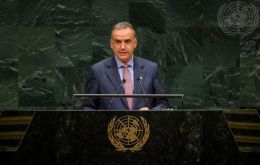
Uruguayan President Yamandú Orsi defended the United Nations' relevance and condemned the economic embargo on Cuba before the General Assembly on Thursday, in an address of just under twenty minutes that contrasted with that of his Argentine counterpart, Javier Milei, two days earlier from the same podium.
-
Friday, September 25th 2026 - 09:37 UTC
Trump and Xi end the state visit with the trade truce extended and no substantive deals
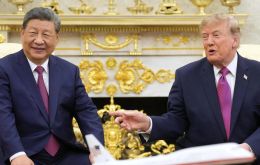
Chinese President Xi Jinping's state visit to Washington ended on Thursday with a two-month extension of the bilateral trade truce, agreed before the meeting itself, and no progress on the central issues dividing the two powers: tariffs, rare earths, agricultural purchases, Taiwan and export restrictions on advanced chips.
-
Friday, September 25th 2026 - 00:08 UTC
Netanyahu rejects genocide allegations before an assembly emptied by dozens of delegations

Israeli Prime Minister Benjamin Netanyahu on Thursday called genocide allegations against his country over the war in Gaza “the biggest lie of the century”, in an address to the United Nations General Assembly that dozens of delegations left before he began speaking.
-
Thursday, September 24th 2026 - 10:59 UTC
UK replies to Milei: “not the behaviour we expect of a democracy”

The United Kingdom has asked for a written statement to be placed in the official record of the UN General Assembly in response to Argentine President Javier Milei's address, saying Buenos Aires' conduct over the Falklands “is wholly incompatible with the principles established in the United Nations Charter and is not the behaviour we expect of a democracy”.
-
Thursday, September 24th 2026 - 10:47 UTC
Delcy Rodríguez tells the UN there will be elections in Venezuela, without setting a date
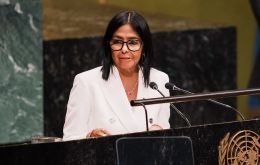
Venezuela's acting president, Delcy Rodríguez, announced on Wednesday before the United Nations General Assembly that her country will hold elections, without specifying when, and thanked US President Donald Trump for “his willingness to return to the path of diplomatic relations and cooperation”.
-
Thursday, September 24th 2026 - 00:01 UTC
The Shift from Display Ads to Affiliate Revenue in Sports Media

For most of the 2010s, sports websites made money in the same way as everyone else online. They put banners on the page, sold ad space, and got paid when people saw the ads. If there was traffic, the bills got paid. What readers did after they got to the page didn't matter.