MercoPress. South Atlantic News Agency



Pumas shift to eating penguins along Argentine coast
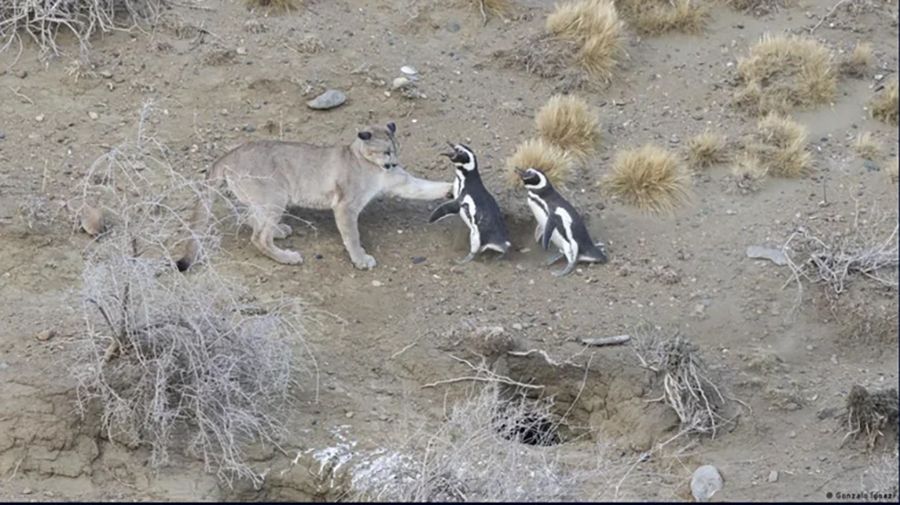 Lonely hunter pumas now operate in groups, given the abundance of penguins
 A recent study published in Proceedings of the Royal Society B has documented an unprecedented ecological interaction in Argentina, where Pumas (Puma concolor) are hunting Magellanic penguins (Spheniscus magellanicus) along the Patagonian coast as a direct result of historical human intervention.
Historically, penguins nested primarily on offshore islands to avoid land predators. However, in the early 20th century, the expansion of sheep farming led to the massive hunting and near-extinction of pumas in coastal areas.
With pumas gone, penguins began colonizing the mainland coast (such as Monte León National Park in the province of Santa Cruz) because there were no large terrestrial predators to threaten their nests.
In the 21st Century, successful rewilding and protection efforts have seen the puma -known typically to be solitary hunters that rely on mammals like guanacos (a relative of the llama)- return to coastal regions. Researchers from Rewilding Argentina and international universities tracked 14 pumas with GPS collars between 2019 and 2023.
Among their findings is the highest density of pumas near penguin colonies ever recorded, roughly double that of other regions. Additionally, the presence of large numbers of penguins in one spot resulted in these otherwise solitary cats interacting with each other more frequently. Coastal pumas move much less and maintain smaller territories because they no longer need to travel long distances to hunt guanacos.
“The pumas that consume penguins interact more with other pumas, because they find themselves in the colony or its surroundings, and have smaller territories and move less, since they do not have to make long journeys to find their prey,” explained Rewilding Argentina Scientific Director Emiliano Donadio, a co-author of the study.
Data showed that the penguin colonies were in no way at risk. In fact, they were found to be stable and even growing. The pumas' impact is not yet threatening the survival of the species.
When penguins migrate away from the coast for the season, the pumas simply switch back to their traditional diet of guanacos.
Mitchel Serota, the study's lead author, warned that because pumas and guanacos are the dominant predator-prey pair in Patagonia, this shift to eating penguins could have a “domino effect” on the vegetation and other animals in the region.
The return of the puma is seen as a success for conservation, showing that the landscape is recovering its native predators, with new behaviors and interactions that scientists are just beginning to understand.
“Carnivores are being reintroduced into an ecosystem that does not necessarily resemble the one that saw them become locally extinct,” warned Iowa State University Ecologist Jake Goheen, who did not participate in the research.


Top Comments
Disclaimer & comment rulesCommenting for this story is now closed.
If you have a Facebook account, become a fan and comment on our Facebook Page!