MercoPress. South Atlantic News Agency


Falklands, Tussac restoration project to protect peatlands
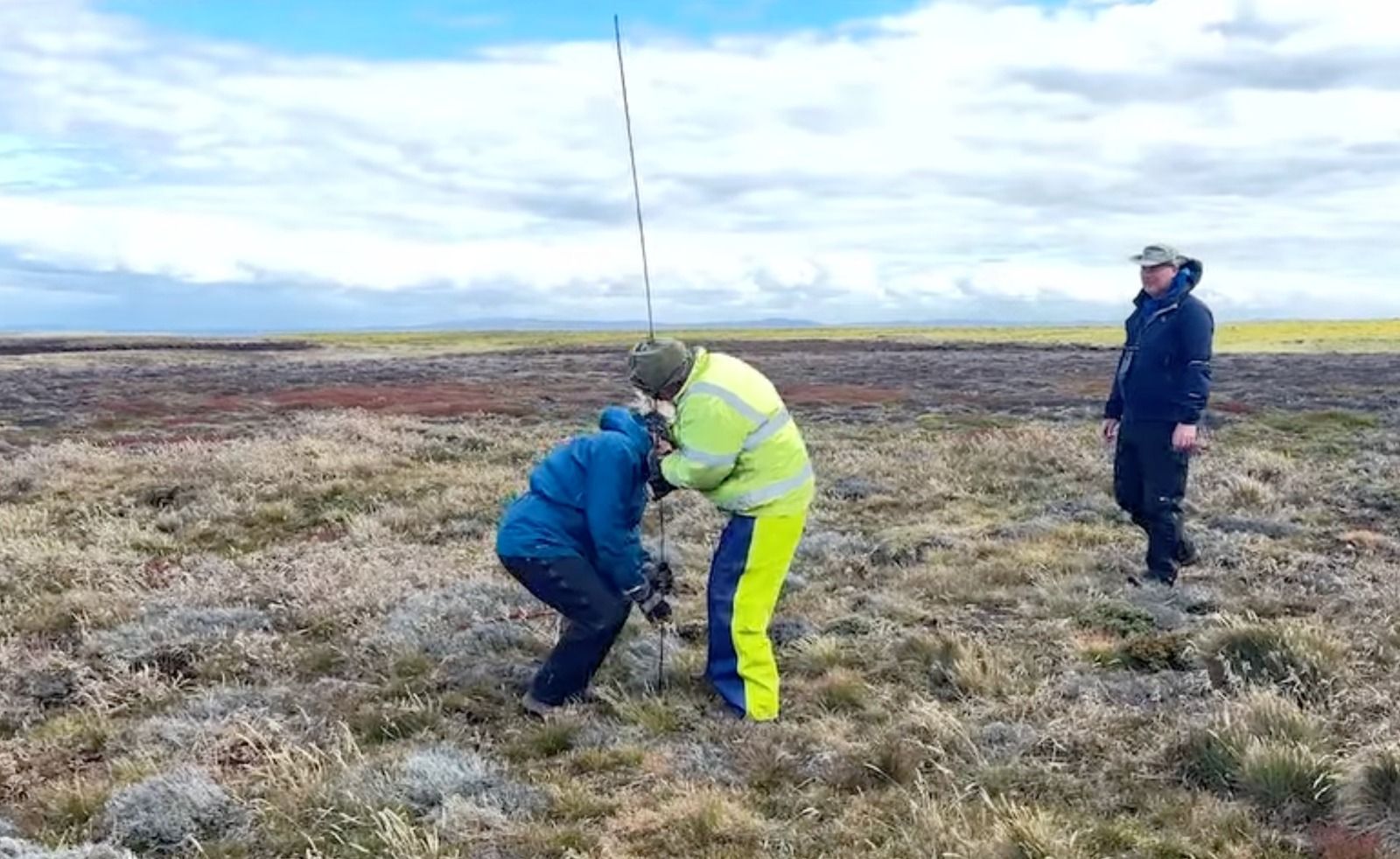 Frame by FITV.
 Dr. Nicholas Midgley, a senior lecturer and his team from Nottingham Trent University have been in the Falkland Islands for the last three weeks investigating coastal peatland and tussac’s significance for agriculture and wildlife.
The team focused especially on Cape Dolphin and Hummock Island conducting surveys on the ground and from the sky, working with steel rods to measure peat bogs and a small drone.
The work is basically directed to try and understand how we might address restoration of tussac sites, hopefully both former and currently, where managing practices have been started in places such as Hammock and Cape Dolphin, according to Dr. Midgley, Senior Lecturer in Physical Geography at the Nottingham Trent University.
“This means measuring peat depth with steel rods, which are pushed into the soil, and with a fifty meter grid measure the peat to the point, and then repeat the operation several hundred, possibly thousands of times, enabling us to build a map of bogs, both in the coastal and inland settings”.
This way we can have a ‘personal’ map on peat depth, and at Cape Dolphin we had peat eight meters plus deep. Besides we have a very small drone for contemporary extensive map sighting which can help us in a very interesting way to look at how tussac extension changes over time, say in five, ten years. This can be achieved by processing aerial archival imagery in the Islands dating back to 1956.
“There are a lot of reasons why we should care about tussac and the peat it develops, and helping store carbon, which is really important in a global context, and even more locally, as it has been historically for agriculture and also for the wildlife. Tussac is really a key stone species for wildlife and we are interested in extending the range of sites that we’ve got started in west Weddlell, we’ve covered Hummock, Cape Dolphin and we are interested in extending it to East Falklands”.
The Nottingham Trent University team is most grateful to Lewis Clifton OBE, The Shackleton Scholarship Fund, the Antarctic Research Trust, and Sally and Ken at Hammock island, for helping with the project.

Top Comments
Disclaimer & comment rulesCommenting for this story is now closed.
If you have a Facebook account, become a fan and comment on our Facebook Page!