MercoPress. South Atlantic News Agency


Brazil promulgates Mercosur-EU deal, completing domestic ratification of trade pact
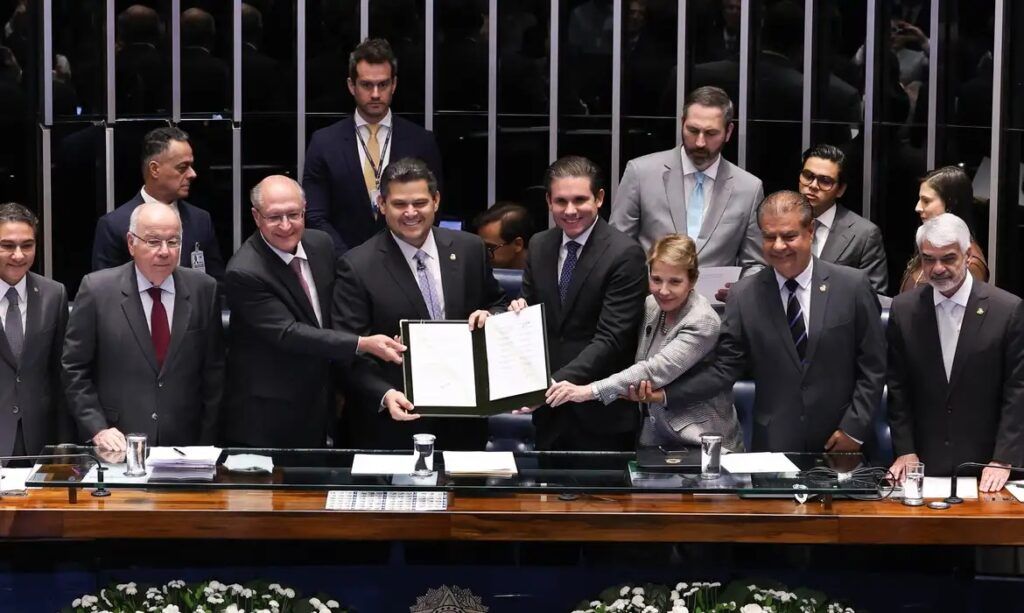 During the formal session, Alcolumbre said trade “is the key to world peace” and argued that countries that do business with one another tend to have more to lose from war than to gain from it
 Brazil’s Congress on Tuesday promulgated the trade agreement between Mercosur and the European Union, completing the final domestic step required for the treaty to take effect on the Brazilian side. The ceremony was led by Senate and Congress President Davi Alcolumbre, who framed the pact as a sign in favor of trade, stability and integration at a time of wars and commercial tensions.
The promulgation came less than two months after the agreement’s terms were signed in Asunción, following negotiations that began in 1999. According to Agência Brasil, the treaty creates a free trade area covering 718 million people and around R$113 trillion in combined GDP. The text had already been approved by Brazil’s lower house and by the Senate earlier this month.
During the formal session, Alcolumbre said trade “is the key to world peace” and argued that countries that do business with one another tend to have more to lose from war than to gain from it. Lower house Speaker Hugo Motta added that the pact has “political and civilizational” value because it brings together two regions that, he said, share commitments to democracy, multilateralism, human rights and sustainable development.
Vice President and Development, Industry, Trade and Services Minister Geraldo Alckmin described the agreement as both an economic and foreign policy instrument, saying it would help diversify markets, reduce external vulnerabilities and strengthen the Brazilian economy’s resilience to global shocks. Government figures cited by Brazilian officials say the agreement now links economies representing roughly a quarter of global output.
Under the deal, the South American bloc will phase out tariffs on 91% of European goods over up to 15 years, while the European Union will remove tariffs on 95% of Mercosur exports over up to 12 years. Brazil has already regulated a bilateral safeguards mechanism designed to shield domestic producers if a surge in preferential imports causes or threatens serious injury to local industry or agriculture.
On the South American side, ratification has also been completed by Argentina, Uruguay and Paraguay, which on Tuesday became the final founding Mercosur member to approve the treaty. In Europe, however, the process remains open. The European Parliament has requested a legal review by the European Court of Justice, although the European Commission has backed provisional application of the trade pillar while that review continues.
Brazil’s promulgation therefore marks a long-delayed political breakthrough, while leaving the final institutional outcome still unresolved on the European side, where legal concerns and political resistance remain in parts of the bloc.


Top Comments
Disclaimer & comment rulesCommenting for this story is now closed.
If you have a Facebook account, become a fan and comment on our Facebook Page!