MercoPress. South Atlantic News Agency


Bolivia's agro-environmental court judge shot dead amid wave of drug-related violence
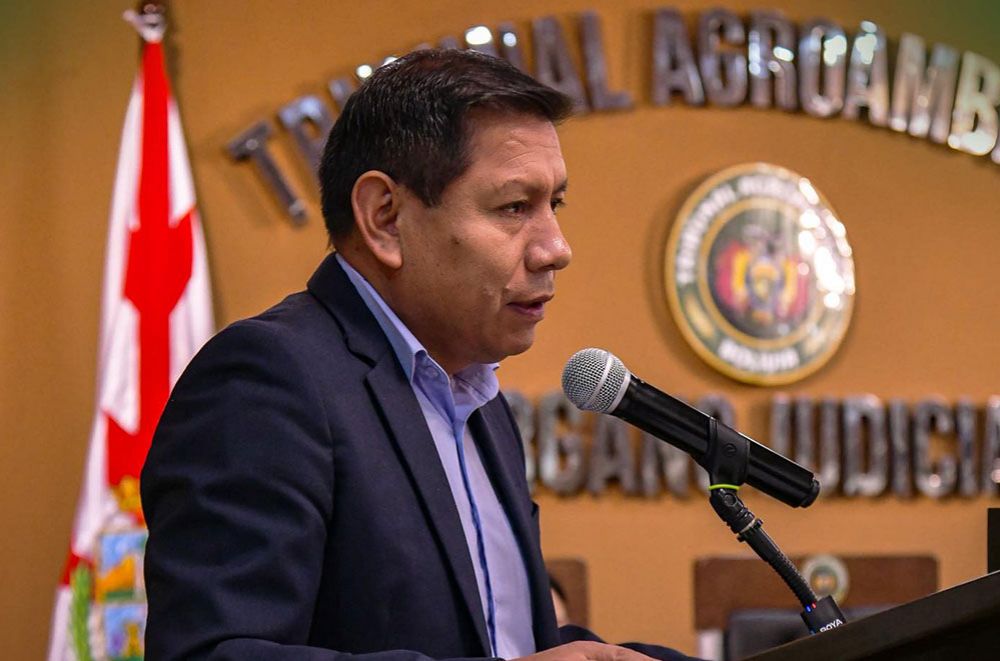 Claure, a 49-year-old lawyer born in Cochabamba, was intercepted near midnight while driving along Busch Avenue
 Víctor Hugo Claure, dean of Bolivia's Agro-Environmental Court, was shot dead late Thursday in the eastern city of Santa Cruz de la Sierra, in what authorities describe as an attack carried out by hitmen and which falls within a sequence of violent events linked to the growing influence of drug trafficking in the country's main city. The killing has prompted unanimous condemnation from the judicial system and from opposition politicians, and poses a direct challenge to the administration of President Rodrigo Paz, in office since November.
Claure, a 49-year-old lawyer born in Cochabamba, was intercepted near midnight while driving along Busch Avenue, in the Costanera neighborhood near the city's fourth ring, accompanied by a woman. Two men on a motorcycle followed his vehicle; one dismounted, approached the judge and fired at close range. The attack, captured by security cameras whose footage circulated in Bolivian media, struck him four times in the body, including a torso wound that caused thoraco-abdominal trauma and fatal hypovolemic shock, according to the autopsy released by prosecutor Yolanda Aguilera. The attackers fled the scene and remain at large despite a police operation deployed within minutes.
The Attorney General's Office activated a commission of prosecutors and experts from the Institute of Forensic Investigations (IDIF) to identify both the material and intellectual authors of the crime. Once the attack was reported, police were also deployed to the Equipetrol area, where a group of Supreme Court of Justice (TSJ) and Council of the Magistracy justices were attending a social event for International Workers' Day. The justices were in Santa Cruz for the National Sports Olympics of the Judicial Branch.
The president of the TSJ, Romer Saucedo, described the murder as an “absence of the State” and stated that “we cannot live in a country where contract killing has taken over and bent the arm of the State.” The Agro-Environmental Court said the crime “constitutes a direct affront to judicial independence.” Former President Jorge Quiroga (2001-2002) called the act “horrifying” and linked the murder to “at least three similar incidents that occurred in recent days in Santa Cruz,” attributing them to “violent drug trafficking that has cheapened contract killings of all kinds.”
Santa Cruz, Bolivia's economic engine and the country's most populated city, registers the highest levels of insecurity in the national territory, with documented presence of gangs linked to Brazilian cartels, particularly the Primeiro Comando da Capital (PCC) and the Comando Vermelho, according to Interior Ministry reports. The murder of a judge represents a significant escalation in a jurisdiction specialized in land and natural resource disputes, areas historically intertwined with economic interests linked to the expansion of the agricultural frontier and the illegal economy in regions bordering Brazil. The Paz government, which took office six months ago with a commitment to strengthening the security apparatus, had not officially commented on the crime at the time of this report.


Top Comments
Disclaimer & comment rulesCommenting for this story is now closed.
If you have a Facebook account, become a fan and comment on our Facebook Page!