MercoPress. South Atlantic News Agency


New Zealand's Unusual Laws: What Foreigners Aren't Prepared For
New Zealand has earned a reputation as one of the most comfortable and peaceful places to live. However, behind the beautiful landscapes, the ocean, and the relaxed rhythm of life, there are rules for how foreigners can benefit. There is a stench for those who have greatly increased the price of Europe and other countries that do not correspond to the benefits. In New Zealand, they may be fined for products left in luggage, limit the operation of stores on Holy Day, or establish new rules for gambling in other rich countries. It is important to know this for both local residents and foreigners in order to avoid unpleasant surprises and better understand the way of life of New Zealanders.
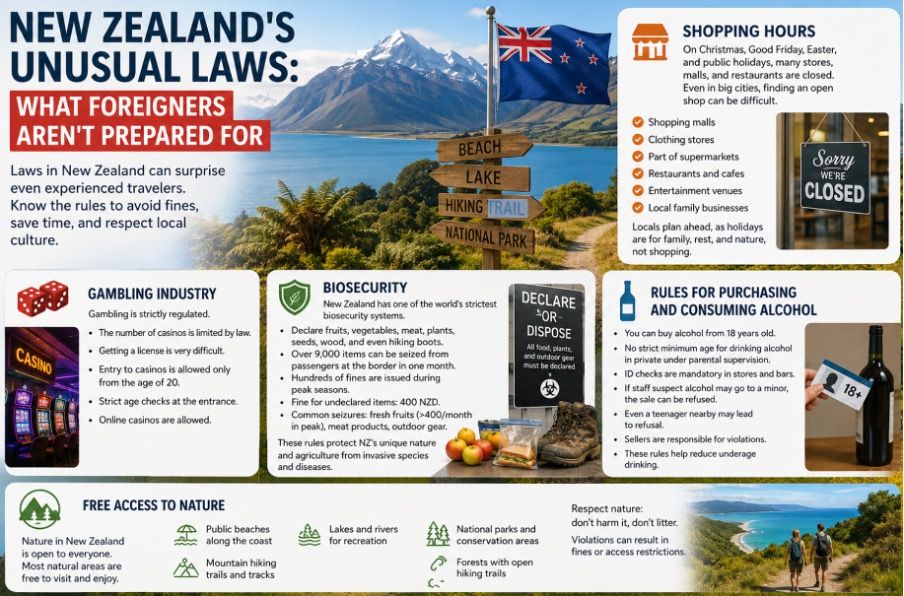
Shopping Hours
Many visitors expect shopping malls and stores to be open as usual or even longer than usual on public holidays. New Zealand has an approach that may surprise visitors, as on Christmas, Good Friday, Easter, and public holidays, a significant part of the trade temporarily ceases to operate. It can be difficult to find an open shopping mall or big store even in the capital of NZ. This comes as a surprise to travelers who are used to shopping at any time. Locals try to buy everything they need in advance before the holidays. People should take this into account when planning their trip. The most noticeable restrictions apply to:
- Shopping malls;
- Clothing stores;
- Part of supermarkets;
- Restaurants and cafes;
- Entertainment venues;
- Local family businesses.
Life in cities becomes calmer and more measured during public holidays. Many residents prefer to spend time with family, go out into nature, or meet with friends at home. For New Zealanders, this is considered an important part of holiday traditions and relaxation. To foreigners, this type of approach may seem unusual because in CIS or EU countries, holidays are often accompanied by sales and high trading activity.
Gambling Industry
In New Zealand, gambling is under strict state control, which will be unusual for residents of Europe or the CIS. It is impossible to open a new casino quickly and easily because the number of casino establishments is limited by law. The state strictly regulates this area in order to reduce social risks associated with gambling addiction. Obtaining a casino license is very difficult and time-consuming. Existing clubs operate under the constant supervision of regulators, but no one forbids playing in online casinos and choosing a quality platform after the bonus do's and don'ts Casinos Analyzer review.
Access to gaming areas is allowed only to adults, while entry is restricted until you are 20 years old. The NZ authorities carefully check this rule at the entrance to establishments. Younger visitors cannot enter even if accompanied by adults. Casino employees are required to monitor compliance with age requirements. Violation of the rules can lead to serious sanctions for the establishment. This approach is aimed at protecting young people from early involvement in gambling.
Biosafety
New Zealand has one of the world's most advanced biosecurity systems, which controls everything that enters the country through the border. A small organic source can become a risk for the unique ecosystem of the rural state, so crop growers claim fruits, vegetables, meat, porridge, plants, wood, and cause tourism problems. It's possible because of surplus ground, while violation of the rules may result in a fine or confiscation of crops. According to official data from the Ministry of First Nations of New Zealand, over 9,000 items can be seized from passengers at the border in one month, while hundreds of fines are recorded for undeclared products per hour during peak seasons.
A fine of 400 NZD is imposed for this violation of registration. The police write a charge for failure to declare essential products (an apple or a sandwich) because they were not declared on the declaration. Fresh fruits with over 400 drops per month at the peak period, tourism problems, and meat products that can carry illnesses are unsafe for the local environment. The system allows you to maintain extremely high biosafety and reduce the risk of introducing invasive species, which can lead to significant environmental damage and savings.
Rules for purchasing and consuming alcohol
Alcohol regulations are structured in a way that the main nuance isn't on the prohibition of consumption. It lies in the control of sales in New Zealand. This nice country allows people to buy alcohol from the age of 18 officially, while this age is considered key in the legislation. There is no separate, clear minimum age for drinking alcohol in private, if this happens under the supervision of parents or legal guardians. In stores and bars, there is a strict check of documents at the checkout and at the entrance. Employees are required to refuse a sale if there is a suspicion that a drink may be handed over to a minor. The presence of a teenager nearby may be a reason to refuse to sell alcohol to an adult, but rules of this type are aimed at reducing minors' access to alcohol.
Control in the alcohol sector is quite strict, while sellers are responsible for any violations. The sale can be immediately canceled if there is any doubt that alcohol is being purchased for someone else. This applies to situations when an adult comes to the store with minors. In these cases, the cashier has the right to refuse to complete the purchase without giving a reason. This practice is common and supported in land-based casinos or restaurants. Locals believe that this helps reduce early alcohol consumption among young people.
Free access to nature
In New Zealand, access to nature is one of the freest in the world, as anyone can verify by actually using the areas. Most beaches, lakes, mountain routes, and nature trails are open to everyone without fees, which makes traveling around the country as accessible as possible. In many cases, areas that in other countries might be private or restricted remain open to public use here. This creates a feeling of constant proximity to nature even within settlements. The state supports the principle of free access to natural resources and tourist routes. The most common types of natural areas open to everyone are:
- Public beaches along the coast;
- Mountain hiking trails and tracks;
- Lakes and rivers for recreation;
- National parks and conservation areas;
- Forests with open hiking trails;
- Coastal natural areas.
This approach allows people to travel without problems and play casino games with friends in nature without permits or fees. Many routes are designed so that they can be used by both tourists and locals. This creates a strong connection between the population and the environment. At the same time, there are rules of conduct that prohibit harming nature or leaving garbage. Violation of these rules can lead to fines or access restrictions.


Top Comments
Disclaimer & comment rulesCommenting for this story is now closed.
If you have a Facebook account, become a fan and comment on our Facebook Page!