MercoPress. South Atlantic News Agency


Scientists begin first study of whisky matured in Antarctica
 Isla Marambio spent three years on the ice at an Argentine research station and is now one of eight single malts being analyzed to see how extreme climates shape whisky
 A team of scientists has begun the first analysis of a whisky matured in Antarctica, aiming to determine what three years at temperatures as low as -35°C did to the spirit's maturation, chemistry and taste.
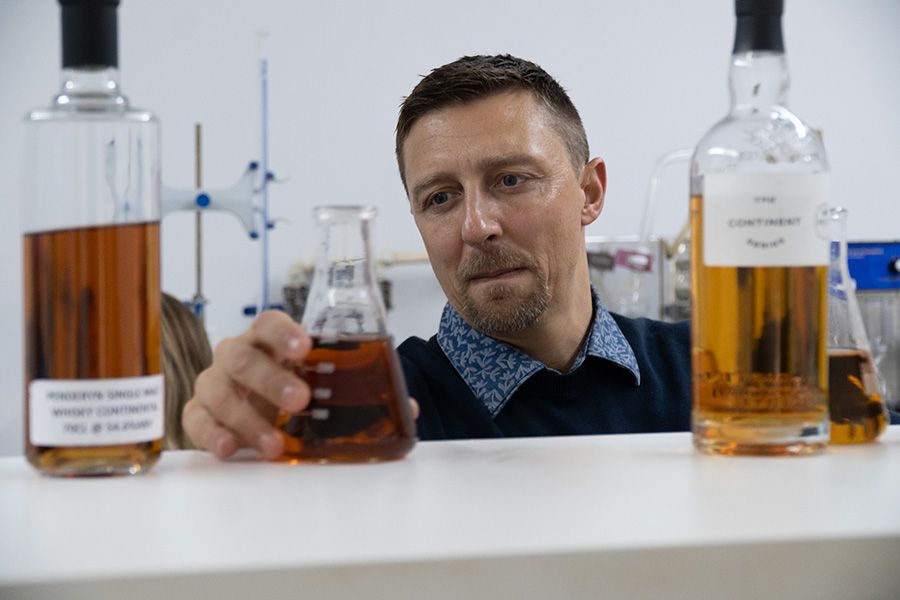
Isla Marambio, made by the Argentine distillery La Alazana, is billed as the world's first whisky matured in Antarctica. It was created for The 8 Continent Series, a collection of eight single malts —one from each continent— curated by Daniel Monk through Cask World. All eight will be analyzed over six months by Dr. Aline Bortoletto, a Brazilian food scientist specializing in the chemistry and sensory science of alcoholic beverages, and her team at INOVBEV in São Paulo.
The whisky was first matured for five years at La Alazana, in Andean Patagonia. Its casks were then flown south to Base Marambio, the Argentine research station on Marambio Island —known internationally as Seymour Island— aboard a military Hercules with support from Argentina's Armed Forces. Néstor Serenelli, who founded the distillery with his wife Lila, traveled with the casks and settled them into an uninsulated hut on the ice, where they stayed for three years in temperatures ranging from around -35°C to +10°C, with frost forming on the wood. Lila later made the journey south to bring the matured whisky home.
It is the coldest of the eight climates in the study, and the first time a whisky matured in Antarctica has been examined scientifically. According to Lila Serenelli, the deep cold appears to have drawn flavor from the wood while holding the spirit in and reducing evaporation, leaving a floral note she says she does not detect in the distillery's other whiskies.
What the study is looking for
Over six months, Dr. Bortoletto and her team will build a detailed chemical and sensory profile of each whisky, combining techniques such as gas chromatography with a trained sensory panel, then compare the results across the eight climates using statistical models. Titled Climate-Driven Maturation Signatures in Global Whisky: A Comparative Multi-Continental Chemical and Sensory Study, it is presented as the first scientific comparison of single malts matured across every continent.
The findings will be recorded in an international scientific report, which organizers say would be presented at food and beverage science conferences, with the aim of helping producers understand how their own climate and environment shape the spirit.
The Serenellis and La Alazana
La Alazana sits in Las Golondrinas, near Lago Puelo, in the Andean foothills of Patagonia. Lila and Néstor Serenelli founded it in 2011 as Argentina's first single malt producer, in a country far better known for its wine. They grow all their own barley and distill in copper pot stills of their own design. Lila trained at Scotland's Heriot-Watt University —the first Argentine to do so— before returning home to shape a distinctly Argentine whisky.
Separately from The 8 Continent Series, the Serenellis sent two other barrels to Base Belgrano II, an Antarctic station even farther south and colder than Marambio, where they will continue to mature for several more years.
The 8 Continent Series
The 8 Continent Series brings together eight distilleries, each with a whisky made on a different continent. The collection follows the eight-continent model, which includes Zealandia, the largely submerged landmass encompassing New Zealand that some geologists have recognized as the eighth continent since 2017.
| Distillery | Country / territory | Continent |
|---|---|---|
| La Alazana | Argentina (Antarctic whisky) | Antarctica |
| Union Distillery | Brazil | South America |
| Shelter Point | Canada | North America |
| Penderyn | Wales | Europe |
| Boplaas | South Africa | Africa |
| Rampur | India | Asia |
| Lawrenny | Tasmania | Australia |
| Pokeno | New Zealand | Zealandia |
The markedly different climates of each whisky are central to the study: all eight matured in conditions far removed from whisky's traditional homes in Scotland and Ireland.
How different climates shape whisky
Lila Serenelli, co-founder and head distiller at La Alazana, said: “We are a small family distillery in Patagonia, and to have made the first whisky ever matured in Antarctica is something we are enormously proud of. I trained in Scotland, but everything we do here is our own, shaped by our mountains, our water and our climate. Standing on the ice, looking out at the frozen sea and knowing our whisky had spent three whole years out there, brought tears to my eyes.”
Néstor Serenelli added: “Taking our casks to Antarctica on a military flight, and placing them on the ice myself, is something I will never forget. We did this as Argentines, doing what no one had done before, and we are not finished yet.”
Dr. Bortoletto said: “This is genuinely uncharted territory. No study has examined how single malt whisky matures across climates this different, from the heat of northern India to the freezing cold of Antarctica. By combining chemical and sensory analysis, we hope to give whisky lovers, and producers, a clearer picture of how much different climates and place shape what ends up in the glass.”
Daniel Monk, curator of The 8 Continent Series and founder of Cask World, said: “Lila and Néstor are the ones who made this possible. I had the idea when I dreamed of a collection with a whisky of every continent and found that Antarctica was difficult if not impossible, but they did the work, overcoming every challenge to mature whisky in Antarctica.”
He added that while Scotland and Ireland are the spiritual homes of whisky, the collection sets out to explore how far the spirit has traveled and how it is now made all over the world, in different climates. He said the study could provide useful data toward making whisky production more sustainable in the future, if producers learn to work better with their own climates.


Top Comments
Disclaimer & comment rules-

Read all commentsMoving casks of whiskey, single malt, around different locations, including Antarctica, then checking the taste, which means drinking it, is this for real!!!
Jul 20th, 2026 - 11:16 pm +1However it tastes its Carbon footprint is enormous, not to mention the scientific resources used.
And for what???
Sheer madness, from people with far too many resources and too little to do, and certainly no worthwhile contribution to make.
Defund them.
Commenting for this story is now closed.
If you have a Facebook account, become a fan and comment on our Facebook Page!