MercoPress. South Atlantic News Agency


British Army exploring military working horses: US used them against Taliban and Russia in Ukraine
When you hear of horses being used in battle, you could be forgiven for thinking back to the First World War or even the Napoleonic era. However, the British Army, specifically The Household Cavalry Mounted Regiment (HCMR), is exploring how Military Working Horses could contribute to future operations.
“We are platform agnostic. Whether it's a Challenger 2 or a horse, it doesn't really matter,” says Lieutenant Colonel Ben McNeil, HCMR's Commanding Officer.
The regiment is taking inspiration from other armed forces around the world, including Russia. In an era where drones are ripping up the playbook of modern warfare, the need for a war horse may seem redundant, however they bring many benefits.
For starters, horses and mules are an effective way of moving troops and cargo across rugged terrain. They can also carry more weight and travel further distances than troops on foot, saving soldier energy for the fight.
Horses are also low-cost, low-maintenance and can be procured even in remote locations – all qualities an armored vehicle or tank does not possess.
One of the big advantages horses and mules can bring to the battlefield lies in their genetics. They have a surprisingly small heat signature, making them great at evading drone detection.
Lt Col McNeil added: “A horse in a forest is a normal context to be in, and that plays to our advantage versus an armored vehicle, which has a very mechanical profile to it and thermal profile with it, as well as sound.”
These advantages are why we've seen horses used by Russia in the Ukraine war for frontline logistics and transport where regular vehicles are vulnerable. Videos circulating online even show Russian soldiers attaching Starlink terminals to horses to get internet on the frontline.
“It shows the utility of them,” said Lt Col McNeil. “Whilst we give our soldiers the opportunity to do something different and they really enjoy it and are enthused by it, it could grow into a capability that the British Army could use in the future.”
Forces closer to home use horses too. “We're learning an awful lot. Our Spanish, our Italian, our German colleagues, our French colleagues in the Gendarmerie, are using them in all sorts of ways, whether that's in ground-holding roles or whether that's in more reconnaissance-related or resupply elements.
”It's about applying a platform, as we are platform-orientated soldiers, into the environment that works.”
Household Cavalry soldiers split their time between the Mounted Regiment – the ceremonial side in London, which involves escorting the King. Then there's the operational side, which involves carrying out reconnaissance in tanks and, eventually, the Ajax armored fighting vehicle, if all goes to plan.
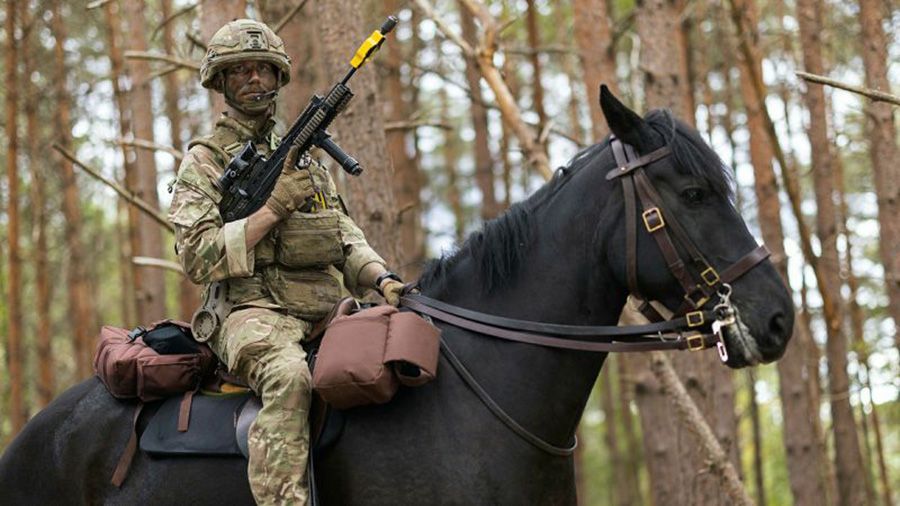
Should these horses ever be used in war, there could come a time when the troopers would need to engage the enemy from the saddle (Picture: MOD)
You don't have to look as far back as you might think for examples of horses used in war. US special forces from Operational Detachment Alpha 595 were sent to the mountains of Afghanistan to fight successfully against the Taliban on horseback, just after the 9/11 attacks in 2001.
Their efforts were depicted in the Hollywood movie 12 Strong and America maintains a mounted capability today.
The first experiment for The Household Cavalry Mounted Regiment took place during their annual summer camp on Longmoor Training Area. Soldiers learned new skills like emergency first aid for horses and tested using camouflage nets on the animals.
As the experimentation continues, we could see the world-famous cavalry horses go from trotting up and down The Mall to finding enemy locations on military operations.


Top Comments
Disclaimer & comment rulesNo comments for this story
Please log in or register (it’s free!) to comment. Login with Facebook