MercoPress. South Atlantic News Agency



Falklands Post is releasing its newest South Georgia-Gentoo Penguin, November 18
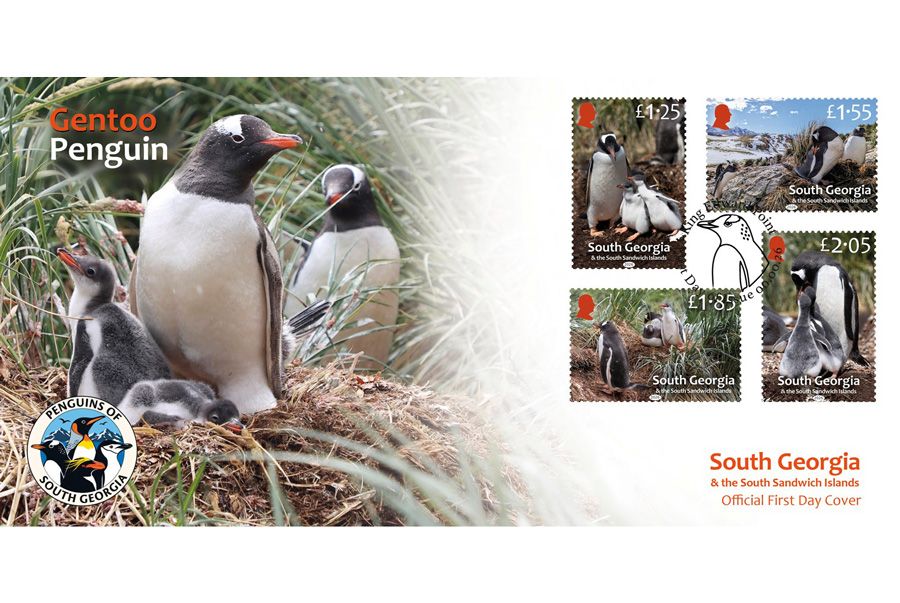 South Georgia Penguins, official first day cover
The gentoo penguin (Pygoscelis papua) is one of South Georgia's most distinctive and widely distributed penguin species. Instantly recognizable by the broad white stripe that extends across the top of its head, together with its bright orange-red bill and pale pink feet, it is the world’s third-largest penguin species.
The distinctive white markings around the head vary subtly from bird to bird, meaning that no two gentoos look quite alike. Adult gentoo penguins typically stand between 75 and 90 centimeters tall and can weigh between 5 and 8 kilograms. Their streamlined bodies and powerful flippers allow them to pursue prey underwater at remarkable speeds, making them among the fastest-swimming of all penguin species, capable of reaching speeds of more than 30 km/h.
Excellent divers, they can descend to depths of over 200 meters in search of food, although most dives are considerably shallower. Globally, the species is classified as Least Concern by the International Union for Conservation of Nature (IUCN), reflecting its relatively large and widespread population.
Gentoos are resident in South Georgia waters all year round. Breeding begins in the austral spring when adults return to coastal breeding areas around South Georgia. Gentoo penguins are remarkably adaptable and although colonies often persist in the same general areas for many years, the exact location and extent of breeding groups can change considerably over time as birds respond to local conditions. Nests are built from stones, grasses and tussac vegetation, carefully arranged into raised platforms. Females usually lay two eggs, which are incubated by both parents for around five weeks. Following hatching, adults share responsibility for feeding and protecting the chicks.
As the young birds grow, they form groups known as crèches, allowing both parents to spend more time foraging at sea. By late summer the fledglings develop their waterproof plumage and leave the colony to begin their life at sea. The waters surrounding South Georgia are among the most productive in the Southern Ocean and provide abundant feeding opportunities for gentoo penguins. Antarctic krill and icefish form large proportions of their diet, although other species of fish, squid and other marine invertebrates are also taken. During the breeding season, adults generally forage relatively close to their colonies, often within 10 to 20 kilometers of the coast, enabling them to return frequently with food for their chicks.
Outside the breeding season they remain in the vicinity of South Georgia's shelf waters but may travel much greater distances in search of prey. Research undertaken by British Antarctic Survey has revealed just how important South Georgia's marine environment is for this species. In 2018, scientists fitted gentoo penguins with satellite tracking devices to better understand their movements at sea. The study showed that birds regularly travelled beyond the Marine Protected Area's original 12 nautical mile (22.2 km) coastal No-Take Zone and, during periods of low krill availability, could overlap with areas used by the commercial krill fishery. In some locations, penguins spent almost half of their recorded foraging time beyond the protected zone while searching for food.
These findings contributed to a better understanding of how gentoo penguins use the waters around South Georgia throughout the year and informed measures adopted during the review of the Territory's Marine Protected Area. In 2019, the coastal No-Take Zone around South Georgia was extended from 12 nautical miles to 30 kilometers from shore, encompassing the foraging range identified by scientists and increasing protection for important feeding areas used by gentoo penguins and other marine predators. Together with ongoing monitoring of breeding success, population trends and diet, such research continues to improve our understanding of one of South Georgia's most familiar and charismatic seabirds and the wider marine ecosystem upon which it depends.
Technical Details
Design Bee Design, Photography £1.25 Camille De Pasquale £1.55 Katie Wells £1.85 Katie Wells £2.05 Camille De Pasquale S/S Camille De Pasquale FDC Katie Wells
Printer Cartor, Process Stochastic lithography; Perforation 13¼ x 13½ per 2cms. Stamp Size 42 x 28mm; Souvenir Sheet Size 109 x 73mm; Release Date 18th November 2026. Production Co-ordination Creative Direction (Worldwide) Ltd


Top Comments
Disclaimer & comment rulesNo comments for this story
Please log in or register (it’s free!) to comment. Login with Facebook