MercoPress. South Atlantic News Agency
Tag: Gabriel Oddone
-
Tuesday, May 26th 2026 - 23:13 UTC
Uruguay signs memorandum with United Kingdom on aerospace, infrastructure, and digital innovation

The Uruguayan government on Monday signed a memorandum of understanding with the United Kingdom to deepen bilateral dialogue and advance cooperation in the aerospace, infrastructure, and digital innovation sectors, in a new step in the rapprochement between the two countries initiated with the visit of Economy and Finance Minister Gabriel Oddone to London in February. The agreement, valid for at least the next four years, was signed between the Uruguayan Ministry of Economy and Finance and the British Foreign, Commonwealth & Development Office.
-
Friday, March 27th 2026 - 23:04 UTC
Uruguay raises fuel prices 7% over Middle East war and shifts to monthly price-setting
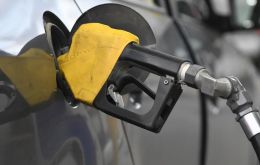
Uruguay's government announced on Friday a 7% fuel price increase effective April 1, as a direct consequence of rising oil prices driven by the U.S.-Israeli war against Iran and the effective closure of the Strait of Hormuz, through which approximately 20% of the world's crude oil supply transits.
-
Thursday, March 26th 2026 - 18:37 UTC
Uruguay: Economy Minister reveals daily U.S. pressure to break commercial ties with China
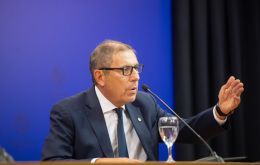
Uruguay's Economy Minister Gabriel Oddone disclosed to business leaders that the United States is exerting “unimaginable” and “unsustainable” pressure on the country to “break” its trade relationship with China, according to the weekly newspaper Búsqueda, citing several attendees at a private meeting with the Confederation of Business Chambers (CCE) held on Tuesday, March 24.
-
Wednesday, March 25th 2026 - 19:52 UTC
Uruguay's economy grew 1.8% in 2025, falling short of official forecasts
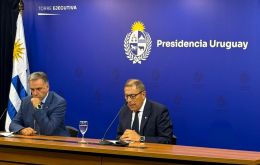
Uruguay's economy grew 1.8% in 2025, according to national accounts data published by the Central Bank of Uruguay (BCU). The result fell nearly a full percentage point below the 2.6% forecast included in the government's budget law and was also lower than the 2.5% estimated by the International Monetary Fund.
-
Wednesday, March 18th 2026 - 11:12 UTC
Government targets faster state processes with new economic reform package
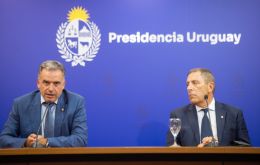
Uruguayan President Yamandú Orsi and Economy Minister Gabriel Oddone said the government will send a competitiveness and innovation bill to Congress on May 31, focused on foreign trade, competition policy, innovation and administrative simplification. The initiative was launched alongside a call for unions, business chambers and academia to submit proposals by April 24.
-
Tuesday, December 23rd 2025 - 11:43 UTC
Uruguay's Economy Minister worried by too much success
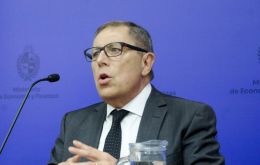
Uruguay's Economy Minister Gabriel Oddone announced Monday that his country's GDP was projected to expand by 2.3% this year. While the figure is slightly lower than initial government forecasts, Oddone emphasized that it represents more than double the average growth rate seen over the past decade.
-
Tuesday, November 25th 2025 - 19:36 UTC
Uruguay's Economy Minister hopeful about EU-Mercosur FTA deal

Uruguay’s Economy Minister Gabriel Oddone said Tuesday in Madrid that he was strongly confident that the long-delayed Free Trade Agreement (FTA) between the European Union (EU) and the Southern Common Market (Mercosur) will be signed shortly. Additionally, he voiced his concerns over the escalating military tensions in the Caribbean.
-
Friday, November 7th 2025 - 10:48 UTC
Brazil grows cheaper for Uruguayans, with price gaps of up to 394%

Brazil continues to offer a cheaper alternative for Uruguayan consumers, with goods costing between two and four times less in border cities. According to a report by the Economic Observatory of the Catholic University of Uruguay (UCU), cited by El País, prices in the Brazilian city of Quaraí are on average 74.4% lower than in neighboring Artigas, marking a widening gap compared to previous months.
-
Tuesday, October 28th 2025 - 09:16 UTC
Uruguay welcomes outcome of Argentina's midterms
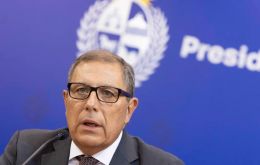
Uruguay's Economy Minister Gabriel Oddone said on Monday that the landslide victory by Argentine President Javier Milei's La Libertad Avanza (LLA) in Sunday's midterm elections would benefit his country with a more stable neighbor, resulting in a favorable environment for the economy.
-
Tuesday, September 16th 2025 - 10:50 UTC
Uruguay: Economy grows 2.1% in 2Q of 2025

Uruguay's economy grew by 2.1% in the second quarter of 2025 compared to the same period in 2024, according to a report released on Monday by the Central Bank (BCU), which also noted a 0.4% growth from the previous quarter.