MercoPress. South Atlantic News Agency



Anniversary of the Battle of the Falkland Islands, 8 December 1914
 The wreck was located upright on the seabed, around 100 miles southeast from Stanley
 The Falkland Islands Government has announced that following the centenary commemoration of the great naval battle and defeat of the Imperial German navy, held in 2014, both the Royal Navy and the Royal British Legion globally concluded the practice of marking the 8th December as a separate remembrance event.
In the Falkland Islands, out of respect for all who lost their lives in Falklands’ waters on that day, an additional ten years of separate commemoration has continued alongside our traditional annual acts of remembrance.
In line with global practice, remembrance of all those who fell in conflict, including the war dead of the 8th of December, will continue to be honored collectively as part of our annual Remembrance Sunday service.

In 2019 the German flagship SMS Scharnhorst was discovered by the Falklands
Maritime Heritage Trust and Falklands’ born marine archeologist Mensun Bound
Whilst there will be no formal event on the 8th December 2025, the day remains a public holiday and members of the public are welcome to commemorate Battle Day in their personal capacity, in whatever way feels meaningful to them.
“We remain deeply grateful to all who paid the ultimate sacrifice and to those who fought in the defense of our Islands and our freedom,” Falkland Islands Government stated.
Events leading to the great Royal Navy victory started on November first, 1914, when a powerful German fleet commanded by the famed admiral Maximilian von Spee destroyed a much smaller Royal Navy force in a naval battle off Coronel, Chile, sinking two British cruisers and killing some 1,800 sailors, including the commander, Rear Admiral Christopher Cradock.
Flush with victory in that first year of World War I, von Spee next planned to destroy the coaling station and radio facility at Stanley in the Falklands on the way to home port in Germany.
The British Admiralty foresaw this development and quickly sent reinforcements to the Falklands, so that, on arriving there on December 8, 1914, von Spee found a much superior British force in port as his fleet approached.
Coronel had been UK’s worst naval defeat for more than a century. Among the forces deployed to seek revenge was a squadron led by two battle cruisers, Invincible and Inflexible—vastly more powerful and considerably faster than Spee’s principal ships, Scharnhorst and Gneisenau.
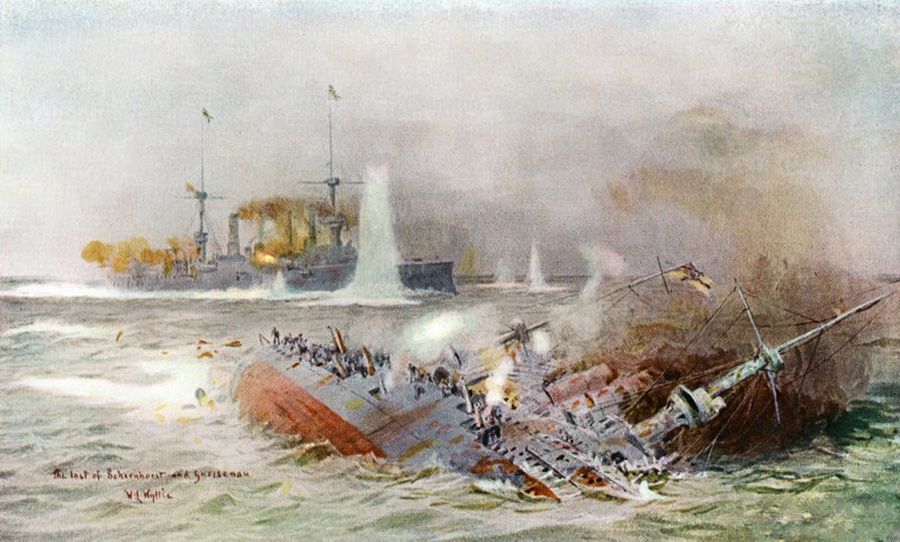
As the Germans came in sight of Port Stanley, they quickly realized that they had sailed into trouble and turned away at full speed to try to escape. Royal Navy ships soon pursued the fleeing enemy. By early afternoon, having steamed southeast of the Falklands, von Spee accepted that escape was impossible and turned back with his two slower big ships while ordering his three faster light cruisers, two colliers, and a hospital ship to flee. Admiral Sir Frederick Doverton Sturdee sent his five cruisers after the smaller German warships (two were sunk later and one escaped) and faced von Spee with his two battle cruisers.
The British gunnery was inaccurate at first, and the Germans maneuvered skillfully, so that it took much of the afternoon before the British made telling hits. Eventually, however, the big British shells struck home. Both German armored cruisers were sunk before about 6:00 PM, with few survivors. Von Spee himself was killed in the fight, as were two of his sons.
The defeat at Coronel had been avenged, and even the German escapee from the battle, Dresden, was caught and destroyed while hiding in Chilean waters three months later.
The Battle of the Falkland Islands has been called the most important naval battle of the war, because it gave a great morale boost to the Allied war effort at a dire time, when the Allies were flailing on the Western Front and were about to get bogged down in Gallipoli. In Germany, von Spee was celebrated as a national hero, and in 1936 the rapidly rearming Nazi German Kriegsmarine launched a pocket battleship named the Graf Spee in his honor. Ironically, that ship was scuttled in the River Plate, not far from Montevideo after having been trapped by the Royal Navy during the Battle of the River Plate in December 1939, twenty-five years to the month from its namesake’s defeat.
In 1927, a monument was erected in Stanley to commemorate the battle, with a representation of the goddess of victory looking out to sea. It is the southernmost monument to World War I on earth.
In 2019 the German flagship SMS Scharnhorst, sunk on December 8, 1914, was discovered in 2019 by the Falklands Maritime Heritage Trust and Falklands’ born marine archeologist Mensun Bound. The wreck was located upright on the seabed, around 100 miles southeast of Stanley, at a depth of approximately 1,600 meters. It was discovered using advanced deep-sea technology, and the discovery was the result of a search that began in 2014, a determination of Mensun since becoming a marine archeologist.


Top Comments
Disclaimer & comment rulesCommenting for this story is now closed.
If you have a Facebook account, become a fan and comment on our Facebook Page!