MercoPress. South Atlantic News Agency



Whales can get lost in noisy oceans, Australian/ Italian scientific report
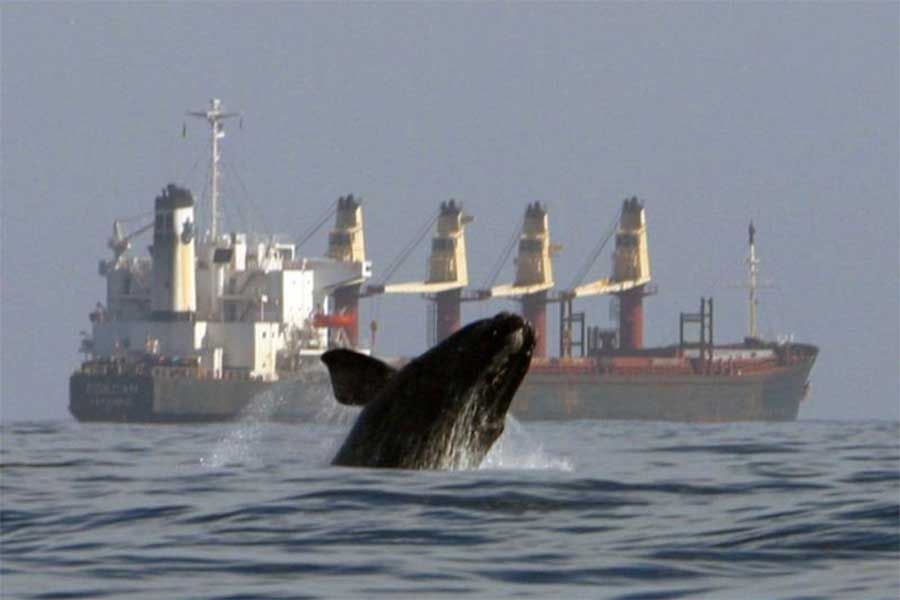 Whales communicate using a remarkable range of sounds, including moans, clicks, and songs that can travel hundreds of kilometers underwater. (pic NOAA)
 The following piece by Derek Davis, an Earth.com staff writer was based on a research undertaken by the University of Melbourne and the Politecnico di Torino on how whales are reacting to noisy oceans.
Shipping traffic, sonar, seismic exploration, and offshore construction are causing significant delays in whole whale migrations and may even prevent some whales from reaching their destinations, according to research from the University of Melbourne, and the Italian Polytechnic di Torino.
The study reveals that ocean noise levels have increased by more than 20 decibels since 1950. This is a 100-fold increase in background noise intensity. This dramatic change is interfering with the complex acoustic communication that whales rely on to navigate vast oceanic distances.
Whales communicate using a remarkable range of sounds, including moans, clicks, and songs that can travel hundreds of kilometers underwater. These vocalizations help them find mates, coordinate with their pods, and navigate toward breeding grounds in tropical waters.
The simulation study suggests that current noise levels, compared to pre-industrial conditions, might be causing a three-to-four-day delay in migration arrivals, representing an extra 20 percent in travel time.
“Whales will avoid uncomfortable environments when there is significant noise, and this could lead to increased journey time or even failure to arrive,” explained Dr. Stuart Johnston, study co-author.
The researchers found that human-made noise affects whales in three distinct ways. First, it reduces their ability to hear acoustic communication among other whales. Second, it generates avoidance behavior when noise becomes sufficiently loud. Third, it lowers the detection of environmental cues that whales use for navigation.
Natural sounds, such as crashing waves and distant icebergs, help whales create mental maps of the ocean. When shipping noise masks these vital acoustic sites, whales struggle to determine their location and direction.
The extra travel time has serious consequences. Pregnant females faced enormous energetic demands during migration, relying solely on reserves built up in feeding grounds. Delays mean less time to reproduce, feed, and nurture young calves.
If noise levels continue to rise, the model suggests that some whales may never reach their destination. The whales could drift off course or avoid loud noise barriers blocking their route.
Ocean noise pollution is a problem we can address. Solutions include designing quieter ships with modified propellers, scheduling offshore construction outside critical migration periods, and exploring alternatives to loud seismic air guns, such as marine vibrators.
“These incredible animals journey up to 10,000 km each year during migration. It’s a huge investment of time and energy. We must find a solution within the shipping and construction industries that don’t come at the cost of whale activity and breeding,” said Dr. Johnston.
The full study was published in the journal ‘Movement Ecology’.


Top Comments
Disclaimer & comment rulesCommenting for this story is now closed.
If you have a Facebook account, become a fan and comment on our Facebook Page!