MercoPress. South Atlantic News Agency
With Milei present and Lula absent, Mercosur and EU sign landmark deal in Asunción
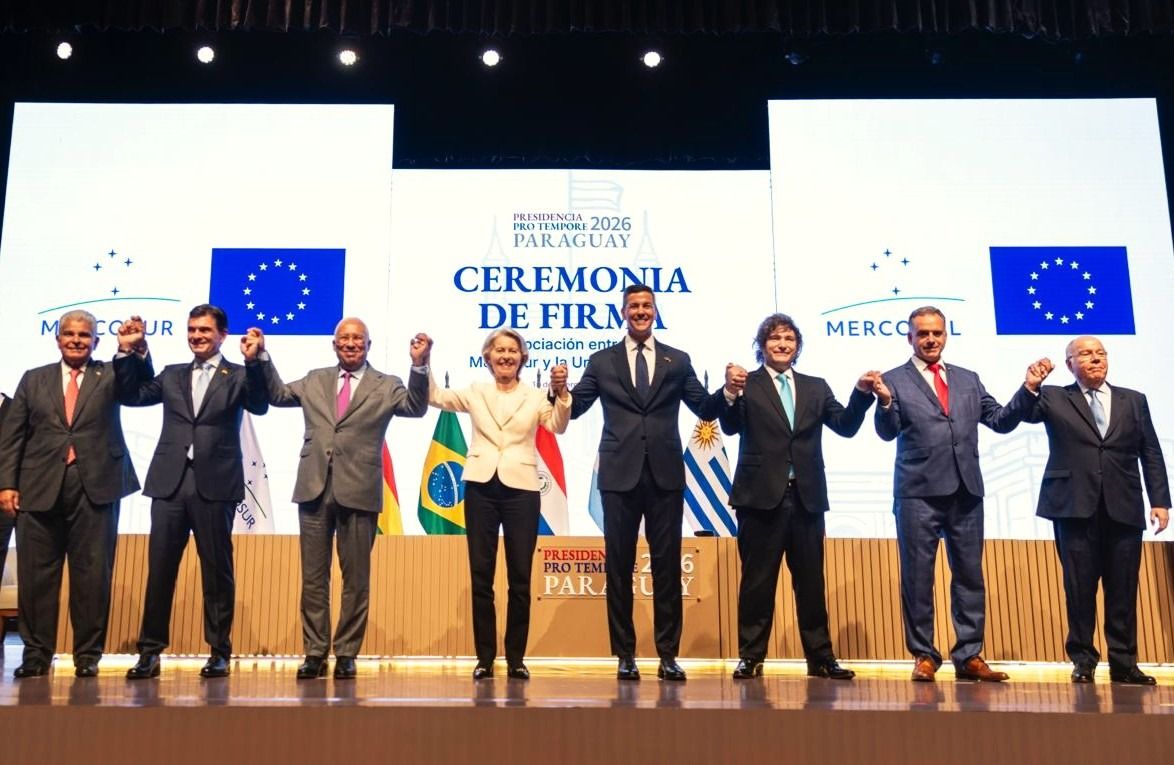 Milei called the deal “the most important achievement in Mercosur’s history” and said Argentina would continue to pursue additional trade initiatives beyond the EU agreement
 The European Union and South America’s Mercosur bloc signed their long-negotiated association and free trade agreement on Saturday in Paraguay, with Argentina’s President Javier Milei attending the ceremony and Brazil’s Luiz Inácio Lula da Silva absent, represented instead by his foreign minister.
The signing took place at Paraguay’s Central Bank theater in Asunción. Under the format agreed for the event, the treaty was formally signed by Mercosur foreign ministers and the EU’s trade commissioner, Maroš Šefčovič.
Leaders’ remarks at the ceremony
Milei called the deal “the most important achievement in Mercosur’s history” and said Argentina would continue to pursue additional trade initiatives beyond the EU agreement, according to Argentine coverage.
EU Commission President Ursula von der Leyen framed the pact as a broader platform for cooperation, while European Council President António Costa said the agreement affects more than 700 million people across both regions.
Paraguay’s President Santiago Peña, hosting the summit as Mercosur’s rotating chair, argued that Europe and South America should “unite” in a “complex, unstable” world, as reported by local outlets.
What the deal does
The agreement aims to phase out tariffs on more than 90% of bilateral trade and would create one of the world’s largest integrated free trade areas, with a combined market of roughly 720 million people.
EU–Mercosur trade reached about €111 billion in 2024, with EU exports focused on machinery, chemicals and other industrial goods, while Mercosur exports are dominated by agricultural products and minerals.
Lula’s absence and the ratification challenge
Lula’s decision not to attend became a focal political detail. AFP reported—citing a presidency source—that the Brazilian president would not travel to Paraguay for the signing. Brazil would be represented by its foreign minister, even as Lula publicly defended the agreement’s economic potential.
Ratification remains uncertain. Reuters said the deal still needs approval by the European Parliament and by the legislatures of Mercosur’s full members (Argentina, Brazil, Paraguay and Uruguay). European farmers and environmental groups have raised concerns about increased South American imports and environmental impacts, including deforestation.
Signature vs. entry into force
On the EU side, the Council adopted decisions authorising the signature of the comprehensive partnership agreement and an Interim Trade Agreement, designed to advance the commercial pillar as the broader treaty proceeds through political steps.
Regional reporting in South America highlighted that implementation details—technical standards, sectoral safeguards and domestic adjustment measures—will be shaped during the ratification phase and subsequent regulatory work in each member state.
International context
AP described the signing as taking place amid heightened global trade tensions, with the EU seeking to strengthen its strategic and economic footprint in South America.
EFE likewise presented the agreement as the culmination of 26 years of negotiations, with the process still facing political hurdles and internal debates—particularly in Europe—before it can take effect.


Top Comments
Disclaimer & comment rulesCommenting for this story is now closed.
If you have a Facebook account, become a fan and comment on our Facebook Page!