MercoPress. South Atlantic News Agency


UK investment in Antarctica underlines role as a leading polar research nation
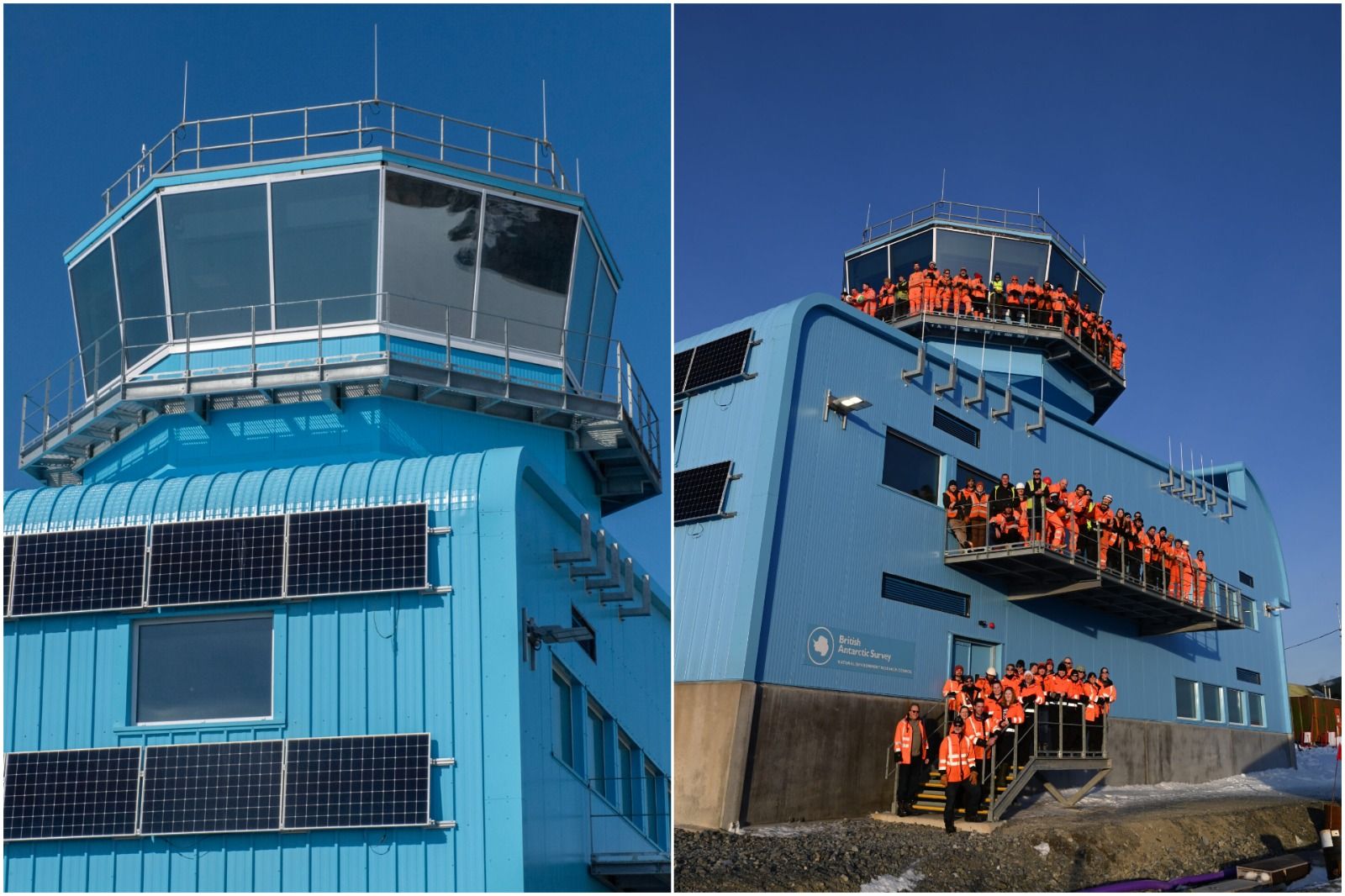 Operations tower and team outside the new Discovery Building at Rothera Research Station, featuring solar panels on the façade. Credit: Pete Bucktrout and David Ganiford, BAS.
 A major new British Antarctic Survey (BAS) facility at Rothera Research Station is being presented as evidence of the UK’s standing in polar research. The £100 million Discovery Building—together with a new services network at Rothera—has been formally opened by BAS Director Professor Dame Jane Francis, completing what BAS describes as the largest UK construction project ever carried out in Antarctica.
With about 4,500 square metres of internal space and more than 100 rooms across two floors, the Discovery Building is intended to become the operational core of the UK’s main Antarctic research station. BAS says it will provide essential services including power generation, drinking water and communications, replacing older infrastructure previously spread across multiple structures. The new set-up is designed to improve safety and efficiency for staff and to cut carbon emissions at the station, while supporting scientific work ranging from ice-sheet stability to marine ecosystems.
Rothera has served as the UK’s gateway to Antarctica since 1975. Over time, it has hosted BAS programmes, projects led by UK universities and work with international partners, including the Netherlands’ Dirck Gerritsz laboratory, alongside long-running environmental monitoring facilities.
Inside the new building, BAS highlights an operations tower responsible for managing air access to Rothera and routes into the “deep field,” central storage backed by a digital inventory system, a vehicle garage for maintaining the station fleet, and an energy centre that supports station-wide operations. BAS says teams preparing for deep-field expeditions will now be able to plan and equip under one roof.
The project was commissioned by the Natural Environment Research Council (NERC), part of UK Research and Innovation (UKRI), as a component of the government-funded £670 million Antarctic Infrastructure Modernisation Programme. BAS says construction began in 2019 and was completed on schedule and within the anticipated budget. The wider programme—described as the biggest government investment in Antarctic science infrastructure since the 1980s—has also delivered the UK polar research ship RRS Sir David Attenborough (launched in 2021), upgraded wharfs at Rothera and King Edward Point, and extended and improved Rothera’s runway.
Officials framed the investment as part of a long-term commitment to Antarctic science and a sustained UK presence on the continent, arguing that polar research contributes to understanding global climate systems and ocean change with worldwide impacts. The ongoing infrastructure push is also linked to the UK Government’s recently published UK Antarctic Strategy.
Lord Patrick Vallance, Minister of State for Science, Research, Innovation and Nuclear, said: “Antarctic research is essential to understanding how changing climate patterns could affect our planet in the years to come, from food security to flooding risk – so together, we can act.
“The UK has long been a leader in polar science and this government investment in modern, state of the art facilities will enable current and future generations of researchers to tackle shared challenges with our international partners.”
Professor Dame Jane Francis said: “The fantastic new Discovery Building and our program of modernization at Rothera offer UK and international researchers the facilities needed to enable science and operations at Rothera and in the deep field for decades to come. We’re incredibly excited to see the building come to life on our 50th anniversary. It’s been an intense period of work in the most challenging construction site in the world – I look forward to the opportunities it offers for collaborative polar science and operations in Antarctica.”
BAS describes the Antarctic Infrastructure Modernisation Programme (AIMP) as a long-term, government-funded effort across the Polar Regions, delivered with multiple partners including Hugh Broughton Architects, BAM, Ramboll, Sweco, G&A Barnie Group Ltd, Turner and Townsend and Norr Ltd. BAS says it has drawn on partner expertise and supply chains since 2017 to deliver engineering work in extreme Antarctic conditions.


Top Comments
Disclaimer & comment rulesCommenting for this story is now closed.
If you have a Facebook account, become a fan and comment on our Facebook Page!