MercoPress. South Atlantic News Agency



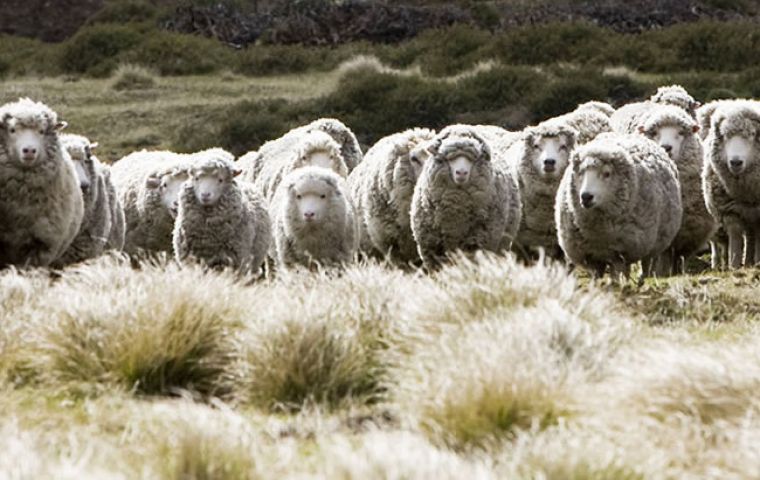
Falklands Agriculture: mainly wool, exceptionally clean and white
 43% of farms are accredited under the Responsible Wool Scheme (RWS) plus a small number of farms have organic certification with Australian Certified Organic
 Much of the Falkland Islands’ land mass is used for agriculture. The main product is wool, with an EU approved abattoir producing mutton and lamb for local and export markets and beef for local markets.
The Falkland Islands have 70 (according to the 2022/23 FI Farm Statistics) farms, which are mostly family owned, totalling 1,143,596ha of land. In total these farms graze just under half a million sheep of various breeds including; predominantly Polwarth/Merino cross with increased Merino genetics and a small number of Texel, Corriedales, SAMM and others. Approx. 50 of these farms also have a total cattle population just over 3,000 which consist mainly of Aberdeen Angus, Hereford, Red Devon and Murray Grey breeds.
The environment here produces exceptionally clean and white wool for which the Falkland Islands do have a very good reputation in their wool trading. The approx. annual wool production for the Falkland is 1,500,000 kg of greasy wool with an average weight of 3.71 kg and a fiber diameter range of 16.8-28µm. 43% of farms are accredited under the Responsible Wool Scheme (RWS) plus a small number of farms have organic certification with Australian Certified Organic (ACO) which is a step towards marketing these attributes internationally.
The uniqueness of the environment also throws up its challenges, and it is towards these that the Department of Agriculture (DoA) directs much of its advisory and research efforts and resources.
The DoA provides research and extension support to improve profitability and sustainability of farming businesses. A profitable farming sector will support a population living outside Stanley and provide valuable produce for both domestic and export purchase. It is an essential part of the Island Plan. The goals of the FIP scheme are to improve profitability by assisting farmers to develop long term solutions to the problems of poor winter nutrition and low wool income. It is achieving this through enabling grazing management systems which will better nourish the sheep, improving pastures and crops and accelerating genetic progress.
We aim to improve genetics of sheep and cattle herds throughout the Falklands with Artificial Insemination and embryo transfer programs. Using the National Stud Flock we also aim to improve reproductive performance of sheep flocks.
Sound health and welfare of farm animals is important, and apart from the normal pressures some further restraints imposed by those choosing the organic path will create further challenges for our veterinary section.

Top Comments
Disclaimer & comment rulesCommenting for this story is now closed.
If you have a Facebook account, become a fan and comment on our Facebook Page!