MercoPress. South Atlantic News Agency


Lula and Chile’s president-elect Kast meet for the first time in Panama ahead of ‘Latin Davos’ forum
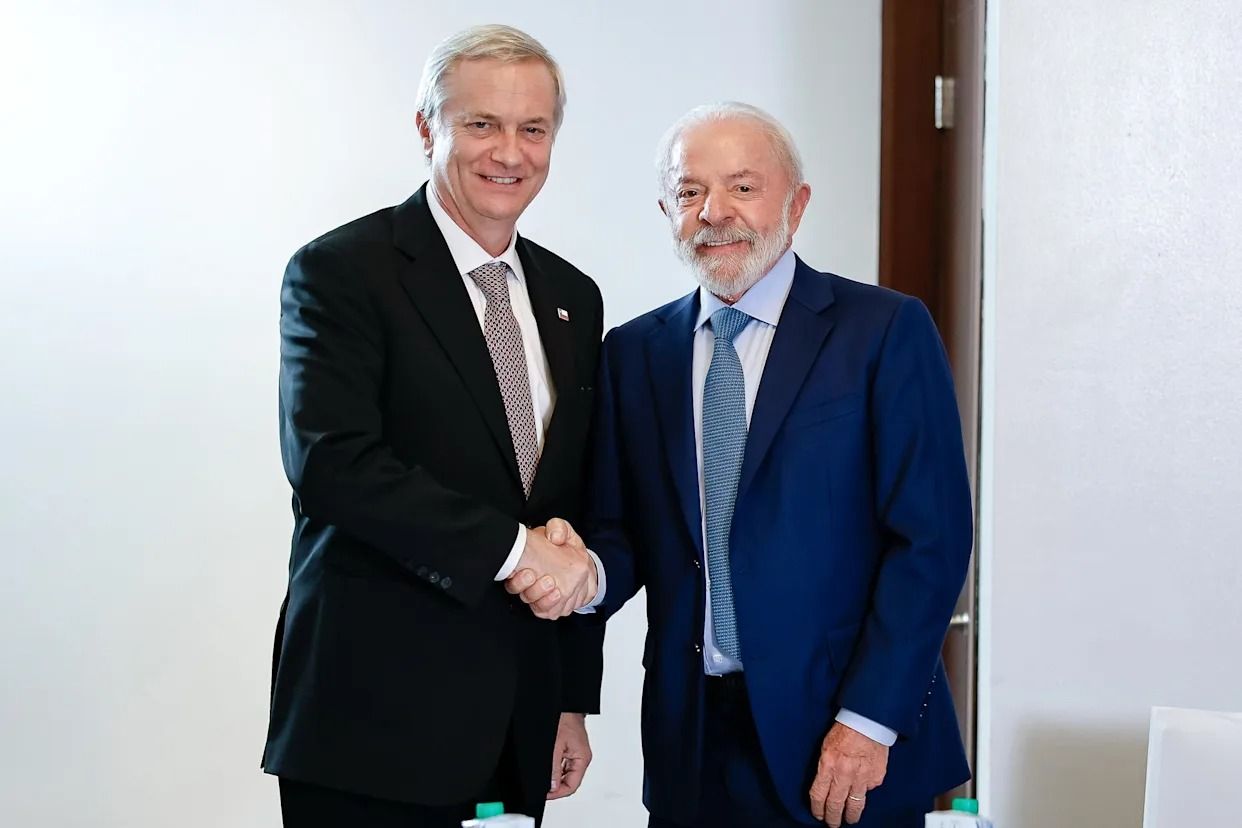 Kast argued that cooperation between Chile and Brazil “can lead the change our region needs”
 Brazil’s President Luiz Inácio Lula da Silva and Chile’s president-elect José Antonio Kast held their first bilateral meeting in Panama on Tuesday, shortly after arriving for the International Economic Forum for Latin America and the Caribbean — an event promoted by organizers and regional media as a “Latin Davos.”
The talks were held behind closed doors and brought together leaders from opposing political camps. After the meeting, Kast described it as “constructive” and said South America faces “enormous” challenges in security, economic progress and poverty reduction. He argued that cooperation between Chile and Brazil “can lead the change our region needs,” in a post on X.
Brazil’s Foreign Ministry had framed such contacts as normal on the sidelines of a gathering that will bring together multiple heads of state. “We maintain dialogue with absolutely all presidents in the region and our relations do not depend on the political cycle,” said Gisela Padovan, the ministry’s secretary for Latin America and the Caribbean, noting that Brazil was already in contact with Chile’s president-elect.
Forum draws eight top-level leaders
The forum runs in Panama City on January 28–29 and is expected to convene presidents, business leaders and multilateral institutions. CAF said the opening session will feature Panama’s President José Raúl Mulino, Lula, Bolivia’s President Rodrigo Paz, Ecuador’s President Daniel Noboa, Guatemala’s President Bernardo Arévalo and Jamaica’s Prime Minister Andrew Holness, with Kast attending as Chile’s president-elect.
Regional reporting has highlighted an agenda focused on growth, macroeconomic stability, investment, the energy transition, digital transformation and social cohesion, as the organizers seek to position the forum as a recurring high-level platform for Latin America and the Caribbean.
No official readout of the Lula–Kast discussion was released, but Kast’s public remarks pointed to security and economic cooperation as core themes, underscoring a broader pattern of cross-ideological engagement among governments across the region.


Top Comments
Disclaimer & comment rulesCommenting for this story is now closed.
If you have a Facebook account, become a fan and comment on our Facebook Page!