MercoPress. South Atlantic News Agency



“The Moon became a sponge of light”: Artemis II astronauts share their observations
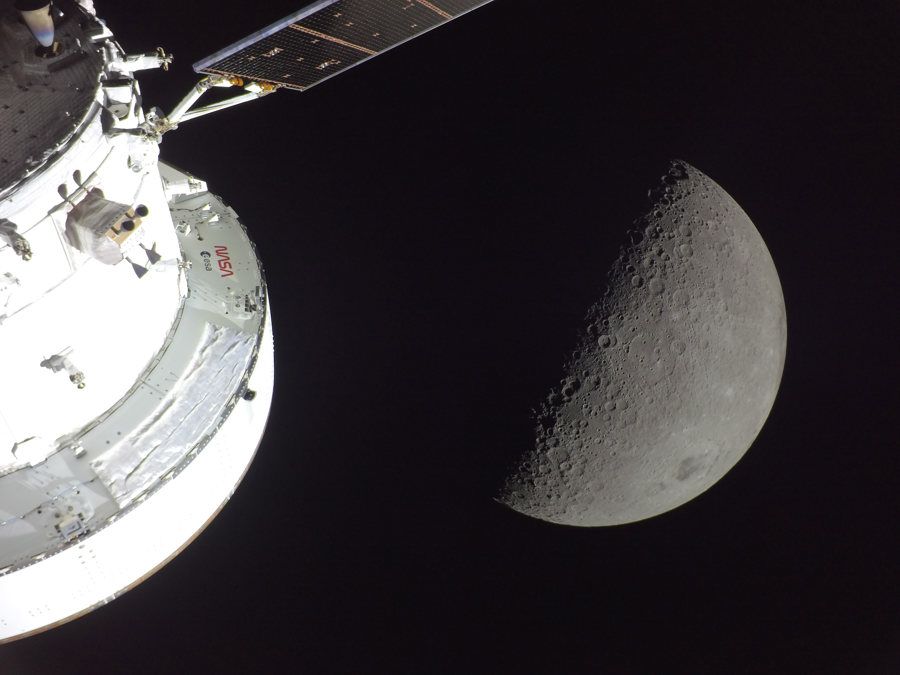 Photo: NASA
 The four Artemis II astronauts shared their lunar flyby observations with NASA's science team on Tuesday, reporting meteoroid impact flashes, levitated lunar dust, unexpected surface colors and an unprecedented total solar eclipse witnessed from the Moon's orbit.
The crew spoke with Kelsey Young, NASA's Science Mission Directorate lead for lunar science objectives, to document their recollections while still fresh — information that will help plan future missions aiming to land astronauts on the Moon in 2028.
Commander Reid Wiseman and Canadian astronaut Jeremy Hansen reported seeing at least four impact flashes, visible glints of light caused by meteoroids striking the lunar surface. Mission specialist Christina Koch observed levitated lunar dust: fine particles of regolith lifted from the surface by electrostatic forces, a phenomenon previously detected during Apollo missions but never before observed by astronauts from this vantage point.
Koch and pilot Victor Glover described the moment Earth appeared from behind the far side of the Moon after a 40-minute communications blackout. “The Moon became a sponge of light,” Koch said. “It was reflecting the light and it lit up when Earth got close enough” to the spacecraft's field of view.
Glover recounted that upon emerging from the far side, the Moon was “so bright that it looked out of place. The gray of the Moon and the black of space seemed to blend together.” The astronauts agreed the surface displayed “matte and brown” tones, unlike the usual gray perceived from Earth.
Eclipse, records and a crater like the Grand Canyon
The crew also witnessed a roughly one-hour total solar eclipse from their position above the Moon — the first ever observed by humans from the lunar vicinity. During the eclipse they were able to study the solar corona and observe planets including Venus, Mars and Saturn with the naked eye.
The flyby brought the Orion spacecraft to a closest approach of approximately 4,067 miles above the lunar surface and set a new crewed spaceflight distance record: 252,756 miles (406,771 kilometers) from Earth, surpassing the mark set by the Apollo 13 mission in 1970. With Glover as the first Black astronaut, Koch as the first woman and Hansen as the first non-American to travel this far, the mission accumulated several historic milestones, CNN reported.
The Sun's position allowed the astronauts to observe far-side formations never before seen by human eyes under sunlight. The Orientale Basin, roughly 600 miles wide, was a primary target. “I made some correlations and mentioned it was like looking at the Grand Canyon, where you can see different layers,” Glover recounted. The crew provisionally proposed naming two craters: “Integrity,” after their spacecraft, and “Carroll,” in memory of commander Wiseman's late wife. The names will be submitted to the International Astronomical Union.
The astronauts are now headed back to Earth, where they expect to splash down on Friday, April 10, in the Pacific Ocean off San Diego, California. Artemis II launched on April 1 from Cape Canaveral for a ten-day mission that marked humanity's return to lunar orbit after more than half a century.


Top Comments
Disclaimer & comment rulesCommenting for this story is now closed.
If you have a Facebook account, become a fan and comment on our Facebook Page!