MercoPress. South Atlantic News Agency

Orion capsule splashes down in Pacific, completing Artemis II, first crewed Moon flight in over 50 years
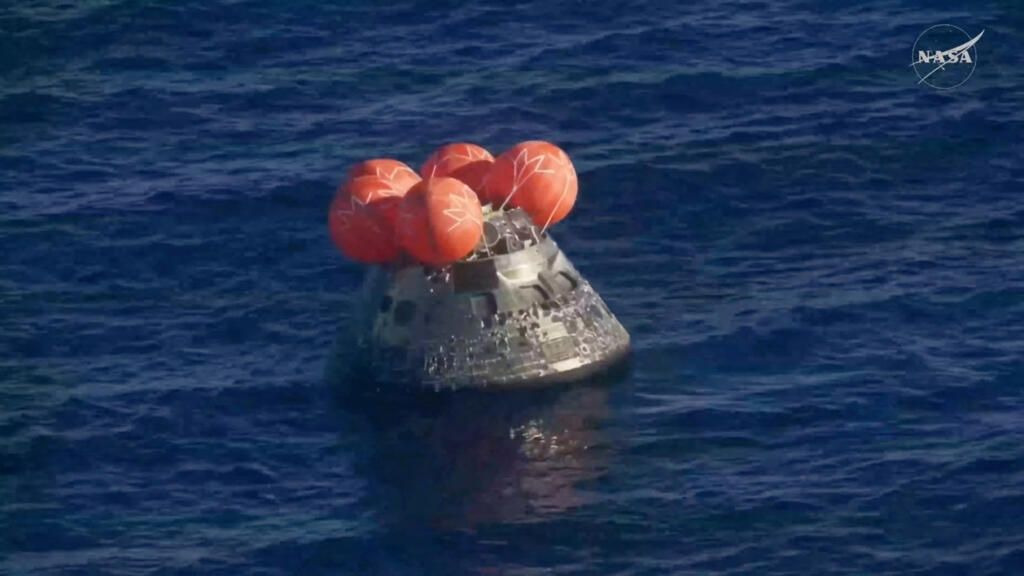 Teams from NASA, the U.S. Navy and Air Force, deployed from the USS John P. Murtha, proceeded with crew recovery
 NASA's Orion capsule splashed down at 8:07 p.m. ET on Friday (00:07 GMT Saturday) in the Pacific Ocean off the coast of San Diego, California, completing the Artemis II mission, the first crewed flight to the Moon since Apollo 17 in December 1972.
The four crew members — Commander Reid Wiseman, Pilot Victor Glover, Mission Specialist Christina Koch (all NASA astronauts) and Mission Specialist Jeremy Hansen of the Canadian Space Agency — returned to Earth after a 10-day journey covering more than 700,000 miles. “This is a perfect descent for Integrity,” Mission Control said upon confirming splashdown, using the name the crew gave to their capsule.
The mission launched on April 1 from Kennedy Space Center in Florida aboard the SLS (Space Launch System) rocket. The crew flew past the far side of the Moon on April 6, reaching the greatest distance ever traveled by a crewed mission. During the journey, the astronauts witnessed a solar eclipse from the lunar perspective, a phenomenon Pilot Glover described as “one of the greatest gifts of that part of the mission.”
Welcome home Reid, Victor, Christina, and Jeremy!
— NASA (@NASA) April 11, 2026
The Artemis II astronauts have splashed down at 8:07pm ET (0007 UTC April 11), bringing their historic 10-day mission around the Moon to an end. pic.twitter.com/1yjAgHEOYl
Atmospheric reentry was one of the most critical moments of the flight. The capsule entered at 400,000 feet traveling at 35 times the speed of sound, generating temperatures of approximately 2,700 degrees Celsius on the heat shield. For roughly six minutes, Orion passed through a planned communications blackout as plasma enveloped the spacecraft. Beginning at 22,000 feet, a sequence of 11 parachutes deployed, slowing the capsule from about 300 miles per hour to approximately 17 miles per hour for splashdown.
Entry Flight Director Rick Henfling provided the mission's final numbers at a post-splashdown news conference: the crew traveled 700,237 miles, reached a peak velocity of 24,664 miles per hour and landed less than a mile from the target point, CNN reported.
Teams from NASA, the U.S. Navy and Air Force, deployed from the USS John P. Murtha, proceeded with crew recovery. The astronauts were extracted from the capsule and flown by helicopter to the ship for medical evaluations. They were subsequently to be taken to San Diego before traveling to Johnson Space Center in Houston.
NASA Associate Administrator Amit Kshatriya acknowledged the technical teams at a press conference: “You'll hear from the astronauts tomorrow, but tonight belongs to the team that built the machine they rode in.” President Donald Trump congratulated the crew and declared: “Next stop, Mars.”
Artemis II is the second flight of the Artemis program, successor to Apollo. The next mission, Artemis III, is planned to land astronauts on the lunar surface for the first time since 1972.


Top Comments
Disclaimer & comment rulesCommenting for this story is now closed.
If you have a Facebook account, become a fan and comment on our Facebook Page!