MercoPress. South Atlantic News Agency



After 25 years of negotiation, the Mercosur-EU agreement takes effect this Friday
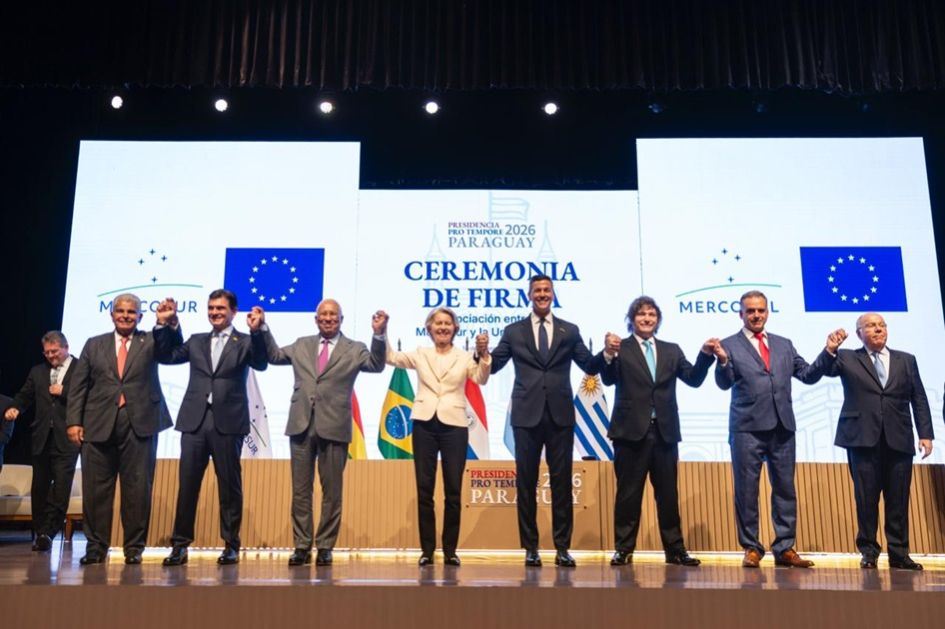 The accord was signed on January 17th in La Asunción, Paraguay
 The association agreement between Mercosur and the European Union (EU) enters provisionally into force on Friday May 1, after more than a quarter-century of negotiations, in what constitutes one of the world's most ambitious trade deals and the largest reciprocal opening ever finalised by the South American bloc. The final signing took place on January 17 in Asunción and, although final ratification by the European Court of Justice and subsequent approval by the European Parliament remain pending, provisional entry into force allows the immediate start of tariff reductions covering 95% of Mercosur products and 91% of EU products.
The phase-out process will unfold over staggered timelines generally ranging from 12 to 15 years, with longer exceptions of up to 30 years for the automotive sector. According to the European Commission, tariffs will be reduced to zero immediately for a wide range of products: for Mercosur consumers, this will include European white wines, Greek and Italian kiwis, tools, costume jewelry, printers, and various manufactured goods. Other goods, such as spirits, red wines, chocolates, and cheeses, will see gradual reductions over periods of four to fifteen years. In return, more than 5,000 Mercosur products will enter the European market with zero tariffs, representing over 80% of Brazilian exports to the bloc, according to data from Brazil's National Confederation of Industry.
The agreement enters into force without the four Mercosur partners having reached consensus on the internal distribution of preferential export quotas allocated by the EU for sensitive products such as beef, rice, and honey. Uruguay's Economy and Finance Minister Gabriel Oddone confirmed on Wednesday that “there is no agreement” and anticipated the application of the FIFO system, known informally as the “law of the jungle”: the first exporter to arrive at a European port with a certificate of origin and successfully match it with an available quota certificate accesses the preferential tariff; later arrivals must wait.
National positions illustrate the depth of the disagreement. Uruguay and Argentina propose distributing quotas based on each product's current trade with the EU; Paraguay calls for an equal 25% allocation for each partner across all quotas; Brazil, in contrast, proposes using global trade as the base, which in practice would grant it the majority of the quotas. The director of the Trade Policy Advisory Office of Uruguay's Economy Ministry, Juan Labraga, said that the “most optimistic” scenario would be reaching an agreement this year to distribute quotas starting in 2027, with the deadline falling in September, although he acknowledged that “in Mercosur time, September is tomorrow.”
For Uruguay, the absence of internal quota distribution is not entirely unfavorable. Oddone stated that the country “is not in a bad position” under the FIFO regime, thanks to consolidated commercial channels with Europe, particularly in beef. That quota, valued by Uruguay's Livestock Ministry at approximately $90 million, is the country's most relevant export item, followed by rice and honey. The Uruguay Exporters' Union and other business associations have stressed, however, that Uruguay's main challenge in the medium term will be defining its competitive differentials clearly in order to attract European investment expected to flow under the treaty.
The Inter-American Development Bank (IDB) estimated in a recent study that Mercosur imports from the EU will grow 38% over the next fifteen years, while South American exports to Europe will rise substantially in agricultural and agro-industrial sectors. Uruguayan exports to the EU reached $1.35 billion in 2025 — 8% of the country's total — and the main projected beneficiaries are beef, dairy products, rice, honey, and logistics services linked to bilateral trade.
The treaty also establishes the protection of more than 350 European geographical indications — including champagne, feta cheese, prosecco, and Parma ham — and 224 Mercosur designations, including Brazilian cachaça and Argentine Patagonian lamb. The entry into force coincides with an international scenario marked by rising protectionism and tariffs applied by the United States, a context that has accelerated European interest, particularly German, in securing access to the South American market.


Top Comments
Disclaimer & comment rules-

Read all commentsMercosur: Economically relevant but politically inept.
May 01st, 2026 - 09:39 am 0Commenting for this story is now closed.
If you have a Facebook account, become a fan and comment on our Facebook Page!