MercoPress. South Atlantic News Agency


Fujimori takes office in Peru and announces the armed forces will join the fight against crime
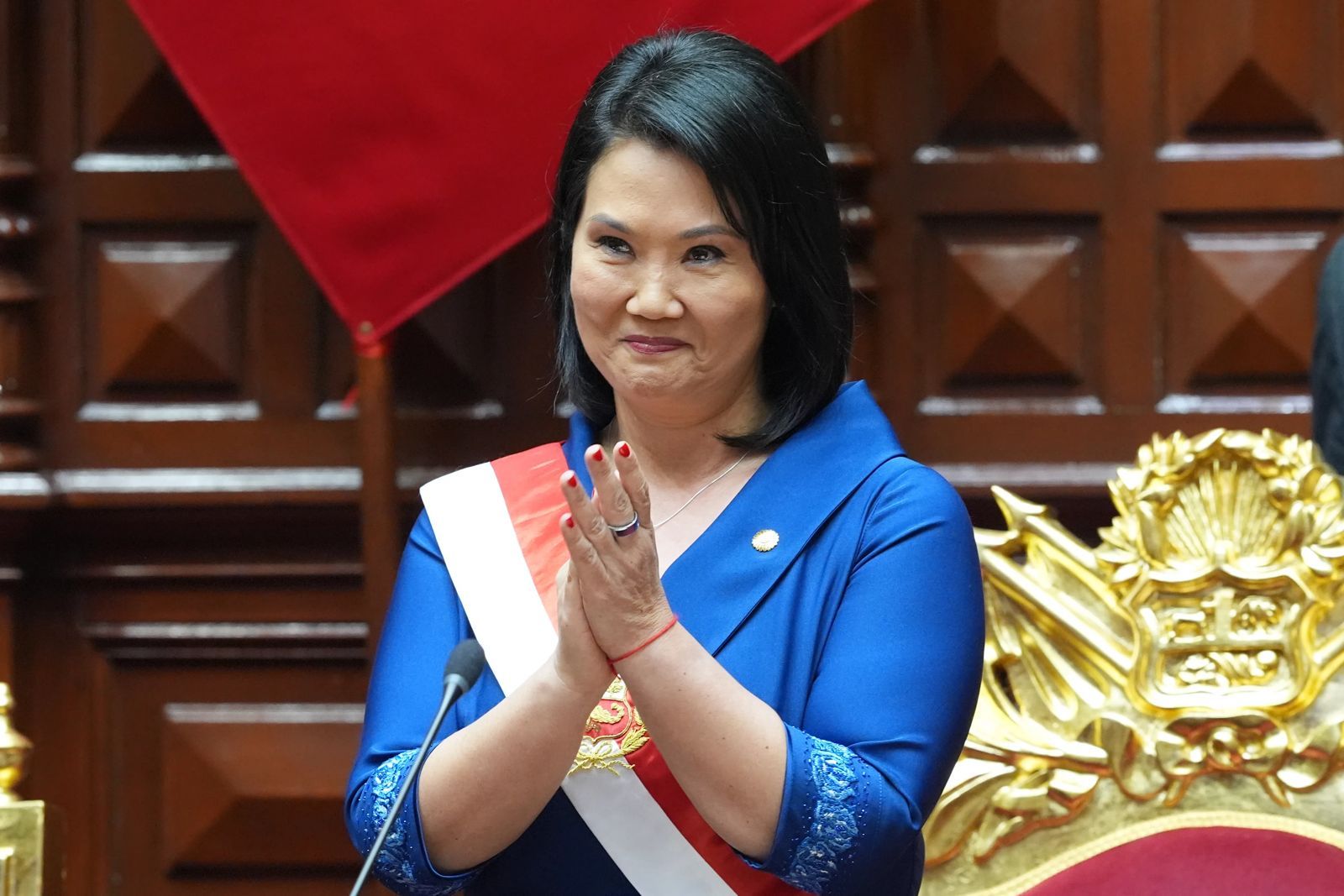 At 51, Fujimori is the first woman to reach Peru's presidency through the popular vote
 Keiko Fujimori was sworn in as president of Peru on Tuesday and announced that the armed forces will temporarily assume internal control during states of emergency to confront organized crime, in coordination with the National Police. The ceremony took place at Congress on July 28, the anniversary of the country's independence, opening a five-year term.
“We will use every tool the Constitution provides us. During states of emergency, the armed forces will temporarily assume internal control in close coordination with the national police until the authority of the state is fully restored and those territories are returned to citizens,” the president said in her first address to Parliament, in which she placed particular emphasis on extortion.
At 51, Fujimori is the first woman to reach Peru's presidency through the popular vote. She takes office on her fourth attempt, after three consecutive runoff defeats, having beaten left-wing candidate Roberto Sánchez by fewer than 50,000 votes in June's runoff.
In her speech she pledged to govern for “all Peruvians, without exception,” with particular attention to those who “have remained for too long on the margins of the country's growth and progress,” and said she inherits a “state adrift” in “a country marked by abandonment.” She said she had not come “to offer miracles, but method and a clear route,” and set as her first priorities citizen security and preparation for the El Niño phenomenon, for which she announced a contingency plan aimed at moving “into the era of timely prevention.”
The inauguration marks the return to power of the movement founded by her father, Alberto Fujimori, who governed between 1990 and 2000, was convicted of crimes against humanity and of corruption, and died in 2024 at liberty following a humanitarian pardon. The new president publicly invoked his memory on the day of her inauguration. That legacy continues to divide Peruvian society: outside Congress, human rights organizations, student groups, and victims' relatives called a national mobilization. Among them are the relatives in the La Cantuta and Barrios Altos cases, for which her father was convicted. “We are not going to sit down and talk with her and we will never publicly recognize her as president,” said Gisela Ortiz, a relative of one of the victims and a former culture minister.
The day began with the traditional Te Deum at Lima's Cathedral Basilica, where Cardinal Carlos Castillo used his homily to criticize those who “use religion for their partisan position and thus obtain votes,” and remembered the victims of state repression in recent years.
Three cabinet appointments were confirmed: Luis Galarreta as president of the Council of Ministers, Elmer Cuba at Economy and Finance, and Carlos Espá at Foreign Affairs. The final composition will be among the first signals of the new government's direction.
The ceremony drew a broad international presence, led by Spain's King Felipe VI and US Deputy Secretary of State Christopher Landau. Attendees included presidents Javier Milei of Argentina, Yamandú Orsi of Uruguay, Santiago Peña of Paraguay, Daniel Noboa of Ecuador, José Raúl Mulino of Panama, and Nasry Asfura of Honduras, along with delegations from China and Japan. Mexico, Brazil, and Venezuela did not send high-level representation.
Fujimori takes office after a decade of institutional instability in which Peru had nine presidents, most of them serving interim terms.


Top Comments
Disclaimer & comment rulesCommenting for this story is now closed.
If you have a Facebook account, become a fan and comment on our Facebook Page!