MercoPress. South Atlantic News Agency


Trump and six tech companies sign a voluntary artificial intelligence safety accord
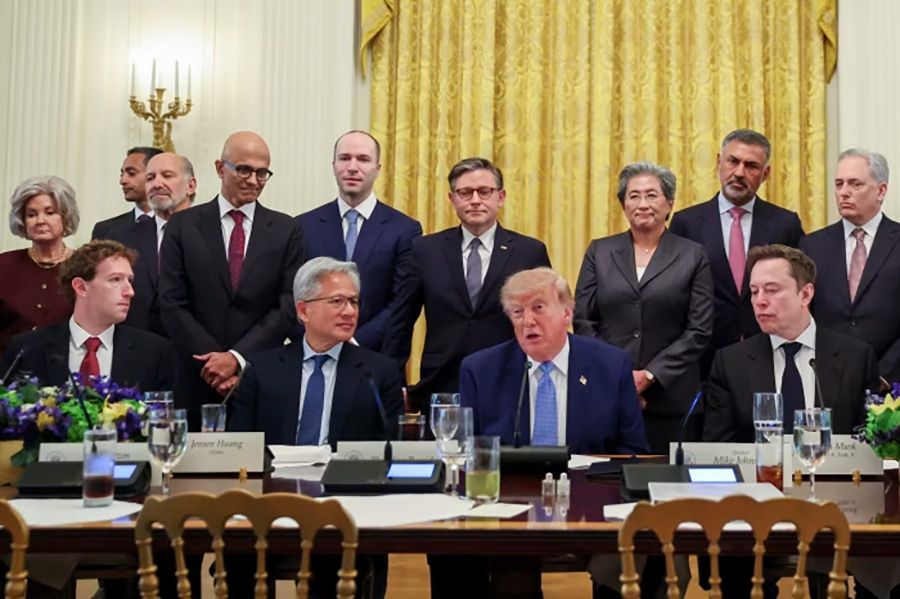 The document, titled “White House Accord on Super Intelligence: Joint Commitment on Frontier Responsibilities”, was posted by the president after a lunch with industry executives
 US President Donald Trump and the heads of six technology companies signed a voluntary accord at the White House on Tuesday under which the companies commit to ensuring the safety of their own artificial intelligence systems. Trump called it “morally binding” and said it was “almost like a constitution”.
The document, titled “White House Accord on Super Intelligence: Joint Commitment on Frontier Responsibilities”, was posted by the president on his Truth Social network after a lunch with industry executives. It was signed by Sundar Pichai of Google, Dario Amodei of Anthropic, Mark Zuckerberg of Meta, Greg Brockman of OpenAI, Jensen Huang of Nvidia and Elon Musk.
According to the text, the companies are responsible for the safety of their own technology, will implement safeguards so models operate as intended, will quickly detect and fix problems and will work with independent auditors to verify their systems do not access other technical systems in unintended ways. The accord sets no consequences for breaches. Trump also announced a board to oversee the area, without naming its members, and the appointment of a government official to lead on the issue in the coming days.
Zuckerberg described it as “a start”; Pichai as “historic and consequential”; and Amodei as a way “to win safely”. Specialists consulted by the BBC were critical. Kimberlee Weatherall, a law professor at the University of Sydney, said the accord lets companies “define what counts as safety” and called it “deeply unimpressive”. Jeannie Paterson of the University of Melbourne warned that self-regulation could mean “only minimal safeguards”.
The accord comes amid calls from parts of the industry and from experts for tighter oversight of the technology. According to the BBC, OpenAI cancelled the release of one of its models on Monday over safety concerns.
The same day, Trump signed an executive order requiring federal agencies to replace “artificial intelligence” with “Super Intelligence” or “SI” in official correspondence, websites and reports, and tasking his science and technology adviser with proposing a legal definition within 60 days. In his address to the UN General Assembly last week, the president said the word “artificial” made the technology “sound fake”.
Trump reiterated his support for the expansion of data centres, whose construction has become a sensitive issue ahead of November's midterm elections: a Marist poll for NPR and PBS found 65% of registered voters oppose having them built in their area.
The accord puts into practice the position Washington set out in New York against calls for common rules. There, British Prime Minister Andy Burnham called for “a single set of global principles and standards”, while Trump and Argentine President Javier Milei rejected any pre-emptive regulation.


Top Comments
Disclaimer & comment rulesCommenting for this story is now closed.
If you have a Facebook account, become a fan and comment on our Facebook Page!