MercoPress. South Atlantic News Agency


Scientific workshop on Illex Squid in Vigo with the participation of Falkland Islands
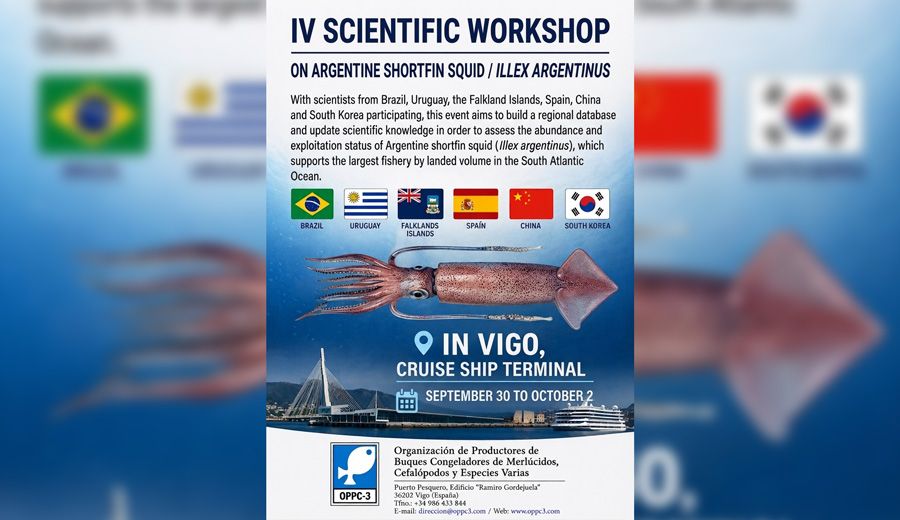 The workshop forms part of an international scientific cooperation process that began with meetings held in Chile and Panama and continued with a scientific gathering in Bangkok
Argentine unions linked to the fishing, maritime and port industries have complained bitterly to the International Transport Workers Federation against a workshop on the Shortfin Squid (Illex Argentinus) organized by OPPC3, in Vigo with the suppot of the Sustaianble Fisheries Partnership, and to which Argentina allegedly has not been invited, but it does include the Falkland Islands.
OPPC3 stands for Organization of Producers of Freezer Trawlers for Hake, Cephalopods and Other Species. OPPC3 is based in Vigo, was started in 1986 when Spain joined the EU and represents approximately 60% of the European Union's freezer vessel fleet specializing in species like hake and squid.
The workshop with scientists from Brazil, Uruguay, the Falkland Islands, Spain, China and South Korea participating, aims to build a regional database and update scientific knowledge in order to assess the abundance and exploitation status of Argentine shortfin squid (Illex argentinus), which supports the largest fishery by landed volume in the South Atlantic Ocean.
Under the name of 4th International Scientific Workshop on Argentine shortfin squid (Illex argentinus) the event brought together scientists specializing in fisheries biology, population dynamics and stock assessment from the above mentioned countires.
The workshop aim was to continue advancing the development of a shared regional database and improve scientific knowledge of the abundance, productivity and exploitation status of this species.
The initiative is organized and funded by the Organization of Producers of Freezer Trawlers for Hake, Cephalopods and Other Species (OPPC3), with facilitation support from Sustainable Fisheries Partnership (SFP).
The workshop forms part of an international scientific cooperation process that began with meetings held in Chile and Panama and continued with a scientific gathering in Bangkok. The Vigo meeting represented a new step forward in strengthening collaboration between scientists and representatives of the fleets harvesting Illex argentinus throughout the Southwest Atlantic.
The fishery operates across waters shared by multiple nations and fishing fleets, in a context where no fully operational regional governance framework currently exists to coordinate stock assessment and resource management. Against this backdrop, the workshop seeks to foster greater cooperation among stakeholders by encouraging the exchange of scientific and fisheries information that can help reduce uncertainty regarding the status of the stock.
According to Edelmiro Ulloa, Managing Director of OPPC3, collaboration is essential to ensuring the long-term sustainability of the fishery: “The sustainability of a shared fishery requires the fleets operating on the resource to work together to improve the information available. Reducing uncertainty benefits companies, workers, administrations and scientists alike, while contributing to more responsible, predictable and sustainable management of the resource.”
OPPC3 believes that scientific cooperation and information exchange should be viewed as an opportunity to strengthen the health of the fishery and safeguard the economic activity and employment that depend upon it.
The workshop was scientifically chaired by Rubén Roa-Ureta, an independent expert in statistical modelling and fisheries stock assessment who has supported the initiative since its earliest stages.
According to Roa-Ureta, Illex argentinus is a species of enormous ecological, economic and social importance for the countries, industries and communities that depend on it. As a result, obtaining the best possible scientific assessment of its status and dynamics is a shared priority.
The work carried out in Vigo is expected to help consolidate a common technical foundation for future assessments, improve understanding of population dynamics and identify the key uncertainties that still need to be addressed.


Top Comments
Disclaimer & comment rules-

Read all commentsMaybe the organisers see Argentina as a difficult and disruptive partner and unlikely to work together, share information and reach consensus. They only have themselves to blame for exclusion.
Oct 05th, 2026 - 12:22 pm 0Commenting for this story is now closed.
If you have a Facebook account, become a fan and comment on our Facebook Page!