MercoPress. South Atlantic News Agency


Argentina's lawyer in Hamburg: if Sea Lion goes ahead, “those rights are lost forever”
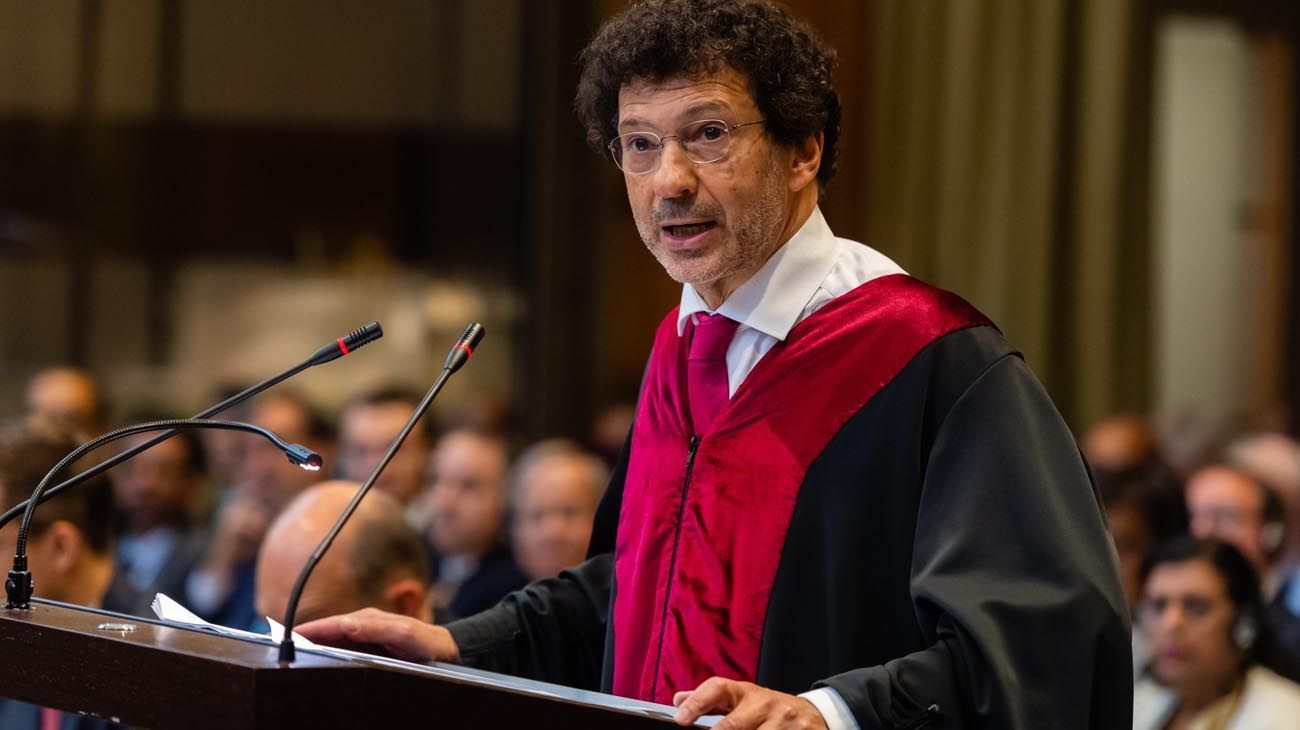 Jurist Marcelo Kohen, part of Argentina's legal team, during the hearings before the International Tribunal for the Law of the Sea in Hamburg.
Jurist Marcelo Kohen, one of the lawyers representing Argentina before the International Tribunal for the Law of the Sea, has argued that if the United Kingdom begins extracting oil at the Sea Lion project north of the Falklands, Argentina's rights over those resources “are lost forever”. The tribunal will announce on November 28 its decision on Argentina's request to suspend the project.
Jurist Marcelo Kohen, one of the lawyers representing Argentina before the International Tribunal for the Law of the Sea, has argued that if the United Kingdom begins extracting oil at the Sea Lion project north of the Falklands, Argentina's rights over those resources “are lost forever”. The tribunal will announce on November 28 its decision on Argentina's request to suspend the project.
“States have the right to decide when, how and under what conditions they will exploit non-renewable resources,” Kohen said in an interview with Infobae. “Drilling and oil extraction cause an irreversible physical change to the continental shelf and its non-renewable resources. Once produced, there is no going back.”
Kohen, a native of Rosario based in Geneva, a professor of international law and secretary-general of the Institut de Droit International, previously represented Argentina before the same tribunal in 2012, when it unanimously ordered Ghana to release the frigate Libertad, held at the request of a creditor fund. In this case he is part of the team led by Argentina's agent, Ambassador Mario Oyarzábal.
According to the jurist, the United Kingdom centred its defence on sovereignty over the islands so that the tribunal would conclude it lacks jurisdiction, since it can only rule on matters under the United Nations Convention on the Law of the Sea. Argentina, he said, limited itself to seeking to preserve its rights over the disputed continental shelf “while the dispute remains unresolved”.
At the November 10 and 11 hearings, the British delegation, led by Attorney General Ellie Reeves, argued that the tribunal has no jurisdiction over sovereignty issues and that suspending Sea Lion would “kill” it, with “devastating” consequences for the islanders. British lawyers estimated the loss for Rockhopper at about US$1 billion, and the chief executive of its Israeli partner, Navitas, warned in writing that even the briefest suspension would be “terminal” for the project. “Economic damage can be compensated; the modification of the continental shelf is irreversible,” Kohen replied.
The jurist also challenged the 2013 referendum invoked by Reeves as an expression of the islanders' self-determination, which he had described during the hearing as a “self-satisfaction referendum”. “It was a referendum that was neither organised nor supervised by the United Nations,” he said. In that vote, 99.8% of voters backed the islands remaining a British Overseas Territory. The United Kingdom maintains that the islanders have the right to decide their future and to develop their natural resources.
For Kohen, whatever the outcome, the case has already forced London “to justify itself before an international tribunal”. “The only way Argentina had to stop the United Kingdom from moving ahead with hydrocarbon exploitation was to turn to international jurisdiction,” he said.

Top Comments
Disclaimer & comment rulesNo comments for this story
Please log in or register (it’s free!) to comment. Login with Facebook