MercoPress. South Atlantic News Agency


Colombia's peace deal turns ten with 36% of its commitments fulfilled
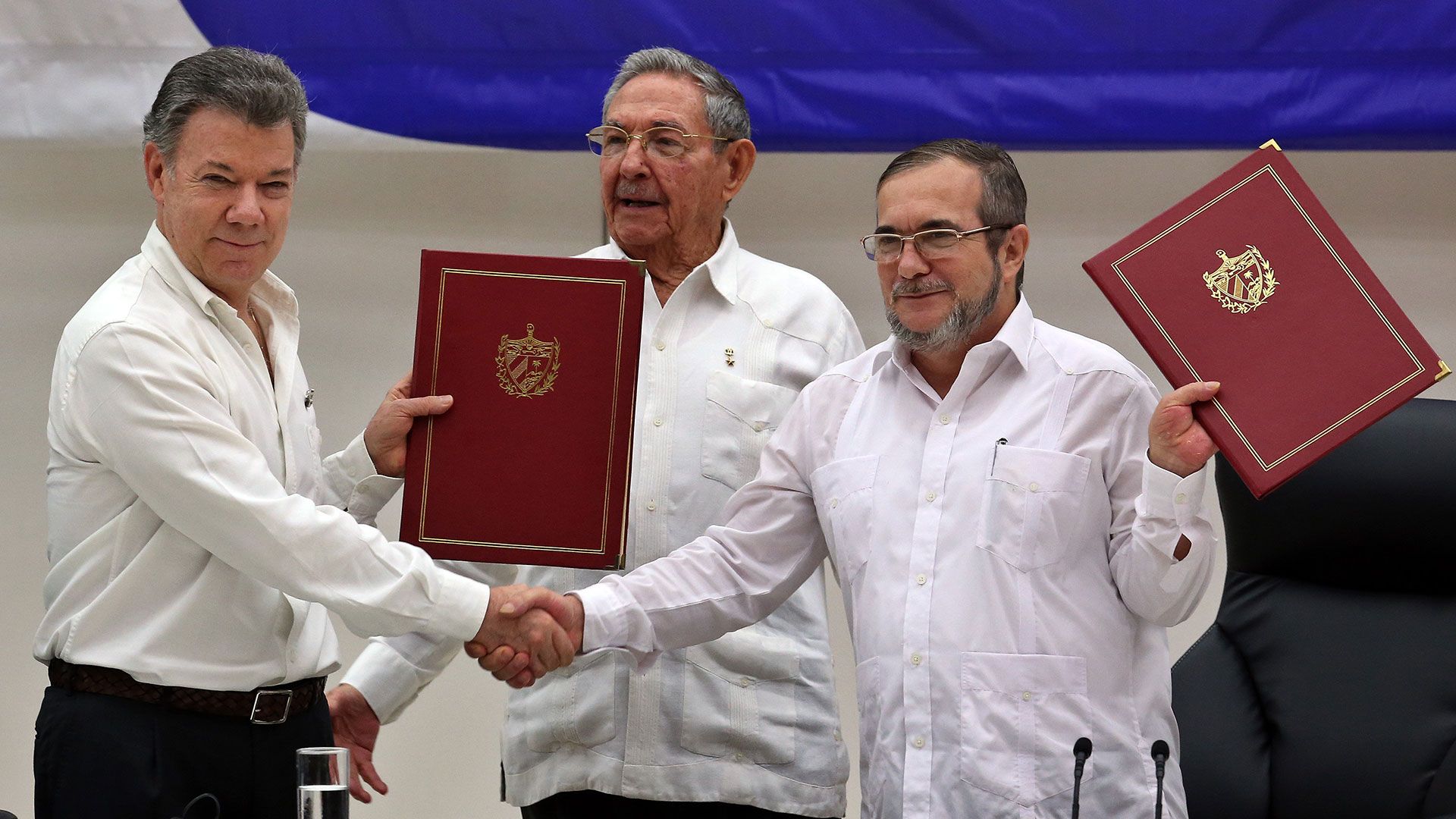 Juan Manuel Santos (L) and FARC leader Rodrigo Londoño, known as Timochenko, shake hands next to Cuban leader Raúl Castro, after the peace agreement.
The peace agreement between the Colombian state and the former FARC guerrillas turns ten on Tuesday with only 36% of its commitments fulfilled, according to the Kroc Institute, more than 500 former fighters killed and a government that considers it a mistake.
The peace agreement between the Colombian state and the former FARC guerrillas turns ten on Tuesday with only 36% of its commitments fulfilled, according to the Kroc Institute, more than 500 former fighters killed and a government, that of President Abelardo de la Espriella, which has cut back the institutions created by the deal and considers it a mistake.
The agreement was signed on November 24, 2016, at the Teatro Colón in Bogotá, after Colombians narrowly rejected a first text in a referendum and Juan Manuel Santos's government renegotiated it. More than 13,600 fighters handed over their weapons, and in 2017 the country recorded its lowest homicide rate in more than three decades.
Implementation, however, has been slow and uneven under three governments. Rural reform, the first point of the agreement, promised to hand three million hectares to landless farmers within 12 years; at the current pace, the Comptroller's Office estimates it would take about 400 years. According to the Ombudsman's Office, 521 signatories of the agreement have been killed over the past decade. The UN Verification Mission confirmed 13 killings of former fighters in 2026 up to September, and attempted murders rose from five in 2025 to 15.
In his three months in office, De la Espriella has cut the budget of the Special Jurisdiction for Peace, the court that tries former guerrillas and soldiers, broken off talks with armed groups, which he declared terrorists, and stepped up military offensives. “The false peace has cost Colombia dearly!” he said on the eve of the anniversary, calling the agreement a “mess”. At his government's request, the UN mission, renewed for a year, will no longer monitor rural reform, a decision backed by the United States.
Santos, who received the Nobel Peace Prize for the agreement, argues that the problem is not the deal but the failure to implement it. “The lack of implementation is what has caused many of the problems,” he said.
The state never filled the territories left by the FARC. The National Liberation Army, dissidents who rejected the agreement and the Clan del Golfo now fight over cocaine routes, gold mines and border crossings. According to the armed forces, these groups have some 29,000 members in 165 structures, compared with about 13,000 in 2022.
“We did not sign a peace agreement to die for it,” Osvaldo Mendoza, a former fighter who organised disarmament in a village in Cauca department, told El País.


Top Comments
Disclaimer & comment rulesNo comments for this story
Please log in or register (it’s free!) to comment. Login with Facebook