MercoPress. South Atlantic News Agency
Energy & Oil
-
Saturday, May 22nd 2021 - 09:02 UTC
Uruguay now a part of the Alliance for the Decarbonization of Transport

Uruguay's entry into the Alliance for the Decarbonization of Transport was formalized Friday when Industry, Energy and Mining Minister Omar Paganini Friday took part in the virtual Transport Forum Summit 2021, an event organized by the OECD.
-
Wednesday, May 19th 2021 - 09:27 UTC
Ecofriendly fuel mixture of waste and cooking oil used in commercial flight from France to Canada
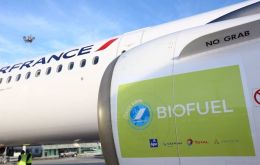
French carrier Air France filled the tanks of an Airbus A-350 bound for Canada with a mixture of kerosene with 16 per cent biomass which should significantly reduce CO2 emissions, the airline announced.
-
Monday, May 17th 2021 - 09:05 UTC
Hydrocarbons: Argentina going up as world goes down

The University of Buenos Aires (UBA)'s Gas and Petroleum Institute Director Aníbal Mellano said in an interview published Sunday in the Ambito Financiero newspaper that his country was “in an ascending cycle, within a descending world cycle for hydrocarbons.”
-
Tuesday, May 4th 2021 - 23:26 UTC
Russia plans major presence in Argentina with two nuclear plants plus military equipment

Russia's Ambassador to Buenos Aires Dmitry Feoktistov has confirmed his country's intention to build two nuclear power plants in Argentina and press sources at the Casa Rosada presidential palace have not denied it, although the project is yet to be officially endorsed by the administration of President Alberto Fernández.
-
Thursday, April 29th 2021 - 16:56 UTC
Argos granted extension to Falklands production licence
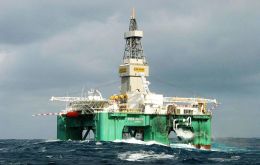
Argos Resources has successfully secured a 12-month extension to the second term of its Production Licence in the North Falkland Basin, the company announced this week. The extension, which runs until 1 May 2022, was approved by the Falkland Islands Government’s Executive Council on March 24.
-
Thursday, April 29th 2021 - 07:25 UTC
Chile on track to phasing out coal as source to generate electricity
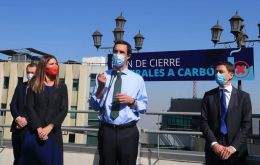
Chilean plans to close half of the country's coal-fired electricity generating plants by 2025, Energy Minister Juan Carlos Jobet assured Wednesday during a ceremony in which the generating company Engie vowed to either close or convert six of the oldest plants by 2024, with a capacity of 800 megawatts (MW).
-
Monday, April 26th 2021 - 08:38 UTC
Bolivia's YPFB eyes oil income of US $ 1,900 million for this year
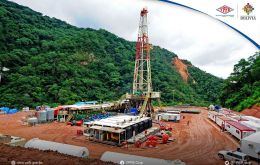
Yacimientos Petrolíferos Fiscales Bolivianos (YPFB) CEO Wilson Zelaya announced the state-run company projected an oil income above 1,900 million US dollars for the year 2021, which would represent a 35% growth compared to 2020.
-
Saturday, April 24th 2021 - 07:02 UTC
Paraguay and South Korean finalize details for joint electric car parts production to start in 2022

Paraguay's Minister of Industry and Commerce (MIC) Luis Alberto Castiglioni Friday discussed with South Korean Ambassador To Asunción In Shik Woo the establishment of an Auto Parts Technology Center for electric cars in the South American country, which is due to commence in 2022 and last for about five years, it was reported.
-
Thursday, April 22nd 2021 - 09:15 UTC
Uruguay tops Latin American transition to environment friendly energy sources
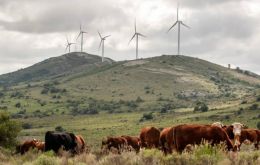
Uruguay continues to be Latin America's leading country regarding energy transition towards renewable sources, according to an index released jointly this week by the World Economic Forum and the Accenture consultancy firm.
-
Friday, April 2nd 2021 - 09:58 UTC
One power plant starts operating in Argentina, foundations laid for another

The 21 MW thermoelectric power plant of Río Turbio Carboniferous Field Wednesday at 8 am began to generate electricity and deliver it to the National Interconnected System, it was announced.