MercoPress. South Atlantic News Agency
Energy & Oil
-
Thursday, April 9th 2026 - 01:08 UTC
Brazilian judge suspends 12% crude oil export tax for five international oil companies
A federal judge in Rio de Janeiro issued a preliminary injunction suspending the 12% crude oil export tax for five international companies operating in Brazil: Shell, TotalEnergies, Equinor, Repsol Sinopec and Petrogal. The ruling represents an initial court victory for the oil companies in their dispute with President Luiz Inácio Lula da Silva's government over a levy they consider unconstitutional.
-
Wednesday, April 8th 2026 - 21:11 UTC
QatarEnergy and Chevron join Shell in Uruguay's offshore oil exploration
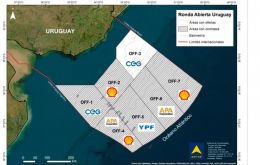
QatarEnergy and Chevron have formally entered as non-operating partners in offshore hydrocarbon exploration blocks off Uruguay's coast, in areas operated by Shell, state energy company Ancap announced. The incorporation of two of the world's largest energy companies reinforces international interest in Uruguay's offshore petroleum potential, a frontier exploration area that has gained prominence over the past two years.
-
Tuesday, April 7th 2026 - 21:06 UTC
“Has anyone talked about democracy? No”: OEI secretary criticizes Trump's oil-driven approach to Venezuela
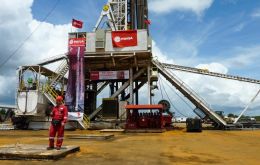
The secretary general of the Organization of Ibero-American States for Education, Science and Culture (OEI), Mariano Jabonero, said that US President Donald Trump's primary interest in Venezuela is energy-related and has nothing to do with promoting democratic values or civilization.
-
Tuesday, April 7th 2026 - 12:28 UTC
Chavismo and opposition faction seek judicial pause to shield Citgo and PDVSA assets

Lawyers representing Delcy Rodríguez's government and those of the opposition sector that has controlled Venezuelan assets in the United States since 2019 jointly asked a New York court for a 45-day suspension in a case where international creditors are seeking to seize funds linked to Petróleos de Venezuela (PDVSA).
-
Friday, April 3rd 2026 - 04:46 UTC
What did Milei say about Falklands oil and why does it matter for Sea Lion?

Argentine President Javier Milei warned Thursday that his government “will respond with all necessary diplomatic measures” to protect the country's interests in the face of the advancing Sea Lion oil project, operated by Rockhopper Exploration and Navitas Petroleum in the North Falklands Basin. The remarks, delivered during the ceremony marking the 44th anniversary of the war, represent the Milei government's firmest stance yet on a project that has just cleared a decisive financial milestone.
-
Thursday, April 2nd 2026 - 21:01 UTC
Milei reaffirms Falklands sovereignty, warns oil firms and vows to rebuild the armed forces

Argentine President Javier Milei on Thursday reaffirmed his country's sovereignty claim over the Falklands Islands, warned of a diplomatic response to British oil exploration in the area, and announced that 10% of fiscal revenue from privatizations will be allocated to purchasing weapons and equipment for the armed forces.
-
Thursday, April 2nd 2026 - 03:00 UTC
Trump vows to send Iran “back to the Stone Age” as oil surges back above $100

Oil prices surged on Wednesday after U.S. President Donald Trump vowed in a televised address to the nation to hit Iran “extremely hard” over the next two to three weeks. West Texas Intermediate (WTI) crude rose 4.1% to $104.21 per barrel, while Brent, the international benchmark, gained 5% to $106.42, according to CNBC data.
-
Wednesday, April 1st 2026 - 10:37 UTC
Bolivia: probe into ring that stole and adulterated fuel imported through Chilean ports
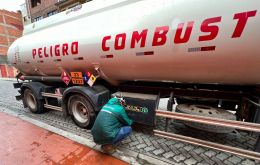
Bolivian President Rodrigo Paz on Tuesday denounced the existence of an international ring dedicated to stealing and adulterating gasoline and diesel imported into the country, with operations detected in Chile, Argentina, and Paraguay. According to the president, the scheme originated under the previous management of Yacimientos Petrolíferos Fiscales Bolivianos (YPFB), the state-owned fuel supply company.
-
Wednesday, April 1st 2026 - 09:01 UTC
Another front for Trump, “pain in the pump”, gasoline above US$ 4 a gallon
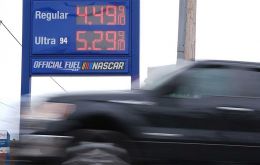
”If the (Iran) conflict is contained soon, the hit to confidence may be temporary, but a prolonged crisis could prompt more precautionary saving and further discretionary spending cuts,” warned Moody’s in a report on the current war in the Middle East, and the impact for US households.
-
Tuesday, March 31st 2026 - 03:58 UTC
Oil tops $114 a barrel as Iran conflict drives record monthly surge
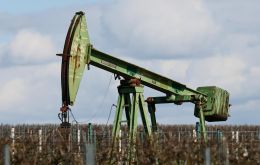
Brent crude, the European benchmark, closed Monday at $112.78 per barrel and continued climbing in the futures market past $114, its highest level since July 2022. Oil has surged roughly 55% in March, the largest monthly gain since the contract's inception in 1988.