MercoPress. South Atlantic News Agency
International
-
Monday, October 19th 2026 - 19:50 UTC
US calls at the UN for an end to the Decolonisation Committee, key to Argentina’s claim
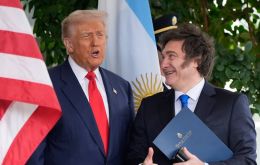
The United States has called at the UN for an end to the mandate of the Special Committee on Decolonisation, the body before which Argentina presents its sovereignty claim over the Falklands every year, and described some of its activities as “a waste of resources”, according to the official summary of the General Assembly Fourth Committee session held on October 15.
-
Monday, October 19th 2026 - 06:13 UTC
Rioting returns to Paris after a day of protests that saw 1,800 arrests across France
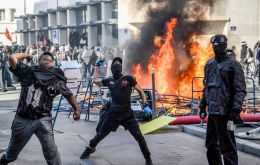
Clashes between police and groups of protesters returned to central Paris on Sunday around the Place de la République, a day after a nationwide day of protests against the cost of living and conditions in schools ended with the looting of hundreds of shops and at least 1,800 arrests across the country, according to police.
-
Sunday, October 18th 2026 - 12:31 UTC
Tesla’s new Roadster uses compressed air and fans to jump and drive upside down

Tesla unveiled on Thursday in Texas a redesigned version of its Roadster electric sports car, developed with SpaceX, which combines suction fans and compressed-air thrusters to climb near-vertical surfaces, drive upside down and flip in the air. The company plans to begin production in 2028.
-
Saturday, October 17th 2026 - 06:17 UTC
Brent touches US$110 for the first time since May on Middle East tensions

Brent crude reached US$110 a barrel on Friday for the first time since May, driven by fears that escalation in the Middle East could further tighten supplies and by doubts over how much diesel Russia can supply to the market. Brent settled 3.7% higher at US$109.86, its highest since May 19, while US benchmark WTI rose 3.5% to US$101.41.
-
Friday, October 16th 2026 - 21:50 UTC
Rodrigues-Birkett, UN leadership hopeful: “Not choosing a woman would send a very negative message”
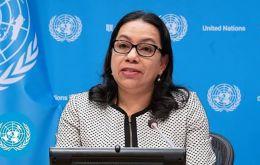
Guyana’s ambassador to the UN, Carolyn Rodrigues-Birkett, one of the best-placed candidates to succeed António Guterres at the head of the organisation, has warned that not choosing a woman “would send a very negative message to the world”, in an interview with the newspaper El País published on the day the Security Council holds its first informal colour-coded straw poll, which reveals whether any of the five permanent members opposes each candidate.
-
Friday, October 16th 2026 - 10:07 UTC
The Falklands dispute threatens Argentina’s bid to join the trans-Pacific trade pact
The escalating dispute between Argentina and the United Kingdom over the Sea Lion oil project north of the Falklands has spilled into trade: London, a member of the Comprehensive and Progressive Agreement for Trans-Pacific Partnership, has not ruled out using its position to stall Argentina’s bid to join the pact, which requires the consensus of all its members. The British government says Buenos Aires’s conduct raises “very serious questions about its reliability as a partner”.
-
Friday, October 16th 2026 - 09:59 UTC
Inter-American Court hears case over the April 11, 2002 killings in Caracas
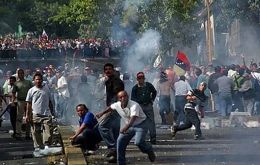
The Inter-American Court of Human Rights held this week in San José, Costa Rica, the first public hearing in the case over the killings of April 11, 2002 in Caracas, when an opposition march came under gunfire near the Miraflores Palace. Nineteen people died and dozens were wounded that day, in the run-up to the coup that removed then-president Hugo Chávez from power for two days.
-
Friday, October 16th 2026 - 09:52 UTC
Uruguay signs a US$5.7 billion data centre investment with Spain’s Solaria
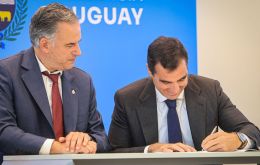
Uruguayan President Yamandú Orsi on Wednesday signed an agreement with Spanish company Solaria Energía y Medio Ambiente to develop a data centre campus of up to 500 megawatts with its own solar generation, a US$5.7 billion investment the government described as the largest in the country’s history. The opposition has demanded explanations about the company’s financial capacity and the jobs the project will create.
-
Friday, October 16th 2026 - 09:40 UTC
Argentina abstains on a Russian UN resolution on colonialism and draws criticism
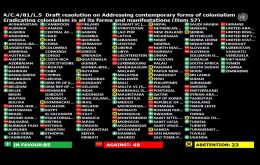
Argentina abstained on Thursday in a vote by the UN General Assembly’s Fourth Committee on a Russian-sponsored draft on “contemporary forms of colonialism”, a decision that Buenos Aires province’s government minister, opposition figure Carlos Bianco, linked to President Javier Milei’s alignment with the United States and to Argentina’s strategy over the Falklands.
-
Wednesday, October 14th 2026 - 22:05 UTC
Badenoch accuses Farage of trading Chagos for Trump’s silence on the Falklands
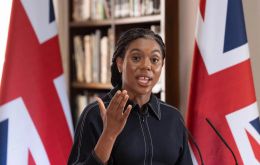
British Conservative leader Kemi Badenoch has called “humiliating” a proposal by Reform UK leader Nigel Farage to offer US President Donald Trump the Chagos archipelago in exchange for him to stop talking about the Falklands. “Giving away British territory in return for someone keeping quiet is not a deal. It is humiliating,” she told The Telegraph.