MercoPress. South Atlantic News Agency
Politics
-
Sunday, August 9th 2026 - 20:37 UTC
Uruguay's Partido Nacional sets a 2030 return to government as its goal

The president of the board of Uruguay's Partido Nacional, Álvaro Delgado, on Sunday called on members of the country's main opposition force to “build the history of the future” and set a return to government in 2030 as the first objective, so that Uruguay can “find direction again.”
-
Sunday, August 9th 2026 - 20:05 UTC
Machado congratulates De la Espriella and says Venezuela will soon follow suit
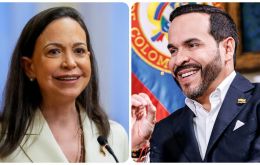
Venezuelan opposition leader and 2025 Nobel Peace Prize laureate María Corina Machado congratulated Colombia's new president, Abelardo de la Espriella, and said Venezuela would “very soon” undertake a process of institutional and democratic strengthening similar to the one she said is beginning in the neighboring country. The Colombian president replied on Sunday thanking her for the support.
-
Saturday, August 8th 2026 - 07:52 UTC
De la Espriella sworn in before Congress in Cali, delivers first speech to the military
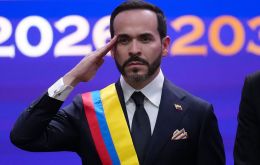
Abelardo de la Espriella took office as president of Colombia in Cali on Friday, the first time a Colombian leader has been sworn in outside Bogotá, and delivered his first speech at an Army battalion rather than before Congress, breaking with the country's institutional tradition.
-
Saturday, August 8th 2026 - 07:48 UTC
Falklands: 'South Atlantic Sentinel' exercise involves all three services

In late July, forces from the three services stationed at Mount Pleasant Complex in the Falkland Islands — headquarters of British Forces South Atlantic Islands (BFSAI) — took part in a series of military exercises designed to demonstrate their speed of response and operational integration, under the banner of the deployment's name, South Atlantic Sentinel.
-
Saturday, August 8th 2026 - 07:38 UTC
Celtic roots of both the Falklands and Malvinas names?

The Irish Times has published a very interesting piece from Tomaí Ó Conghaile following on the fallout from the World Cup, who argues that both the English and Spanish versions of the Falkland-Malvinas Islands names have their roots in Celtic languages.
-
Saturday, August 8th 2026 - 07:00 UTC
China will have the largest embassy in London, the former Royal Mint
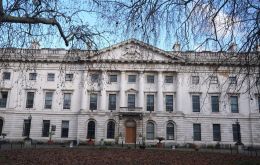
The UK High Court on Friday threw out a challenge against UK authorities' decision to permit a new Chinese super embassy in central London. The challenge was brought by a neighborhood group called the Royal Mint Court Residents' Association (RMCRA), which represents families and businesses in roughly 100 properties around the planned embassy site.
-
Friday, August 7th 2026 - 21:17 UTC
Venezuelan government and opposition open US-backed talks
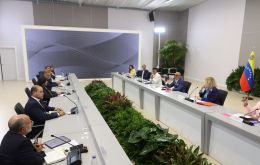
Delegations from the Venezuelan government and one sector of the opposition met on Thursday in Caracas to open negotiations backed by the United States, in the first face-to-face encounter since Nicolás Maduro's detention by US forces on January 3.
-
Friday, August 7th 2026 - 20:58 UTC
Why the Falkland Islands are British
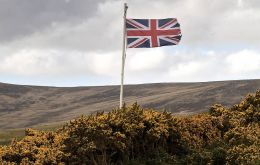
By Graham Pascoe (*)
On 11 July 2026 the Argentine foreign minister, Pablo Quirno, wrote a long article on the Falkland Islands (or the Malvinas, as they are called in Spanish) in the Buenos Aires newspaper La Nación, as Iona Cleave reported in the London Telegraph the next day. On 23 July he published an almost identical article in the Israeli English-language daily Jerusalem Post. In both his articles the foreign minister repeated several arguments which (he said) showed the strength of Argentina's claim to the Falklands. Unfortunately for him, everything he said is historically and legally untrue, as will be pointed out below. -
Friday, August 7th 2026 - 10:58 UTC
Argentine Senate passes property bill after dropping two key chapters
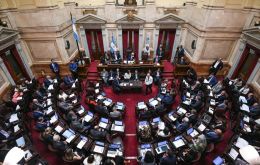
Argentina's Senate approved in the early hours of Friday, by 37 votes to 33, the Inviolability of Private Property bill promoted by Deregulation Minister Federico Sturzenegger, after the governing bloc withdrew the two chapters that drew the most resistance. The text now goes to the Chamber of Deputies.
-
Friday, August 7th 2026 - 10:43 UTC
Milei promotes a summit of right-wing presidents outside existing regional bodies
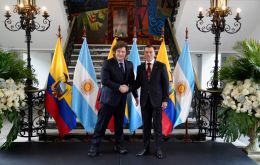
Argentine President Javier Milei is working to convene a summit of right-wing leaders from across the Americas outside existing multilateral organizations, though no date has been set. The initiative comes amid a series of trips that took him this week to Ecuador and Colombia.

