MercoPress. South Atlantic News Agency
Tag: Peronism
-
Wednesday, June 10th 2026 - 14:51 UTC
Argentina: A year after Kirchner's final conviction, a possible pardon splits Peronism before 2027

A year has passed since Argentina's Supreme Court made final the corruption conviction against former President Cristina Fernández de Kirchner —six years in prison and a lifetime political ban— and the possibility of pardoning her if Peronism returns to power is dividing the movement, as it searches for a candidate for the late-2027 presidential elections. Kirchner is under house arrest in a Buenos Aires apartment, in the Constitución neighborhood, where her supporters will again gather on Wednesday to demand her release.
-
Saturday, January 3rd 2026 - 08:24 UTC
Europeans are all Peronists now, where are the leaders willing to make hard choices?
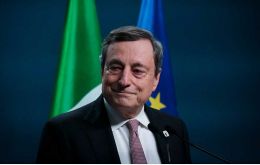
By Cristina Martinez (*) - European voters increasingly resemble their Argentinian counterparts, who, until recently, believed the unsustainable promises offered by Peronist politicians. To avoid the economic shock therapy that has befallen Argentina, Europe’s leaders must be willing to make hard choices, and electorates must be willing to reward them for it.
-
Thursday, October 2nd 2025 - 09:06 UTC
Kicillof visits CFK as midterms loom over
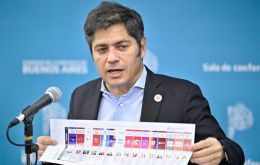
Axel Kicillof, Governor of the Argentine province of Buenos Aires, and arguably the main opposition leader following Sept. 7 elections in his district, where he dealt a heavy blow to President Javier Milei's political force, paid a visit Wednesday to Justicialist (Peronist) Party Chairwoman Cristina Fernández de Kirchner (CFK).
-
Wednesday, March 19th 2025 - 10:55 UTC
Peronists oppose Milei's intention to take another loan from the IMF

Argentina's Justicialist [Peronist] Party (PJ) led by former President Cristina Fernández de Kirchner (CFK) Tuesday expressed its rejection of President Javier Milei's Emergency Decree (DNU) 179/25 clearing the way for further borrowing from the International Monetary Fund (IMF) with no Congressional approval. The PJ deemed the initiative “illegitimate” and unconstitutional on the grounds that it violated Law 27.612, which requires the Executive to submit full IMF agreement details to Congress, and Article 75 of the National Constitution, which assigns Congress the authority to manage national debt.
-
Friday, December 13th 2024 - 10:31 UTC
Argentina: Senator Kueider under arrest in Paraguay expelled from Parliament

Argentina's Senate voted overwhelmingly Thursday to expel the Peronist Edgardo Kueider from Entre Ríos, who was arrested in Paraguay with US$ 200,000 of undeclared money in addition to pesos and guaranis. Giving Kueider the thumbs down were the opposition Unión por la Patria (Peronism), the Radical Civic Union (UCR), the ruling La Libertad Avanza (LLA) of President Javier Milei, and part of former President Mauricio Macri's Propuesta Republicana (PRO).
-
Friday, November 29th 2024 - 15:51 UTC
Pepe Mujica criticizes Cristina Kirchner: “The old lady is at the head of Peronism screwing around”
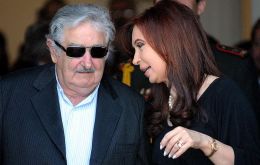
Former Uruguayan President José “Pepe” Mujica has taken aim at prominent Latin American leaders, criticizing a lack of generational renewal in politics and authoritarian trends in the region. Speaking from his home in Montevideo, Mujica called out Argentina’s Cristina Kirchner, accusing her of clinging to power rather than transitioning into an advisory role. “There’s the old Cristina at the head of Peronism, instead of leaving room for new generations. How hard it is for her to let go of the cake!” Mujica quipped.
-
Monday, October 23rd 2023 - 10:42 UTC
No president-elect in Argentina

Argentina's next president will be chosen in a runoff election on Nov. 19, according to preliminary results released Sunday minutes before 10 p.m. local time in Buenos Aires (GMT -3).
-
Thursday, February 23rd 2023 - 10:53 UTC
Argentina: Ruling bloc in the Senate breaks up and a new bench emerges
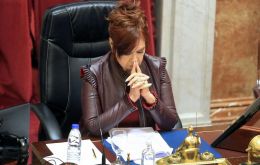
A group of Argentine senators announced on Wednesday their withdrawal from the bloc of the ruling Frente de Todos in the Upper House and their decision to form their own bench, in the run-up to the complex electoral process that the South American country will undergo this year.
-
Monday, October 10th 2022 - 10:31 UTC
Madrid mayor pledges not to allow Peronism 'fiscal populism' into Spain
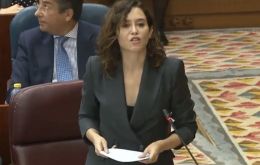
The mayor of Spain's capital Madrid, Isabel Díaz Ayuso, and a rising star among the conservative Popular Party has condemned the Spanish Socialist government accusing it of following Argentine Peronism populist policies, underlining that “here in Spain people want to be free”
-
Thursday, October 29th 2020 - 14:27 UTC
Alberto Fernández confesses that Néstor Kirchner marked a before and after for his life and is his permanent inspiration

“Néstor, in history and in my heart,” said Argentine President Alberto Fernández emotionally, along with a video recalling his relationship with his former political mentor, former President Néstor Kirchner (2003-2007) on the tenth anniversary of the former president's surprising death.