MercoPress. South Atlantic News Agency
Tag: Xi Jinping
-
Friday, September 25th 2026 - 09:37 UTC
Trump and Xi end the state visit with the trade truce extended and no substantive deals
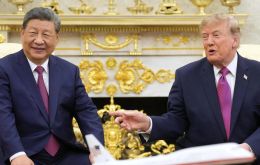
Chinese President Xi Jinping's state visit to Washington ended on Thursday with a two-month extension of the bilateral trade truce, agreed before the meeting itself, and no progress on the central issues dividing the two powers: tariffs, rare earths, agricultural purchases, Taiwan and export restrictions on advanced chips.
-
Thursday, August 27th 2026 - 08:20 UTC
Beijing asks Washington to “overcome obstacles” before Xi's White House visit
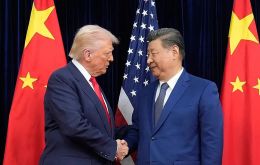
Chinese Foreign Minister Wang Yi has urged the United States to “remove interference” and “overcome obstacles” in high-level exchanges between the two countries, during a meeting in Beijing on Wednesday with US Ambassador David Perdue, as part of preparations for President Xi Jinping's state visit to Washington.
-
Saturday, May 16th 2026 - 03:12 UTC
Trump closes China visit without substantial agreements but with Xi's offer on Strait of Hormuz
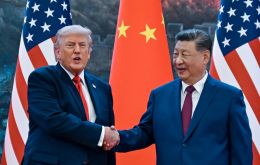
US President Donald Trump on Friday concluded his state visit to China of less than 48 hours without substantial announcements on the main points of the bilateral agenda, although he described the encounter as “very successful” and “unforgettable” and said he had reached “fantastic” trade deals whose details were not disclosed. The final day of the trip, held at Zhongnanhai, the residence of the Chinese Communist Party leadership, produced as its most visible outcome an offer by Chinese President Xi Jinping to help reopen the Strait of Hormuz, closed by Iran since the start of the war in late February.
-
Wednesday, May 13th 2026 - 12:25 UTC
Trump lands in Beijing for first summit with Xi in China since 2017
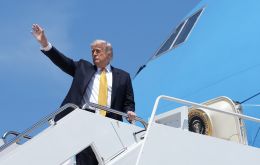
US President Donald Trump landed in Beijing on Wednesday at 19:52 local time (11:52 GMT) to begin a three-day state visit to the Asian giant, his second trip to the country since the one made in 2017 during his first term and the first by a US president to the Chinese capital in nearly nine years. The summit with his Chinese counterpart, Xi Jinping, will run Thursday and Friday and will tackle the fragile trade truce sealed in Busan last October, the war waged by the United States and Israel against Iran, the technological rivalry between the world's two largest economies, and the dispute over Taiwan.
-
Wednesday, May 13th 2026 - 03:20 UTC
The Trump-Xi summit in Beijing turns on five fronts: Iran, Taiwan, tariffs, rare earths, and AI
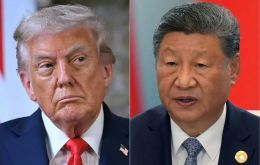
The summit between US President Donald Trump and his Chinese counterpart Xi Jinping that begins on Wednesday in Beijing will unfold around an agenda concentrated on five main fronts: the US war against Iran, the Taiwan question, bilateral tariffs, Chinese exports of rare earths, and, according to The Wall Street Journal, an initial approach to managing the risks of artificial intelligence. It will be the first visit by a US president to the Chinese capital in nearly nine years and comes three days after China's Foreign Ministry released a propaganda video that revived the Soviet-era concept of “peaceful coexistence” to describe the bilateral relationship.
-
Monday, May 11th 2026 - 03:55 UTC
Trade, Iran and Taiwan dominate agenda of Trump-Xi summit beginning Wednesday in Beijing
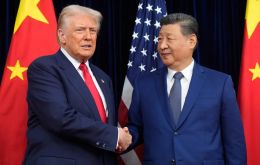
China confirmed on Monday that US President Donald Trump will pay a state visit from 13 to 15 May at the invitation of his Chinese counterpart, Xi Jinping. It will be the first trip by a US president to the country in nearly a decade —since Trump's own November 2017 visit— and will unfold against the backdrop of the US war against Iran, the fragile trade truce between the two powers, and the dispute over Taiwan's sovereignty.
-
Friday, February 6th 2026 - 03:46 UTC
Taiwan protests Uruguay–China statement calling the island an “inalienable” part of China
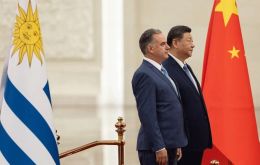
Taiwan’s government issued a “strong protest and condemnation” after a joint statement released in Beijing by Uruguay’s President Yamandú Orsi and China’s President Xi Jinping reiterated Montevideo’s adherence to the “one China” principle and described Taiwan as an “inalienable” part of Chinese territory.
-
Tuesday, February 3rd 2026 - 12:53 UTC
Orsi, Xi Jinping sign cooperation deals in Beijing as Uruguay backs “one China” and trade talks with Mercosur are floated
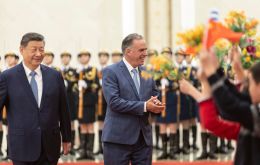
China’s President Xi Jinping met Uruguay’s President Yamandú Orsi in Beijing on Tuesday, a visit framed by both sides as a bid to deepen political alignment and broaden economic ties at a moment of heightened geopolitical competition.
-
Monday, February 2nd 2026 - 17:43 UTC
China’s Xi calls to make Renminbi “a powerful currency,” as Trump is ready to change Fed’s chair
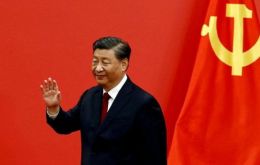
China’s President Xi Jinping has called for the renminbi to achieve global reserve currency status, “a powerful currency” according to remarks published on Saturday in Qiushi, the Chinese Communist Party’s flagship ideology journal.
-
Sunday, November 2nd 2025 - 00:13 UTC
Trump calls meeting with Xi a “G2” summit, reviving idea of a two-power world order
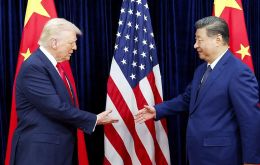
US President Donald Trump described his meeting with Chinese President Xi Jinping in Busan as “historic,” calling it a “G2” summit — a term that suggests shared global leadership between Washington and Beijing.