MercoPress. South Atlantic News Agency
United States
-
Wednesday, May 13th 2026 - 12:25 UTC
Trump lands in Beijing for first summit with Xi in China since 2017
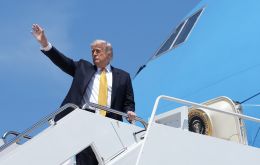
US President Donald Trump landed in Beijing on Wednesday at 19:52 local time (11:52 GMT) to begin a three-day state visit to the Asian giant, his second trip to the country since the one made in 2017 during his first term and the first by a US president to the Chinese capital in nearly nine years. The summit with his Chinese counterpart, Xi Jinping, will run Thursday and Friday and will tackle the fragile trade truce sealed in Busan last October, the war waged by the United States and Israel against Iran, the technological rivalry between the world's two largest economies, and the dispute over Taiwan.
-
Wednesday, May 13th 2026 - 11:57 UTC
White House “51st state” trolling tests Caracas's oil opening
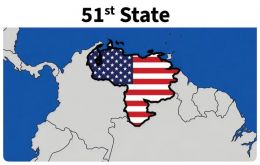
The official White House account on Tuesday published a series of messages on social media platform X suggesting the annexation of Venezuela to the United States under the formula of the “51st state,” a discursive shift that strains the bilateral rapprochement built since the capture of former President Nicolás Maduro on 3 January. The first post shows a map of Venezuela covered with the US flag and the caption “51st State”; eight minutes later, a video revives Secretary of State Marco Rubio's announcement of Maduro's capture, with footage of the former leader being flown to New York. The publication comes at a moment of apparent stagnation in the economic opening that acting President Delcy Rodríguez has pushed from Caracas to attract US investment.
-
Wednesday, May 13th 2026 - 03:20 UTC
The Trump-Xi summit in Beijing turns on five fronts: Iran, Taiwan, tariffs, rare earths, and AI
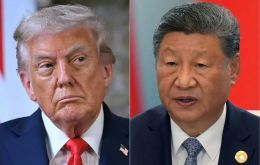
The summit between US President Donald Trump and his Chinese counterpart Xi Jinping that begins on Wednesday in Beijing will unfold around an agenda concentrated on five main fronts: the US war against Iran, the Taiwan question, bilateral tariffs, Chinese exports of rare earths, and, according to The Wall Street Journal, an initial approach to managing the risks of artificial intelligence. It will be the first visit by a US president to the Chinese capital in nearly nine years and comes three days after China's Foreign Ministry released a propaganda video that revived the Soviet-era concept of “peaceful coexistence” to describe the bilateral relationship.
-
Monday, May 11th 2026 - 04:42 UTC
Trump calls Iran's response to his peace proposal “totally unacceptable”
US President Donald Trump described Iran's response to Washington's latest proposal to end the war that has pitted the two countries against each other since 28 February as “totally unacceptable” on Sunday. “I have just read the response from Iran's so-called 'Representatives.' I don't like it — TOTALLY UNACCEPTABLE!” the president wrote on his Truth Social platform.
-
Monday, May 11th 2026 - 03:55 UTC
Trade, Iran and Taiwan dominate agenda of Trump-Xi summit beginning Wednesday in Beijing
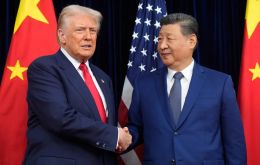
China confirmed on Monday that US President Donald Trump will pay a state visit from 13 to 15 May at the invitation of his Chinese counterpart, Xi Jinping. It will be the first trip by a US president to the country in nearly a decade —since Trump's own November 2017 visit— and will unfold against the backdrop of the US war against Iran, the fragile trade truce between the two powers, and the dispute over Taiwan's sovereignty.
-
Saturday, May 9th 2026 - 14:59 UTC
US removes 13.5 kilos of highly enriched uranium from Venezuela's RV-1 reactor
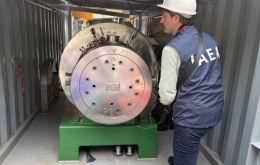
The U.S. Department of Energy's National Nuclear Security Administration (NNSA) has completed the removal of 13.5 kilograms of highly enriched uranium from the former RV-1 research reactor at the Venezuelan Institute for Scientific Research (IVIC), in Miranda state, in an operation coordinated with the United Kingdom, the International Atomic Energy Agency (IAEA), and Venezuela's transitional government.
-
Friday, May 8th 2026 - 05:08 UTC
Lula and Trump declare bilateral relationship reset after three-hour meeting at the White House
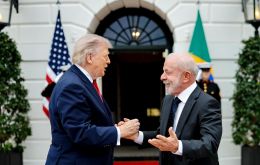
The presidents of Brazil, Luiz Inácio Lula da Silva, and the United States, Donald Trump, held a meeting of close to three hours at the White House on Thursday in which both leaders declared an end to one of the most severe bilateral crises in two centuries of relations between the two largest economies in the Americas. The encounter, formalized as a working meeting, unfolded in a climate of personal fluency and allowed for the agreement to establish bilateral channels to address commercial, security, and regional cooperation matters.
-
Friday, May 8th 2026 - 02:14 UTC
United States imposes new sanctions on Cuban military conglomerate GAESA amid escalating pressure

US Secretary of State Marco Rubio announced on Thursday a new package of sanctions against the Grupo de Administración Empresarial S.A. (GAESA), the conglomerate linked to the Cuban Armed Forces that controls approximately 40% of the island's economy, in a fresh escalation of the economic pressure deployed by the Trump administration against the Havana regime. The measure is part of the implementation of Executive Order 14404, signed by President Donald Trump on May 1, which authorizes sanctions against those responsible for political repression and threats to US national security.
-
Thursday, May 7th 2026 - 15:08 UTC
Lula arrives at the White House to mend fences with Trump after a year of tariffs and disputes
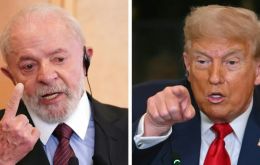
Brazilian President Luiz Inácio Lula da Silva was received on Thursday by his American counterpart Donald Trump at the White House, in his first official visit to Washington since his return to power in 2023 and the second face-to-face meeting between the two leaders, following a brief 45-minute encounter on the sidelines of the ASEAN summit in Kuala Lumpur last October. The meeting, formalized as a working session rather than a state visit, seeks to consolidate the fragile bilateral truce reached after one of the most severe diplomatic crises in two centuries of relations between the two most populous democracies in the Americas.
-
Wednesday, May 6th 2026 - 01:45 UTC
Just one day after its launch, Trump halts Hormuz reopening operation and turns to negotiations with Iran
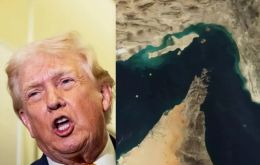
US President Donald Trump on Tuesday night announced the suspension of “Project Freedom,” the military operation launched barely 24 hours earlier to escort stranded vessels through the Strait of Hormuz, citing significant progress toward a peace agreement with Iran. The announcement, posted on his Truth Social platform, contradicted the messaging sustained throughout the day by Secretary of State Marco Rubio, Secretary of Defense Pete Hegseth, and Joint Chiefs chairman General Dan Caine, all of whom had framed the operation as a non-negotiable humanitarian rescue mission for stranded sailors.

