MercoPress. South Atlantic News Agency

Falklands: international observers praise electoral process and civil liberties
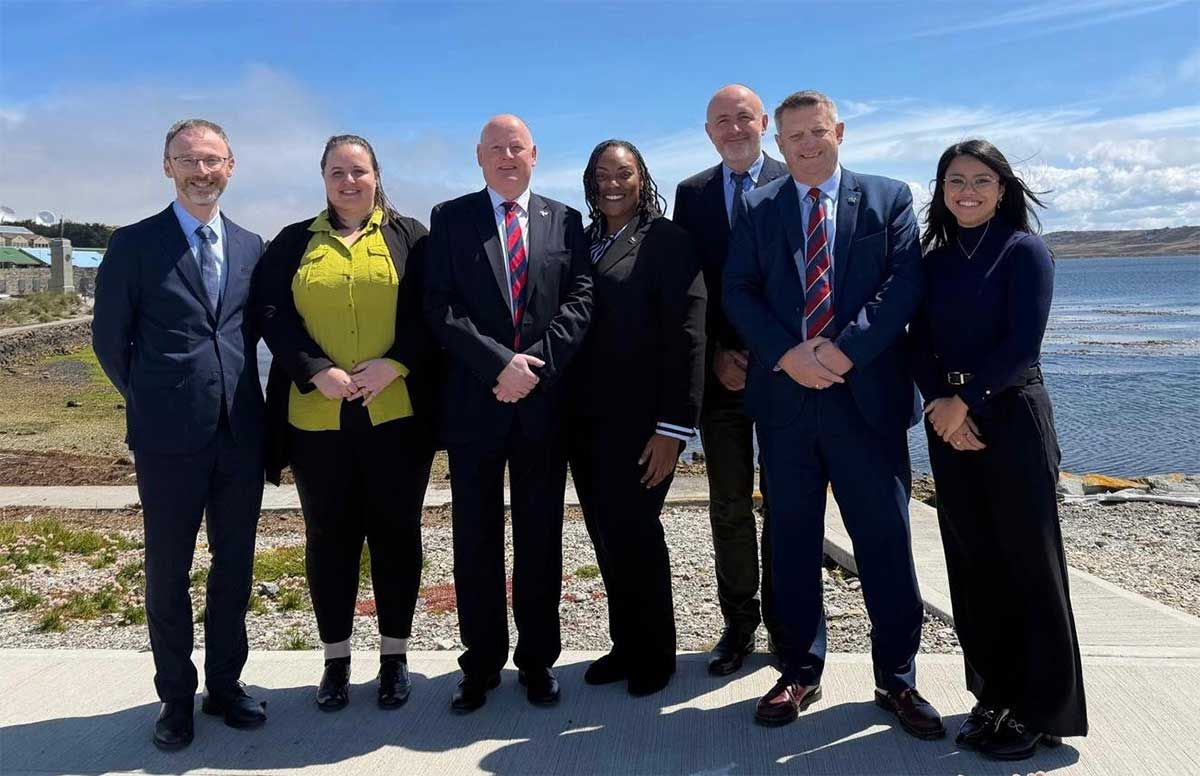 The observers' approach was a “passive task,” explained observer mission chief Alun Davies of Wales. (Pic CPA-UK)
 For the first time, an international team of observers was present in the Falkland Islands during—and prior to—the general election held on December 11, to monitor the entire electoral process. The delegation consisted of seven members from the Commonwealth Parliamentary Association of the British Islands and Mediterranean Region (CPA-BIMR), including parliamentarians, electoral analysts and staff from the CPA UK branch.
Ahead of election day, the observers spent several days meeting with senior government and electoral authorities of the Falklands, the candidates standing in the election, and community groups. They then monitored the procedures during the electoral event itself. A preliminary report was issued shortly after the close of polling, while a more comprehensive report is expected within three months.
During the visit, head of mission Alun Davies MS, a member of the Welsh Senedd, explained how international standards are applied in small jurisdictions such as the Falklands, and the approach used to observe and assess the electoral process.
“The core principles of global election observation apply regardless of the size of a country, state or province, irrespective of how many people live there,” Davies said.
“There is no such thing as a ‘typical’ state or case. They come in all shapes and sizes, and CPA-BIMR frequently works in smaller democracies, including the Cayman Islands and Sark. International standards are designed to apply to all democratic processes—for example, the secret ballot is the same in the Falklands as it is in India.”
Davies stressed that the mission does not compare the Falklands with other jurisdictions. “This is not a review, an investigation, or a comparative study. Observers assess whether the electoral process aligns with internationally accepted standards, within the specific local context.”
He noted that much of the work fits within a broader framework of shared learning across Commonwealth parliaments. Davies recalled discussions with Falklands legislators on a range of topics, including the impact of Brexit on the Islands’ Development Plan.
“I have learned a great deal about the Falklands, how they are governed, the challenges they face. I find it fascinating how much we can learn from one another,” he said.
“We are here to observe”
“The observer mission we are part of is one element of CPA-BIMR’s ongoing role in strengthening democratic practice,” Davies continued.
Asked about potential vulnerabilities in a small democracy, Davies emphasised the non-interventionist nature of the mission. “We are not looking for problems. ‘Observation’ is a passive verb. We are not here to comment on or interfere with what is happening. We are here to observe.”
He likened the approach to field observation. “If you are enjoying wildlife, you observe. You try to be almost invisible.”
The seven-member delegation observed events during the pre-election period and on polling day before drafting the preliminary report. Davies said the final report would contain any findings identified by the observers.
“If we do see something, we will report it within three months. But that is not why we are here. We are part of a broader collaborative process of election observation. If observers encounter a significant issue, responsibility for addressing it rests entirely with Falklands institutions,” he said.
“If there is a problem within the electoral administration, there are procedures in the Falklands to deal with it. It is not for this mission to intervene in any way.”
While electoral analysts reviewed reports from the 2013 referendum, Davies stressed that the current mission is fully independent.
“Our analysts have read the report, but we are entirely independent. This is a separate exercise. We will write our own report as a standalone document, and it will be up to the Falklands to respond to any recommendations we make.”
He added: “We are not looking back at the 2013 referendum to predict what should happen now. We are observing the process from its beginning through to its conclusion.”
Democratic culture highlighted
Asked which aspects of the Falklands’ electoral environment stood out most, Davies said that, personally, “it is the context in which democracy takes place.”
“You can have states that are strongly democratic but lack a democratic culture. You can also have a small jurisdiction with a deeply democratic character.”
He highlighted strong community engagement during candidate interviews and public question sessions. “People were deeply involved in debates, including on commercial salmon farming in open pens. What struck me was not only the subject itself, but how empowered people felt to participate.”
Davies also noted the accessibility of candidates and elected representatives. “Decision-makers are much closer to the community, with far greater accessibility than in some larger states.”
On political accountability more broadly, he said: “Politics is not something that happens once every four years at the ballot box. It is about responding to correspondence and taking people’s concerns seriously. Politics is much more than an occasional electoral process.”
Regarding the absence of political parties, Davies said this was neither unusual nor problematic from an international standards perspective.
“There is nothing unusual about the absence of formal party structures,” he said, citing examples such as the Cayman Islands, St Helena, Northern Ireland and even Wales. “What matters is freedom of expression, freedom of assembly and association—the freedom to join a political party if you wish, and also the freedom not to.”
Personal ties and public trust
On the campaign environment and very low campaign budgets, Davies said that personal relationships naturally shaped campaigning, something common in small jurisdictions.
“Low campaign spending is not unusual. Personal relationships exist everywhere and are often decisive in whether someone is elected or not.”
“These dynamics are entirely normal in democratic processes, particularly in small territories and Crown Dependencies.”
On public trust, Davies said it rests on confidence that the electoral process is fair and transparent.
“People may not like the result, but they will trust it and accept it.”
He added that political trust extends beyond the scope of observer missions. “Public trust in politics is a 365-day-a-year issue, not one day every four years. But that is not our remit. We are here to follow the electoral process.”
Regarding the role of the media, Davies said the mission does not assess media structures, but rather whether voters receive sufficient information to make informed choices.
“What matters is the ecosystem,” he said, noting that sources of information vary widely between jurisdictions. “In my own constituency, the main local source of information is Facebook.”
“Our concern is freedom of expression and informed choice. How informed does a citizen feel? That is a different question.”
Davies also pointed to technology as a growing democratic challenge across the Commonwealth. “Artificial intelligence is an obvious concern at present and has been widely debated within the CPA.”
He also mentioned electronic voting. “I could have voted here in the Falklands last night because I am a celebrity, but why can’t I vote for my local councillor by phone?”
The Falklands as an example for the CPA
While the mission’s mandate in the Falklands is focused on observing the electoral process, Davies said lessons drawn from multiple reports help shape CPA’s future work.
“The role of the CPA is to promote and strengthen democracy,” he said, adding that “the Falklands are central to what we aim to achieve.”
Describing the reception received by the observer team, Davies said it was both positive and engaged. He highlighted the warmth of the welcome and the willingness of residents to take part in conversations, both in Stanley and in Camp.
Informal discussions provided valuable context, he added. “Whether speaking with rural families in Camp, at Darwin House, or over coffee, it all helped us understand the community better.”
Davies expressed hope that the exchange of experiences between the Falklands and the wider Commonwealth would continue.
“This is about us learning from the Falklands—not simply the Falklands learning from others.”

Top Comments
Disclaimer & comment rules-

Read all commentsUN resolutions. 1514, 1541, 2625, and the International Covenant on Civil and Political Rights all support the Falkland Islanders right to external self-determination.
Dec 15th, 2025 - 11:27 am 0Commenting for this story is now closed.
If you have a Facebook account, become a fan and comment on our Facebook Page!