MercoPress. South Atlantic News Agency

Milei trapped between inflation and growth: admits “not everyone is better off” but vows no course change
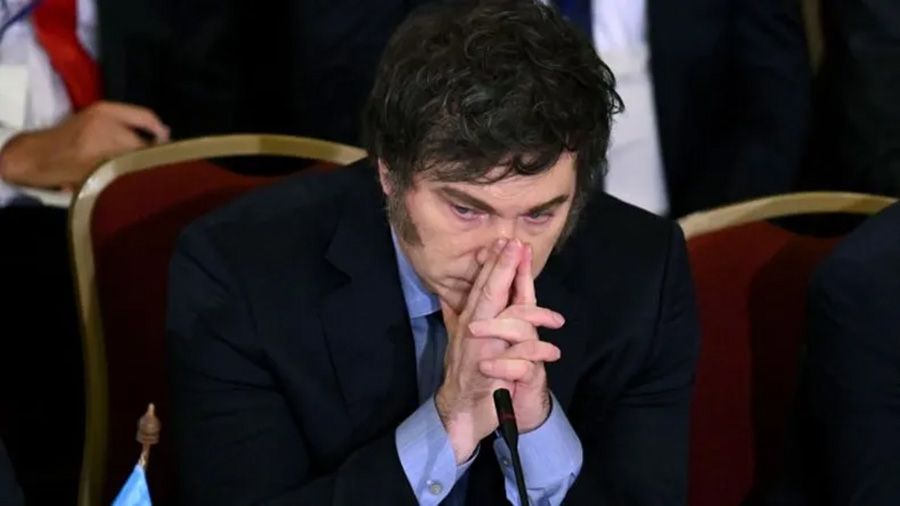 For a president who has repeatedly stated that “inflation is always and everywhere a monetary phenomenon,” printing money for direct transfers to vulnerable groups is off the table
 Argentine President Javier Milei acknowledged for the first time that “not everyone is better off” under his government, but ruled out modifying his economic plan despite inflation that has accelerated for ten consecutive months, falling real wages and record household delinquency. “The chainsaw won't stop. We will tie ourselves to the ship's mast — we will not listen to the siren songs,” he said at the American Chamber of Commerce (AmCham) summit.
The government's dilemma is clear: measures that could inject money into the economy and boost consumption threaten to further accelerate inflation, which closed March at 3.4% monthly after rising uninterrupted from the 1.5% recorded in May 2025. Promises that monthly inflation would “tend to zero” by August or finish the year around 10% have been abandoned. Real wages fell 6% between November and March, according to a Banco Provincia report.
For a president who has repeatedly stated that “inflation is always and everywhere a monetary phenomenon,” printing money for direct transfers to vulnerable groups is off the table. Milei calls such policies “Keynesian garbage.” Instead, the Central Bank opted to lower reserve requirements to push interest rates down and stimulate lending — a subtler approach that nonetheless faces a hurdle: household delinquency reached 11.2% in February, the highest since 2004, according to consultancy 1816.
“There is an economy with record GDP and even record private consumption, but at the same time showing difficulties in trickling down to broad sectors of society,” the consultancy's report states. Growth is uneven: labor-intensive sectors — industry, construction, retail — show weakness, while less employment-heavy sectors — agriculture, energy, mining — lead the expansion. Construction, which formally employs roughly 380,000 people, collapsed after Milei's public works cuts in 2024.
Economy Minister Luis Caputo denies any tension between reducing inflation and boosting growth. “We will see a process of disinflation with stronger growth,” he said at AmCham, promising that starting in April, Argentina would enter “the best 20 months the country has seen in decades.” He also announced that by June, work will be underway on 9,000 kilometers of road corridors, with another 12,000 kilometers to be tendered.
Matías Rajnerman, chief economist at Banco Provincia, identified the risk that any injection of pesos could be channeled into dollar purchases, pushing up the exchange rate and fueling inflation. However, he noted the current moment — as Argentina's agricultural harvest begins selling — offers a favorable window to attempt stimulus without destabilizing the currency.
Sebastián Menescaldi of consultancy EcoGo argued Milei “has no short-term way out” and can only try to “give the economy a bit more slack through monetary channels, but at the cost of a possible dollar correction and prices continuing at a higher pace.”
Milei's fiscal rigidity, however, has backing: the IMF this week approved the second review of its program with Argentina and released an additional $1 billion. And the president has the advantage that the next elections are more than a year away.


Top Comments
Disclaimer & comment rulesCommenting for this story is now closed.
If you have a Facebook account, become a fan and comment on our Facebook Page!