MercoPress. South Atlantic News Agency



Argentina, Bolivia, Chile, Ecuador, and Peru sign joint agreement to combat transnational crime
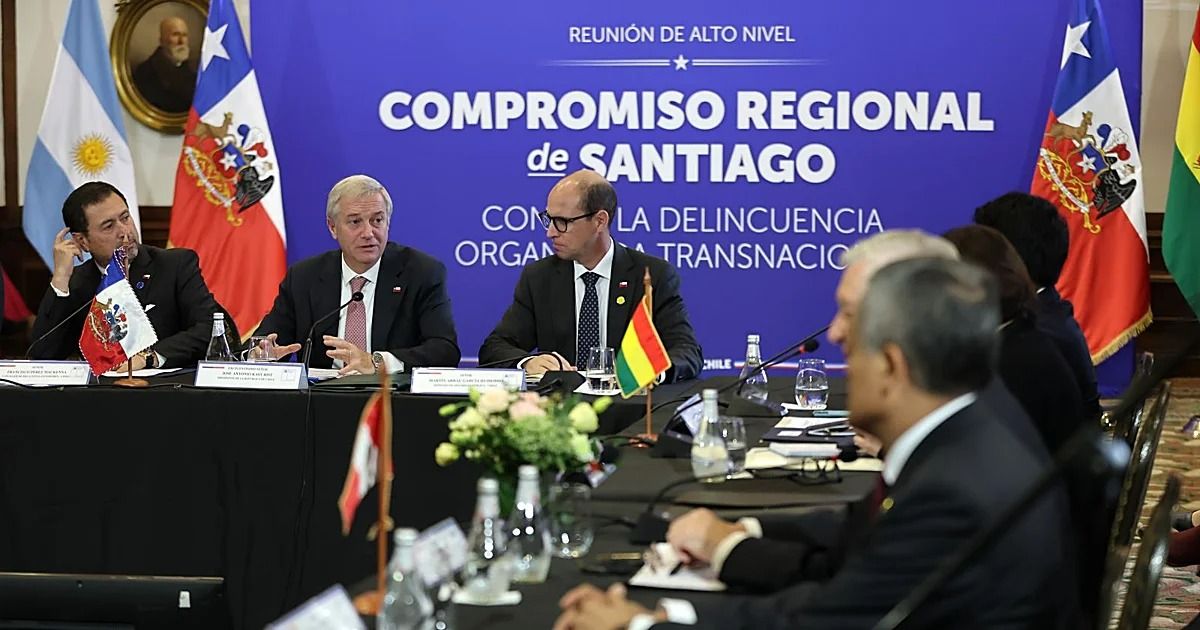 “This is not just a political gesture, it is not a diplomatic milestone,” Kast said at the opening, arguing that “there can be a before and an after here”
 The governments of Argentina, Bolivia, Chile, Ecuador, and Peru on Thursday signed in Santiago a joint cooperation agreement against transnational organized crime, in a meeting convened by the Chilean government of President José Antonio Kast and attended by five foreign ministers, four security ministers, and one interior minister. The so-called Santiago Regional Compact articulates five areas of cooperation and will be presented before the 56th General Assembly of the Organization of American States to extend the initiative to the rest of the continent.
“This is not just a political gesture, it is not a diplomatic milestone,” Kast said at the opening, arguing that “there can be a before and an after here.” The Chilean leader, from the conservative far right, said that “these five countries have grown tired of watching how organized crime is killing our young people, taking over our neighborhoods, and buying loyalties.” For his part, Chilean Foreign Minister Francisco Pérez said that “in the face of a threat that does not recognize borders, the response also cannot remain within national borders.” Argentina under President Javier Milei was represented by Foreign Minister Pablo Quirno and Security Minister Alejandra Monteoliva. Bolivia was represented by Foreign Minister Fernando Aramayo, amid the grave political and blockade crisis facing his country. Ecuador sent Foreign Minister Gabriela Sommerfeld and Vice Minister of Public Security Jorge Rivadeneira, and Peru sent Foreign Minister Carlos Pareja and Interior Minister José Zapata.
The agreement covers five work areas: exchange of information among intelligence services, prosecutor's offices, and police forces; border coordination over the movement of people, goods, and illicit flows; traceability of financial flows linked to money laundering and the financing of organized crime; cooperation among technical national bodies such as customs, police, migration, and financial analysis units; and the strengthening of regional response mechanisms. The five countries agreed to form a working group tasked with developing a joint action plan with “concrete actions and measurable, verifiable results,” to coordinate technical-operational efforts within ninety days, and to meet again within one hundred and eighty days.
The meeting also marked the international debut of Chilean Security Minister Martín Arrau, appointed eight days ago in Kast's first cabinet reshuffle in replacement of Trinidad Steinert. “It cannot be that organized crime has confronted disorganized states,” Arrau said before his regional peers. The compact emerges amid growing regional concern over the expansion of transnational criminal organizations such as the Tren de Aragua, of Venezuelan origin, which has penetrated Chile since 2022 with cells dedicated to kidnapping for ransom, human trafficking, migrant smuggling, and contract killings; and Los Pulpos, of Peruvian origin, dedicated to extortion of merchants. Chilean National Prosecutor Ángel Valencia gave a private exposition before the meeting on the investigations against transnational networks operating in the Southern Cone.


Top Comments
Disclaimer & comment rules-

Read all commentsThat's nonsense! The Ecuadorian President is accused, including by US institutions, of being responsible for 70% of the cocaine trafficked in the world. And now he's at the top of the anti-drug trafficking summit? What a joke!
May 29th, 2026 - 08:41 am 0Commenting for this story is now closed.
If you have a Facebook account, become a fan and comment on our Facebook Page!