MercoPress. South Atlantic News Agency
Stories for May 29th 2026
-
Friday, May 29th 2026 - 23:32 UTC
Trump labels PCC and Comando Vermelho as terrorist organizations and Brazil fears intervention
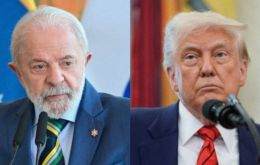
Brazil's government on Friday issued an official note rejecting the decision adopted by the administration of US President Donald Trump to designate Brazil's two main organized crime groups, the Primeiro Comando da Capital (PCC) and the Comando Vermelho, as terrorist organizations. “We will not accept the use of arbitrary measures from abroad as a pretext to attack our sovereignty and our economy,” the statement warned, while avoiding explicit reference to the US administration. The measure, announced on Thursday, adds both organizations to a list that includes Al Qaeda, the Islamic State, the main Mexican cartels, and the Venezuelan Tren de Aragua.
-
Friday, May 29th 2026 - 23:09 UTC
Colombia votes for new president with healthcare system on verge of collapse as main concern
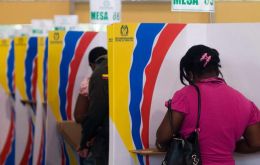
Colombia will hold on Sunday 31 May the first round of the presidential elections that will determine the succession of President Gustavo Petro for the 2026-2030 term, with an electoral roll of 41,287,084 voters and healthcare emerging as the electorate's main concern, according to opinion polls. The national health system is going through its most severe crisis in decades: pharmacies are denying medications, hospitals are closing services, and specialist appointments are indefinitely postponed. A possible runoff would be held on 21 June if none of the fourteen candidates surpasses 50% of the vote.
-
Friday, May 29th 2026 - 07:51 UTC
Argentine justice advances on 111 assets of the Kirchners and Lázaro Báez in Vialidad case

The Federal Criminal Cassation Chamber of Argentina on Thursday rejected the extraordinary appeals filed by former president Cristina Fernández de Kirchner, her children Máximo and Florencia, and businessman Lázaro Báez against the confiscation of 111 assets ordered as part of the Vialidad case. The decision, adopted by the court's Chamber IV, virtually closes the path to the country's highest tribunal and clears the execution of the asset-related measures associated with the conviction for fraudulent administration imposed on the former president in December 2022 and confirmed by the Supreme Court in June 2025.
-
Friday, May 29th 2026 - 07:00 UTC
Global carmakers struggle to maintain competitiveness against China's technological offensive

Major US, European, and Japanese automakers are undergoing a process of strategic repositioning in the face of the accelerated rise of Chinese manufacturers, which have consolidated their leadership in electric vehicles, batteries, industrial design, and software development, according to an investigation published this week by the BBC on the occasion of Auto China 2026, the world's largest motor show. The transformation is reflected in the public acknowledgment from executives themselves: the president of Honda, Toshihiro Mibe, said after visiting a highly automated plant in Shanghai that his company has “no chance against this,” while Ford CEO Jim Farley warned that Western carmakers are “in a fight for our lives.”
-
Friday, May 29th 2026 - 06:42 UTC
Argentina, Bolivia, Chile, Ecuador, and Peru sign joint agreement to combat transnational crime
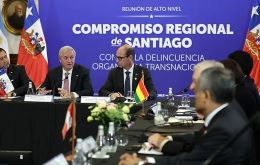
The governments of Argentina, Bolivia, Chile, Ecuador, and Peru on Thursday signed in Santiago a joint cooperation agreement against transnational organized crime, in a meeting convened by the Chilean government of President José Antonio Kast and attended by five foreign ministers, four security ministers, and one interior minister. The so-called Santiago Regional Compact articulates five areas of cooperation and will be presented before the 56th General Assembly of the Organization of American States to extend the initiative to the rest of the continent.
-
Friday, May 29th 2026 - 06:31 UTC
Capricorn Bioceanic Corridor advances to final stretch to connect Atlantic with Pacific
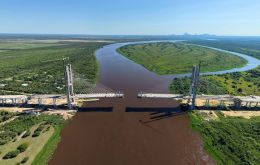
The Capricorn Bioceanic Corridor, one of the most ambitious infrastructure projects underway in South America, is moving through its final stretch on the border between Paraguay and Brazil, with just twenty-one metres remaining to complete the physical link of the so-called Bioceanic Bridge, according to Paraguayan government authorities cited in late May 2026. The structure, built over the Paraguay River, will connect the cities of Carmelo Peralta, in the department of Alto Paraguay, and Puerto Murtinho, in the Brazilian state of Mato Grosso do Sul, and constitutes one of the central pieces of a logistics corridor that will link the Atlantic Ocean with the Pacific across four South American countries.