MercoPress. South Atlantic News Agency


Lula seeks his own security recipe to counter Brazilian right wing's tough-on-crime narrative
 The plan also includes investments to regain control of 138 penitentiary facilities through drones, scanners, and metal detectors
 Brazilian President Luiz Inácio Lula da Silva on Tuesday unveiled in Brasília a public security plan worth around USD 2.25 billion aimed at weakening the finances of organized crime, regaining control of prisons, curbing arms trafficking, and improving homicide investigations, five months ahead of October's presidential election. The package is designed to give the government a distinct identity on one of the issues where public opinion sees the ruling party at its weakest against the right wing's punitive narrative.
“This is not just the launch of a program, it is a signal to organized crime that, in a short time, they will no longer dominate territories [in Brazil] — they will be returned to the Brazilian people,” the president said, flanked by ministers and the head of the Federal Police. The initiative is directed primarily against the Primeiro Comando da Capital (PCC), with some 40,000 members, a presence in around thirty countries, and estimated annual revenues of USD 2 billion, and against the Comando Vermelho (CV), its historic rival, with some 30,000 members. It also targets the militias made up of former police officers and smaller regional outfits.
One of the central pillars is financial cooperation with Brazil's 27 states and with the United States. Lula recalled having raised the matter last week in Washington with his US counterpart, Donald Trump, and noted that some of Brazil's most-wanted criminals are sheltered in Miami, that the country's mafias launder money in Delaware, and that a substantial share of illegal firearms in circulation originates in the United States. The president insisted that organized crime's tentacles “are also in businesses, in football, and in the National Congress,” shifting the responsibility for the phenomenon beyond the image traditionally associated with the favelas.
The plan also includes investments to regain control of 138 penitentiary facilities through drones, scanners, and metal detectors, with the goal of preventing imprisoned crime bosses from running their operations from inside their cells. Forensic teams investigating homicides will be reinforced, and the tracing of the thousands of illegal weapons in circulation will be upgraded.
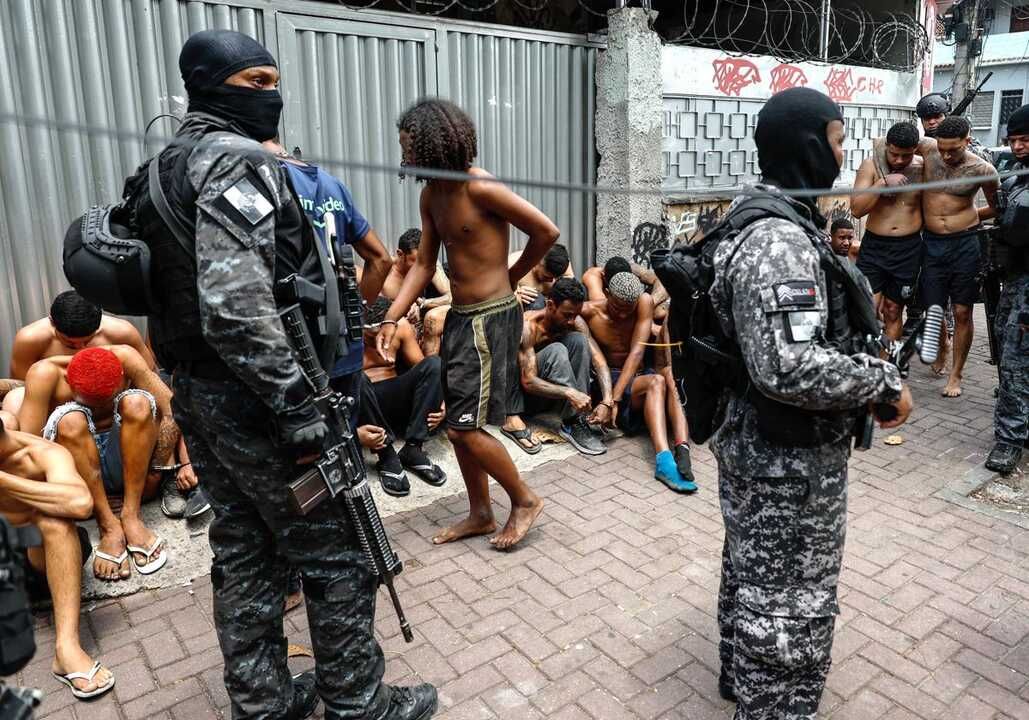
The president's main electoral rival, Senator Flávio Bolsonaro, son of former president Jair Bolsonaro, sentenced to 27 years in prison, advocates lowering the age of criminal responsibility and is pressing Washington to designate the PCC and the CV as foreign terrorist organizations. At a rally last weekend in Florianópolis he warned criminals that, should he win the election, “they will go to prison or be neutralized.” Brazil has the world's third-largest prison population, after the United States and China, and recorded around 44,000 violent deaths in 2024, 14% of them at the hands of uniformed officers, according to the Brazilian Public Security Forum. In October, a police operation in Rio de Janeiro left 121 dead, the deadliest in the country's history.


Top Comments
Disclaimer & comment rules-

-

Read all commentsPublic safety is, or should be, the first and foremost responsibility of government. By all indicators, that makes Brazilian government an abject failure. I wish that Lula's initiative will succeed, but am not at all assured that it is not yet another promise or political posturing. Time will tell. When the metal grates on residential windows come down and folks congregate again in front of their homes in the late afternoon, I'll believe it.
May 13th, 2026 - 05:56 pm 0When justice system releases top notch known criminals, at the same time reckons those in prison still run their businesses infiltrated in all possible segments, unfortunately skepticism is the least everyone who's been afraid of being robbed, assaulted, kidnapped, or else since the leftists made that feeling worser every term they ruled and got reelected by offering easy money to our people so no one with minimum sense of reality (unless able to afford ways to escape/defending themselves) can deny it when +72% of population was forced to change habits due to to most recent years of insecurity (published by Folha de Sao Paulo newspaper during December 2025), and worsening.
May 13th, 2026 - 11:49 am -1Commenting for this story is now closed.
If you have a Facebook account, become a fan and comment on our Facebook Page!