MercoPress. South Atlantic News Agency


Mercosur backs Argentina days after Islanders' UN appeal for self-determination
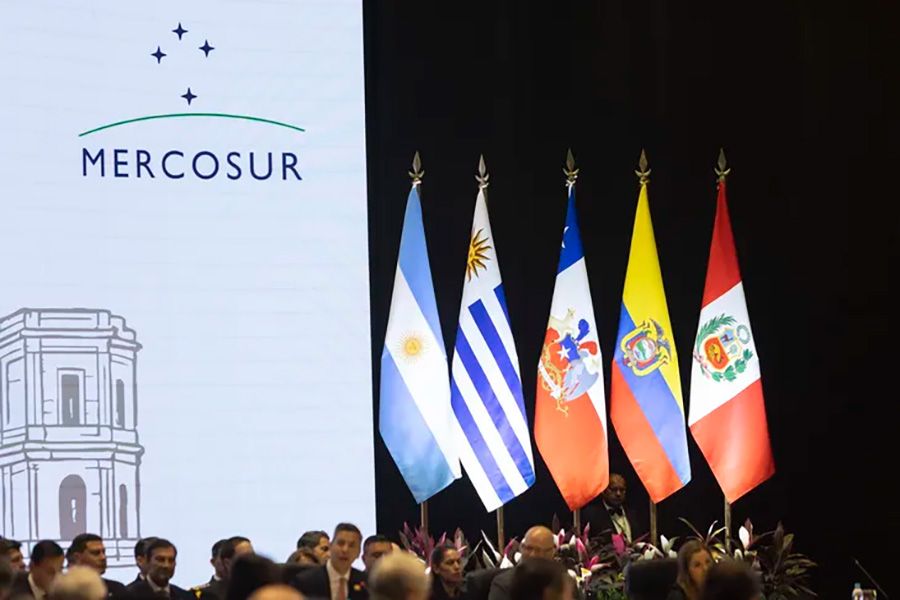 Mercosur's 68th Presidential Summit in Asunción issued a Special Declaration reiterating their support for Argentina's “legitimate rights” in the sovereignty dispute over the Falklands
 Within the span of a week, the two opposing positions in the Falklands dispute were laid out clearly in two separate arenas: South American governments' backing for Argentina's sovereignty claim, and the defense of self-determination that two representatives of the Islanders took to the United Nations. Neither pronouncement was a reply to the other, but together they illustrate the distance between two hard-to-reconcile logics.
The more recent came on June 30, at the close of Mercosur's 68th Presidential Summit in Asunción, when the bloc's member and associated states issued a Special Declaration reiterating their support for Argentina's “legitimate rights” in the sovereignty dispute over the Falklands, South Georgia, the South Sandwich Islands and the surrounding maritime areas. The text —signed by the presidents of Paraguay, Bolivia, Brazil and Uruguay, and by Argentine Foreign Minister Pablo Quirno, in the absence of President Javier Milei— questioned British economic activities in the disputed area and tasked Uruguay, as pro tempore president, with a fresh approach to the UN to resume bilateral negotiations. The statement was not a novelty but the ratification of a position the bloc has reiterated at every summit since the 1996 Declaration of Potrero de los Funes.
Five days earlier, on June 25, two members of the Falkland Islands Legislative Assembly, Dorothy “Dot” Gould and Michael Goss, had presented before the UN Decolonization Committee (C24) a position that starts from the opposite premise. Both defended the right to self-determination of the archipelago's inhabitants and renewed the invitation —never accepted since 1965— for the committee to send a visiting mission to the Islands. Goss directly questioned the very scheme Mercosur backs: a bilateral negotiation between Argentina and the United Kingdom over the Islands' future without the participation of their inhabitants. “That is not a negotiation. That is a transfer of ownership dressed as diplomacy,” he said, arguing that, since the Argentine Constitution sets the recovery of sovereignty as a “permanent and non-renounceable” objective, the outcome of any negotiation would be predetermined.
The contrast centers on a distinction Goss drew before the committee: the difference between the Islanders' “interests” and their “wishes.” While the resolutions Argentina and Mercosur invoke speak of taking the population's “interests” into account —which, in the Islanders' view, can be defined by others— the representatives demanded recognition of their “wishes,” expressed by themselves. Gould, for her part, appealed to personal testimony: she recalled arriving on the Islands at age five, described a community of around 3,600 people with more than seventy countries of birth, and stressed that the territory funds its healthcare and education without asking the United Kingdom for money. Both cited the 2013 referendum, in which 99.8% voted to remain a British Overseas Territory.
The two positions reflect incompatible readings of the same principle. Argentina claims sovereignty as a state policy and holds that UN resolutions do not provide for the self-determination of the Islanders, whom it regards as a transplanted population; Mercosur backs that claim and calls for resuming negotiations. The United Kingdom, which has administered the archipelago since 1833, makes any negotiation conditional on the wishes of the inhabitants and defends their right to self-determination. The Islanders, who are not a formal party to the dispute between the two states, demand to be one. The week condensed, without a direct exchange, the core of a disagreement the UN has examined for six decades.


Top Comments
Disclaimer & comment rules-

-

-

Read all commentsYawn. nothing more than tedious repetitive garbage that was said last year and no doubt will be spewed out next year, meanwhile life goes on as normal in the islands,
Jul 03rd, 2026 - 10:01 am 0I am looking forward to once again meeting folk from the Falkland Islands at the Royal Welsh Show (20-24th July). On a per-capita basis, then the Falkland Islands sends more of it's population to the show, than any other country/territory in the world. As such, the Falkland's flag continues to fly in a prominent position outside the International Visitor's Pavilion.
Jul 03rd, 2026 - 11:10 am 0I’ll say it again, for Argentina to call anyone an ‘implanted population’, is laughable.
Jul 03rd, 2026 - 10:27 pm 0Commenting for this story is now closed.
If you have a Facebook account, become a fan and comment on our Facebook Page!